
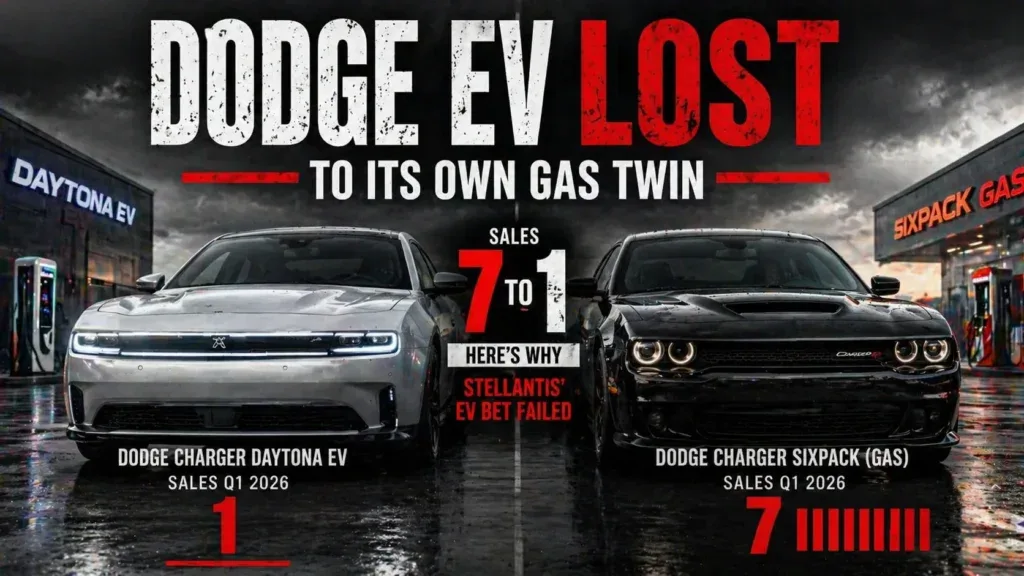
There’s one number that tells the entire Stellantis EV story right now: 7 to 1. For every one buyer who chose the electric Dodge Charger Daytona in Q1 2026, seven buyers chose the gas-powered Charger Sixpack. In a company that spent billions building an EV future, that ratio is more than a bad sales result — it’s a verdict from the market.
Stellantis posted a net loss of $22.3 billion in 2025. The Jeep Wagoneer S electric SUV saw sales collapse 93%. The Fiat 500e sold just 68 units nationally in three months. These are not rounding errors — these are products that almost nobody wanted.
How did one of the world’s largest automakers get this so wrong? And what should today’s car buyers take away from it?
They Built EVs for a Market That Didn’t Exist Yet 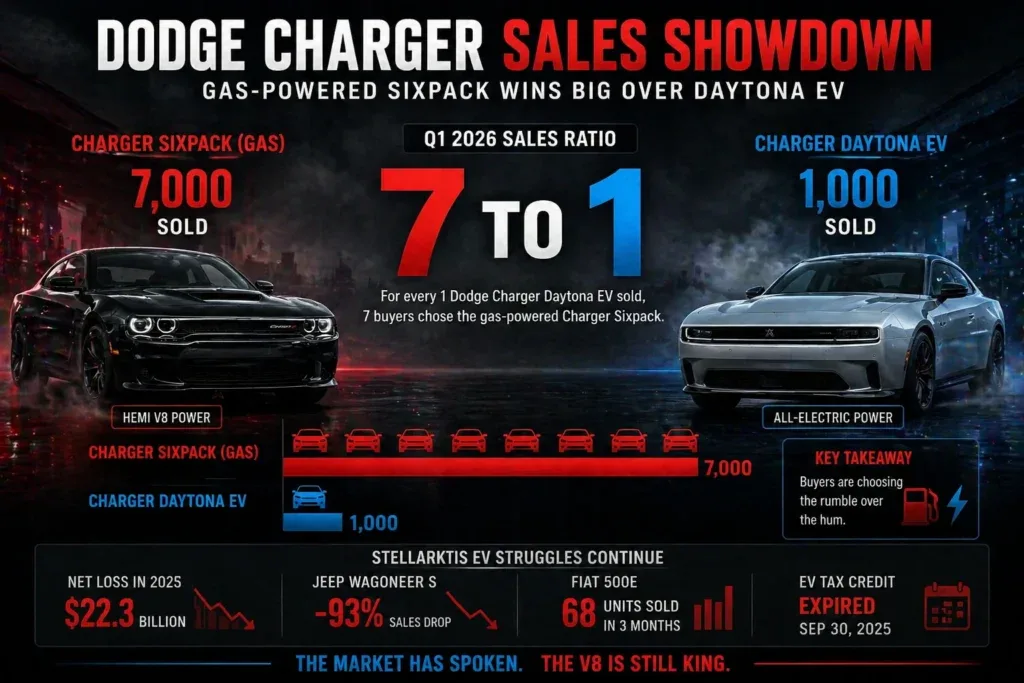
Stellantis’s core mistake was not building bad cars. The Charger Daytona EV is genuinely impressive — it’s fast, it looks great, and it makes meaningful power. The problem was assuming that Dodge buyers — people who buy muscle cars for the sound, the feel, and the V8 identity — would simply accept an electric replacement.
They didn’t.
When the gas-powered Charger Sixpack came back with the Hemi V8 in late 2025, buyers who had been waiting responded immediately. The Sixpack is up 59% year-over-year. The Daytona EV is approaching near-zero demand. The lesson is not that EVs are bad — it’s that you cannot force an EV on a buyer community that has a deep emotional connection to something you just took away from them.
The same story played out with the Jeep Wagoneer S. Jeep’s hardcore buyers — the Wrangler and Grand Cherokee faithful — were not asking for a premium electric crossover at $60,000-plus. They wanted the reliable, capable Jeep they already trusted. When Stellantis pulled plug-in hybrid Wranglers and Grand Cherokees from the lineup, it removed the very models that were genuinely connecting with electrification-curious Jeep buyers.
The Tax Credit Expiry Was the Final Blow
Stellantis’s EV lineup was already struggling when the $7,500 federal EV tax credit expired in September 2025. That expiry made every Stellantis EV effectively $7,500 more expensive overnight — and none of them had the cost structure or product strength to absorb that hit.
For a buyer comparing a $55,000 electric Jeep against a well-equipped gas Jeep Grand Cherokee at $45,000, the math before the credit expiry was difficult. After the expiry, it became nearly impossible.
Rivals like Hyundai and Toyota had built their EVs and hybrids at prices where buyers could justify the premium even without federal help. Stellantis had not.
What the Turnaround Looks Like
Stellantis CEO Antonio Filosa has been direct about what went wrong: the company overestimated how fast American buyers would adopt EVs. The new plan focuses on what actually works — hybrids, conventional gas engines, and selective EV development rather than an aggressive across-the-board pivot.
The returning Hemi V8 in Ram trucks, the new Jeep Cherokee with a conventional hybrid system, and the Ram 1500 REV range-extender truck rather than a pure EV are all signs of this reset. Stellantis is no longer trying to drag its buyers toward electrification. It’s trying to meet them where they are.
The $13 billion U.S. investment plan announced alongside the loss figures is real — but it’s heavily weighted toward products buyers have already proven they want: refreshed Jeep and Ram lineups, new Dodge models, and gradual electrification rather than forced adoption
also read https://driveglobalnews.in/2026-subaru-trailseeker-the-new-electric-suv/
What This Means for Car Buyers 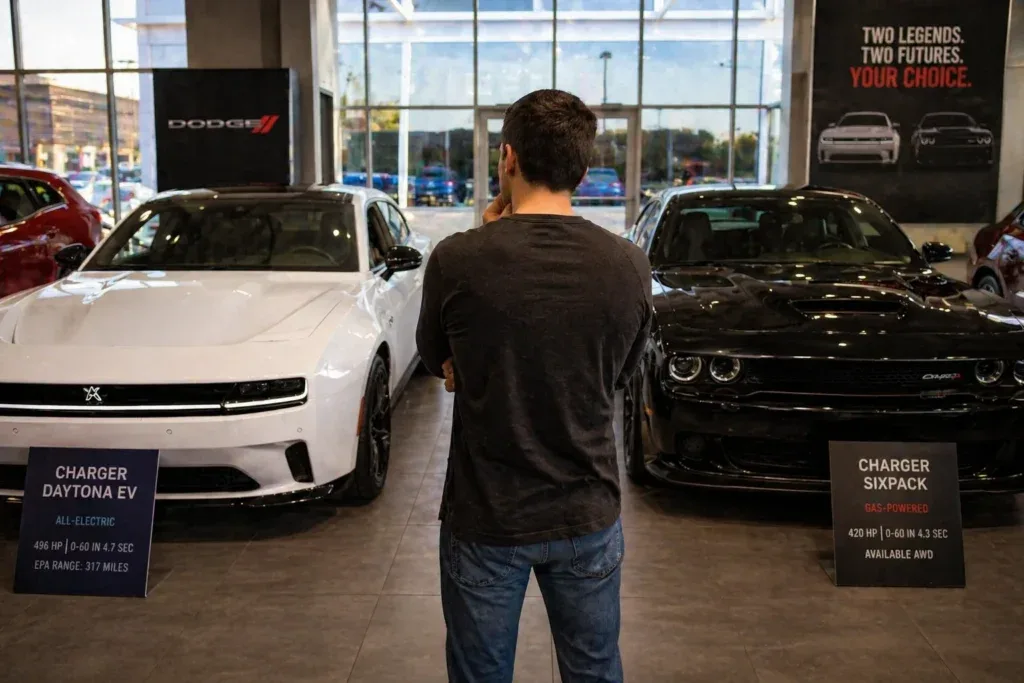
If you’re shopping for a Jeep, Ram, or Dodge product right now, the practical takeaway is straightforward. Gas and hybrid options are getting stronger and more available, not weaker. The brand is listening to what buyers actually want.
If you were tempted by a Charger Daytona EV, the fire-sale pricing that’s appeared on slow-moving inventory represents genuine value if you actually want an EV. Dealers with unsold Daytona EVs are motivated to deal.
And if the broader lesson here matters to your buying decision — it should. Every automaker that rushed EVs to market ahead of buyer demand is now recalibrating. That recalibration means more choice, more realistic pricing, and more practical options across every brand over the next 18 months.
Bottom line: Stellantis’s failure is the clearest proof yet that the EV market rewards meeting buyers where they are — not where automakers wish they were.
Use our Car Loan EMI Calculator to plan your monthly payment before visiting any dealership.