
Detroit 3 Are Getting $2.3 Billion Back From the Government — Ford and GM both raised their 2026 earnings guidance this week. The reason is a number that sounds almost too good to be true: the Detroit Three — Ford, GM, and Stellantis — expect to receive nearly $2.3 billion in combined tariff refunds from the federal government.
That money flows from the February Supreme Court ruling that struck down Trump’s IEEPA emergency tariff authority. The automakers paid those tariffs throughout 2025 and early 2026. Now they’re getting some of it back.
The question every car buyer wants answered: does any of this reach the showroom floor?
also read : https://driveglobalnews.in/2027-audi-q4-e-tron-gets-a-meaningful-update/
Where the Money Is Going — Honestly
Let’s not sugarcoat it. The $2.3 billion in refunds is going to corporate earnings, guided financial performance, and shareholder returns — not directly to price stickers. 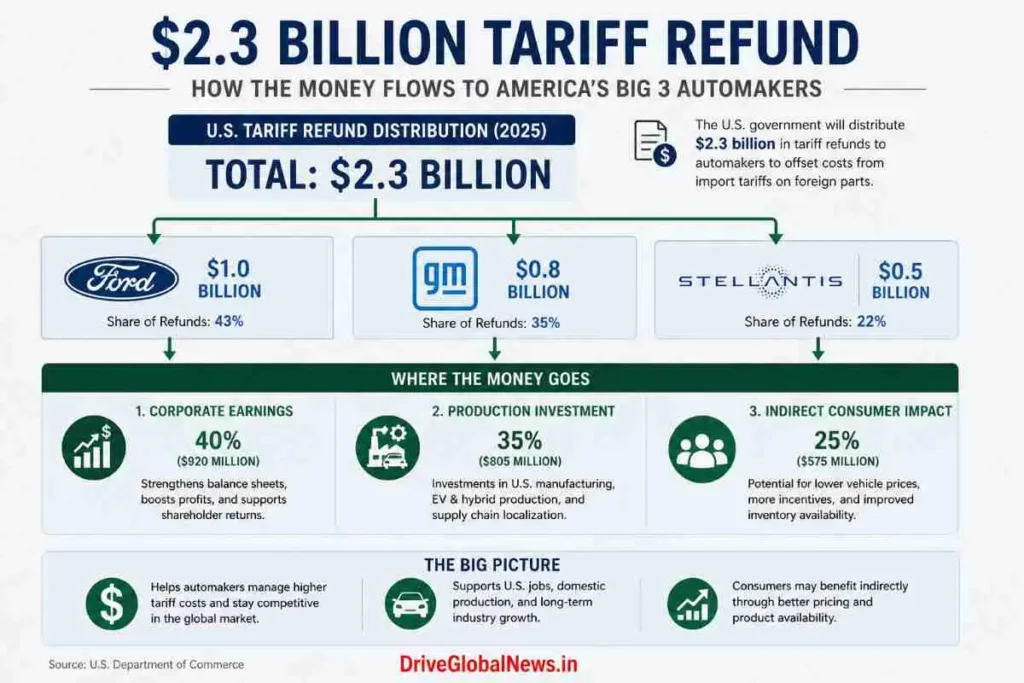
GM raised its full-year adjusted EBIT guidance by $2 billion to $13.7-15.7 billion specifically citing the tariff refund. Ford raised guidance similarly. These are financial-reporting benefits, not consumer pricing decisions.
That said, the indirect effects on buyers are real — just slower and less dramatic than the headline number suggests.
Lower cost pressure = less need for price increases. Without the refund, Ford and GM would be absorbing ongoing tariff costs entirely through margins or by passing them to buyers. The refund buys time and financial flexibility. Models where Ford might have raised prices in Q3 2026 may not see that increase — or may see a smaller one.
Investment in production. Ford specifically said its improved financial position funds the elimination of summer shutdowns at truck plants and the addition of nearly 1,000 workers. More F-150 and Super Duty production means more inventory, which means less pressure on dealers to charge above MSRP.
GM’s transmission investment. GM announced $340 million in additional investment toward U.S. transmission production for next-generation pickups and SUVs — funded partly by the improved earnings position. That domestic investment eventually means lower tariff exposure on those components going forward.
also read : https://driveglobalnews.in/bmw-x5-vs-mercedes-gle-vs-hyundai-palisade/
The New EU Tariff Complicates Everything
Here’s the brutal irony of this week’s news. The Detroit Three are celebrating a $2.3 billion refund — and on the same day, Trump announced 25% tariffs on EU vehicles.
GM, Ford, and Stellantis don’t primarily import from Europe, so the EU tariff doesn’t directly hit their core lineup. But it does affect their European-origin components and the competitive landscape. As European brands face higher costs on imported models, buyers who might have chosen a BMW or Mercedes will increasingly look at American brands — potentially helping GM and Ford in the luxury truck and SUV segments.
The GM Cadillac Escalade and Ford Expedition don’t compete with BMWs in the traditional sense. But as European luxury SUV prices rise under 25% tariffs, American premium trucks start looking more attractive by comparison.
What EV Buyers Should Take Away
The tariff refund situation is directly relevant to EV buyers considering domestic versus imported options.

American-built EVs — Hyundai Ioniq 5 (Georgia), Chevrolet Equinox EV (Mexico, but North American), Ford Mustang Mach-E (Mexico) — have lower ongoing tariff exposure than European-built alternatives. The refund reinforces this advantage.
European EVs — Audi Q4 E-Tron (Germany), BMW i4 (Germany), Volvo EX40 (Belgium) — just had their tariff exposure jump from 10-15% to 25%. The pricing implications will work through dealer inventory over the next 60-90 days.
The practical buying advice in this environment is the same it’s been for months: domestic production is your friend. In a tariff whipsaw market, the car built in Georgia, Tennessee, or Ohio is the one whose price you can actually predict.