
Sedans were supposed to be dead.
The automotive media wrote the obituary around 2019 when every American started buying SUVs. Toyota kept making the Camry anyway. Honda kept making the Accord anyway. And quietly, stubbornly, both became better cars than they’ve ever been.
Now in 2026, both are hybrid-only. Both have been significantly updated. Both are selling in numbers that make the “sedan is dead” crowd look a bit foolish.
So which one do you actually buy?
The Numbers
| 2026 Toyota Camry Hybrid | 2026 Honda Accord Hybrid | |
|---|---|---|
| Starting Price | ~$30,900 | ~$33,300 |
| Fuel Economy | 51 MPG combined | 44 MPG combined |
| Horsepower | 225 HP | 204 HP |
| 0-60 mph | ~7.2 seconds | ~7.4 seconds |
| Cargo Space | 14.4 cu ft | 16.7 cu ft |
| Rear Legroom | 38.9 inches | 40.8 inches |
| Warranty | 5 yr/60K basic | 5 yr/60K basic |
| Built | Georgetown, KY | Marysville, OH |
Two numbers immediately stand out. The Camry gets 51 MPG combined — one of the best fuel economy figures of any non-plug-in car sold in America at any price. The Accord has 2.3 more cubic feet of trunk and meaningfully more rear legroom.
Everything flows from those gaps.
also read : https://driveglobalnews.in/nobody-expected-toyota-to-beat-hyundai-in-ev/
The Case for the Toyota Camry Hybrid
51 MPG combined is a number that deserves to be said twice.
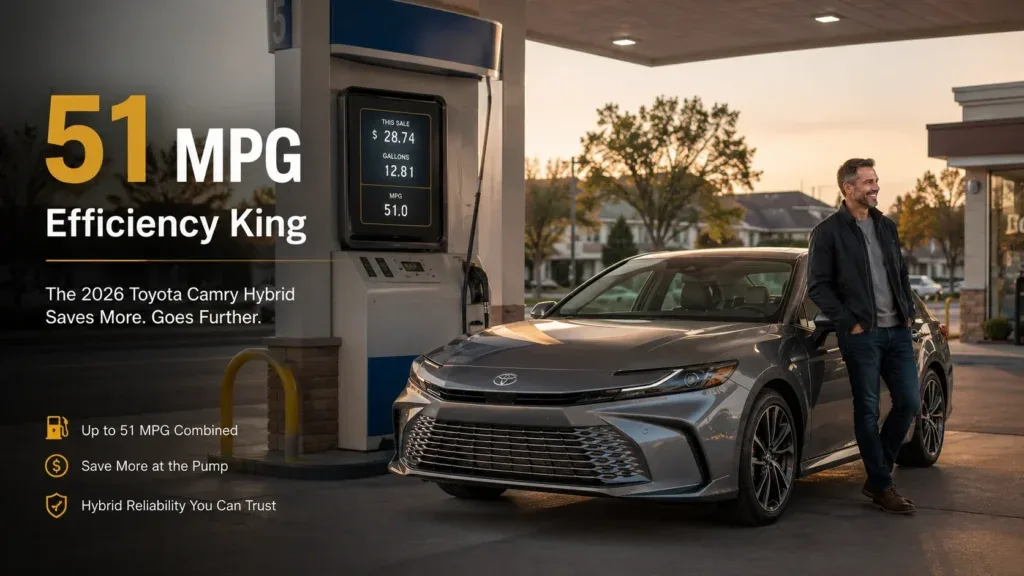
Fifty-one miles per gallon. In a full-size family sedan. That’s Prius territory. At $4.50 gas and 15,000 annual miles, a Camry Hybrid owner spends approximately $1,323 per year on fuel. The Accord Hybrid at 44 MPG costs approximately $1,534 per year. That’s $211 less per year — and over five years, $1,055 in fuel savings just from choosing the Camry.
The Camry also costs $2,400 less to start. Between lower purchase price and better fuel economy, the five-year financial advantage of the Camry over the Accord approaches $3,500 for the average driver.
That’s not a small number. That’s a European vacation, or a year of insurance payments, or a significant chunk of college tuition.
The Camry’s reliability track record is exceptional even by Toyota standards. J.D. Power’s 2026 dependability study placed it among the top-rated vehicles in the entire segment. The hybrid system has now been in production for years across millions of units — not a new technology being validated, but a proven system running on earned confidence.
And the 2026 redesign gave the Camry something it genuinely lacked before: looks. The new generation is genuinely handsome — lower, wider, with sharper lines that finally make it feel like a car you’d choose rather than one you settle for.
Buy the Camry if: Fuel economy is the priority, budget matters, you’re keeping the car long-term, or you want the most proven hybrid system in the business.
also read : https://driveglobalnews.in/chevy-equinox-ev-vs-ford-mustang-mach-e-in-2026/
The Case for the Honda Accord Hybrid
The Accord’s counterargument has two parts. One is practical. One is emotional.
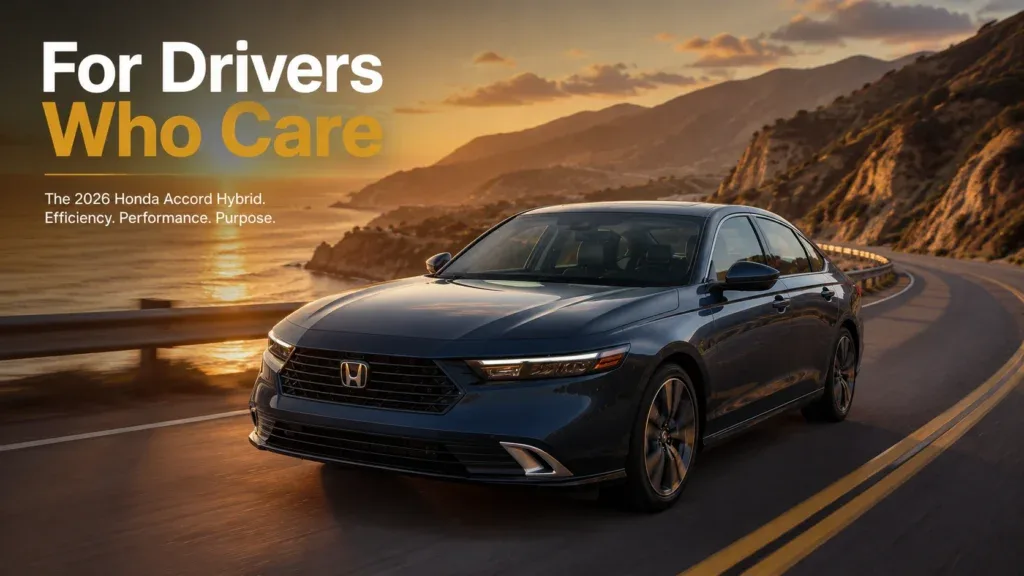
The practical part: more space. 40.8 inches of rear legroom versus the Camry’s 38.9 inches is a genuine difference for tall passengers. The Accord’s 16.7 cubic feet of trunk space beats the Camry by 2.3 cubic feet — meaningful if you regularly carry luggage, strollers, or gear.
For a family sedan that’s going to carry four adults on a regular basis — the Accord is simply more comfortable for the people in the back seat.
The emotional part: the Accord drives better.
This is subjective but consistent across every independent reviewer. The Accord’s steering has more weight and feedback. The chassis communicates what the road is doing. The Honda hybrid system’s simulated gear changes through the paddles give the driver more engagement than the Camry’s smooth, competent-but-detached CVT-style delivery.
If you spend 45 minutes each way commuting on twisty suburban roads, the Accord rewards you for it. The Camry doesn’t punish you, but it doesn’t reward you either.
The 204 HP isn’t as much as the Camry’s 225 HP on paper — but in real driving the Accord feels more responsive because of how the power is delivered, not how much there is. Throttle response is sharper. Mid-range pull is stronger.
Buy the Accord if: You regularly carry tall adults in the back, driving feel matters, trunk space is important, and you’re willing to pay the $2,400 premium and accept slightly worse fuel economy for a genuinely better driving experience.
The Honest Answer
This is one of the cleanest buyer-profile splits in any comparison.
Family of four, adults in back row regularly, keeps the car 7-10 years? Accord. The space advantage is real and daily.
Solo commuter or couple, prioritizes running costs, plans to own 10+ years? Camry. $3,500 in five-year financial advantage is hard to argue with.
Wants the most reliable car they can buy? Camry, barely — Toyota’s hybrid system has more proven miles behind it.
Wants to actually enjoy driving to work? Accord. It’s the better driver’s car.
Neither is a wrong choice. Both are excellent. Both will last 200,000 miles with basic maintenance. Both are built in America. Both will hold their value better than almost any other sedan you can buy.
The only wrong move is spending weeks agonizing over the decision when either one will serve you well for the next decade.
Pick the one that fits how you actually use a car, then stop thinking about it.
Check your monthly payment on either one with our Car Loan EMI Calculator.