

In 2010, the Nissan Leaf did something no mainstream automaker had dared to do.
It put a practical, affordable, five-seat electric car in ordinary American driveways. Not a sports car. Not a luxury vehicle. A normal family hatchback. With a proper range for daily driving. At a price that required stretching but not abandoning financial reality.
It was the car that proved an EV could be a real car. Not a statement. Not a science project. Just transportation.
Sixteen years later, the Leaf is back. Third generation. Everything rebuilt. And finally — finally — Nissan has given it the range and technology it deserved a decade ago.
also read : https://driveglobalnews.in/subaru-getaway-vs-kia-ev9-in-2026-two-three-row/
What Went Wrong With the Old One
The first and second-generation Leaf were genuinely important vehicles that aged badly.
The first-gen peaked at 107 miles of range. The second-gen improved to 226 miles maximum. But the charging architecture — a 50 kW CHAdeMO port that the rest of the world abandoned in favor of CCS and then NACS — became a stranded island as charging infrastructure evolved around it. Range degraded faster in hot climates than owners expected. And the car’s upright, friendly styling — beloved in 2011 — looked dated by 2019.
The Ariya was supposed to be the answer. It was priced at $45,000+, had reasonable range, and looked modern. But 15% import tariffs made it uncompetitive against the Georgia-built Ioniq 5 at $35,000. Nissan discontinued it earlier this year.
The new Leaf is the real reset. Starting fresh, built on an entirely new platform, priced where the original Leaf was meant to be.
also read : https://driveglobalnews.in/tesla-just-killed-the-model-s-and-model-x-the/
What the Third-Generation Leaf Offers
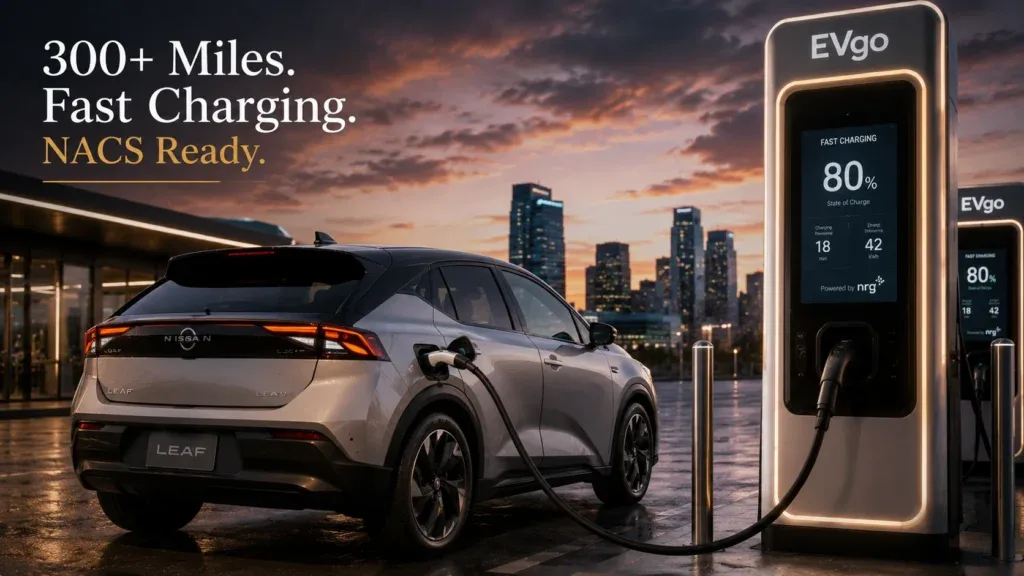
The new Leaf is confirmed for late 2026 availability with two distinct powertrain options — which is genuinely unusual for a mainstream hatchback and signals Nissan’s understanding that different buyers want different things from the same nameplate.
All-electric version: Built on the updated platform shared with the Mitsubishi Lancer EV. Range target: over 300 miles EPA. DC fast charging at up to 150 kW — not the 350 kW leaders, but more than adequate for a $30,000-$33,000 vehicle. NACS port standard — Supercharger access without adapters.
Hybrid version: This is the genuinely surprising addition. Nissan is making the Leaf available with a hybrid powertrain — acknowledging that some buyers want the Leaf’s size, price, and character without fully committing to charging infrastructure. The hybrid variant targets 40+ MPG and competes directly with the Toyota Corolla Hybrid at similar pricing.
That two-powertrain strategy is smart. It gives the Leaf range relevance that the old model completely lacked. A buyer who loved the Leaf’s practical hatchback format but couldn’t commit to pure EV ownership now has a hybrid option in the same familiar package.
Pricing: Expected around $31,500 for the base EV, slightly higher for the hybrid. Competitive with the Chevrolet Bolt at $27,600 at the entry point, and considerably better equipped at comparable price points.
Body style: The new Leaf retains the hatchback format that made the original practical — a decision that runs against the SUV-everywhere trend and is probably correct for the Leaf’s urban and suburban buyer base. Five doors. Practical cargo area. Enough rear legroom for adults on normal trips.
Why This Matters Beyond the Specs
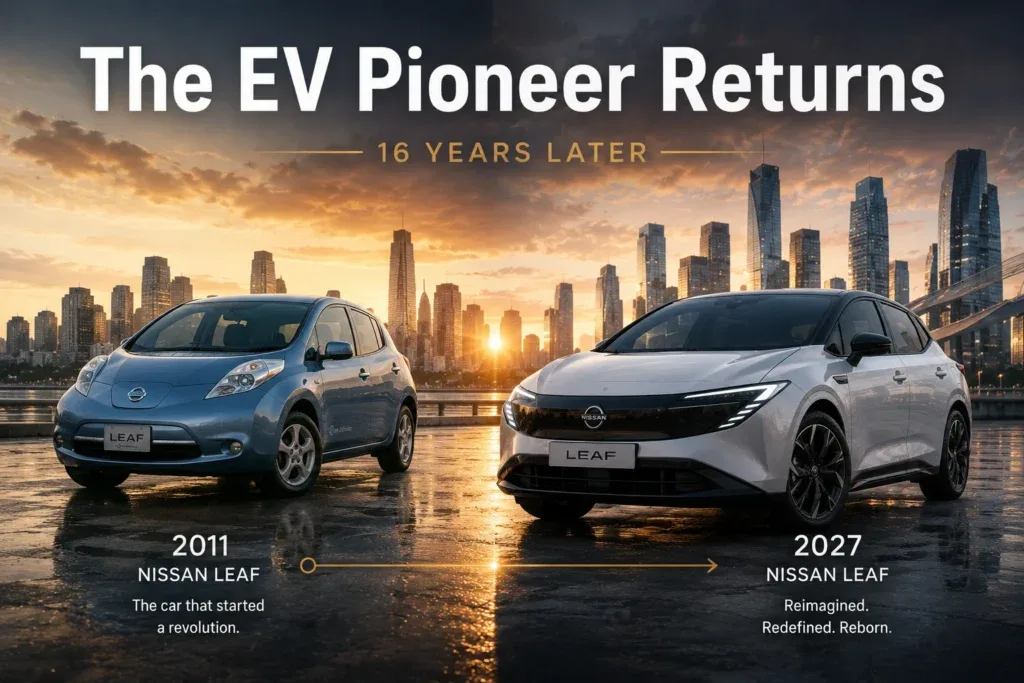
The Leaf’s return at 300+ miles is strategically significant for Nissan in a way that goes beyond one model’s sales.
Nissan’s American business has been in decline for years. Sales falling. Market share shrinking. The Rogue hybrid coming late. The Ariya failing. The lineup aging.
The new Leaf is one of the first pieces of the Re:Nissan plan — CEO Ivan Espinosa’s restructuring strategy — to actually reach customers rather than exist as a press conference announcement. If the Leaf performs well — and at $31,500 with 300+ miles of range and a hybrid option, the fundamentals are solid — it validates the broader Nissan recovery story.
It also fills a specific gap that Nissan has left open for too long. At $31,500, there’s no other five-door electric hatchback with 300+ miles of range from a major brand with a national dealer network. The Bolt is a crossover. The Model 3 starts at $40,000. The Ioniq 5 is $35,000.
The Leaf at $31,500 is its own answer.
Whether buyers who moved on from the second-gen Leaf will give the third generation a fair look is the commercial question. The automotive press gave the original Leaf every major award in 2011. If the new one performs at the level its specs suggest — there’s no reason it can’t do that again.
The EV that started the revolution deserves its second act. Late 2026 is when we find out if it got one right.