
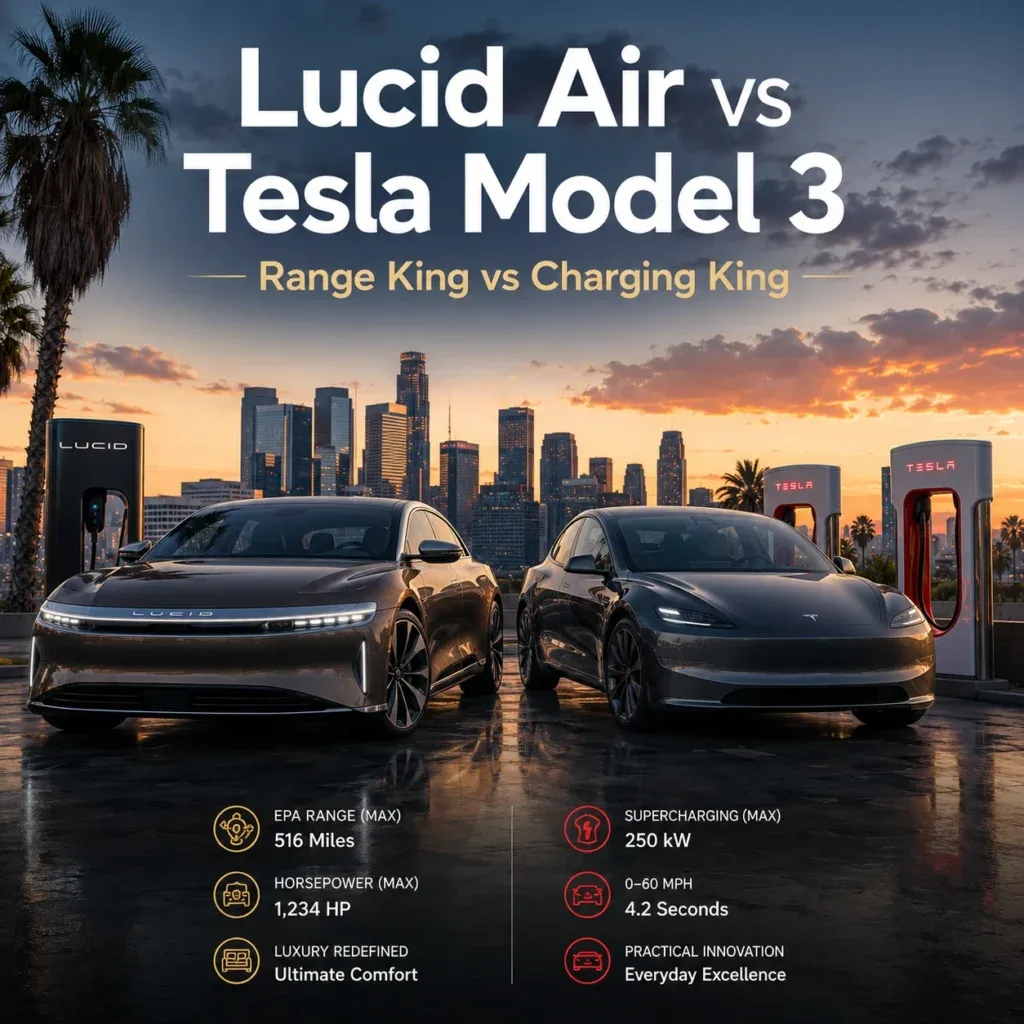
This comparison shouldn’t work on paper.
The Lucid Air starts at $70,990. The Tesla Model 3 starts at $40,000. Thirty thousand dollars separates them at entry level. That’s not a trim difference — that’s a different buyer entirely.
And yet people cross-shop these two cars constantly. Because the Lucid Air offers something no other electric sedan in the world can match. And the Tesla Model 3 offers something the Lucid can’t buy its way out of.
Understanding what each one does — and why it matters for your specific life — is the actual comparison worth having.
The Numbers
| Lucid Air Pure RWD | Tesla Model 3 Long Range RWD | |
|---|---|---|
| Starting Price | $70,990 | $45,000 |
| EPA Range | 410 miles | 341 miles |
| Top Range (Grand Touring) | 516 miles | — |
| Horsepower | 480 HP | 333 HP |
| 0-60 mph | 4.5 seconds | 4.8 seconds |
| Peak Charging | 400 kW | ~250 kW |
| Charge Network | NACS (third-party) | Tesla Supercharger |
| Built | Casa Grande, Arizona | Fremont, California |
| Cargo | 18.1 cu ft total | 24.8 cu ft total |
The range gap is the headline. 410 miles versus 341 miles on base configurations. And the Lucid Air Grand Touring — at $138,000 — does 516 miles on a single charge. That’s not a spec sheet number anyone expected a production car to achieve.
The price gap is the reality check. $70,990 versus $40,000 is a conversation stopper for most buyers who haven’t already decided they’re in Lucid territory.
But let’s actually dig into when each car makes sense.
also read : https://driveglobalnews.in/subaru-getaway-vs-kia-ev9-in-2026-two-three-row/
The Case for the Lucid Air

516 miles of range is a number that changed the conversation about what electric vehicles can do.
The original objection to EVs — “but what about long road trips?” — becomes genuinely unanswerable when the car goes further per charge than most gas vehicles do per tank. A Toyota Camry with a 15.8-gallon tank at 35 MPG goes 553 miles. The Lucid Air Grand Touring at 516 miles is within spitting distance of that — in a vehicle that charges from 10% to 80% in about 22 minutes at a 350 kW station.
For buyers who drive significant long distances regularly — commuting 100+ miles round trip, driving between cities frequently, taking road trips several times a month — the Lucid’s range advantage isn’t just a spec. It changes how many times you stop. And stopping less matters more than most EV comparisons acknowledge.
The interior is the other argument. Lucid’s cabin is legitimately extraordinary for an American-built vehicle. Enormous glass roof. Reconfigurable front storage area. A spaciousness that feels more like a business-class airplane seat than a car interior. The fit and finish has improved significantly from the early production cars that had quality concerns.
400 kW peak charging — when you can find a 400 kW station, which remains rare in 2026 — is faster than anything Tesla offers. NACS port means Supercharger access, though at Tesla’s maximum rate rather than Lucid’s theoretical peak.
The honest weakness: Lucid’s service network is thin. Forty-two service centers nationally as of May 2026. If you live in a major metro area, you’re probably fine. If you’re in a secondary market — the nearest service center might be a meaningful drive. For a $70,000+ purchase, that matters.
Buy the Lucid Air if: Range is the priority. You regularly drive 200+ miles in a day. The interior experience matters to you as much as the powertrain. You’re in a city with nearby Lucid service. And the $70,000+ price point is genuinely within your budget — not a stretch.
also read : https://driveglobalnews.in/nobody-expected-toyota-to-beat-hyundai-in-ev/
The Case for the Tesla Model 3

The Model 3 doesn’t win this comparison on specs. It wins on ecosystem.
21,000 Supercharger stations in North America. Consistent, reliable, fast charging at locations that are now in virtually every city and on virtually every major highway corridor. Native in-car navigation that routes automatically to Superchargers with accurate arrival state-of-charge predictions. Automatic session start. Automatic payment.
The Model 3 NACS port is the same as the Lucid Air NACS port — both can use Superchargers. But the experience isn’t identical. Tesla’s native integration is more seamless than third-party access. The car talks to the network in ways that non-Tesla vehicles accessing the same chargers don’t.
For road trips — the scenario where range and charging matter most — the Model 3 with 341 miles and native Supercharger access is practically easier to operate than the Lucid Air with 410 miles and third-party Supercharger access.
The Model 3 is also $25,000-$30,000 cheaper. That’s not a number to wave away. In May 2026 with inflation at 3.8%, real wages falling, and average car payments at $812 per month — that gap matters to most households.
And the Model 3 is simply more practical day-to-day. More cargo space. Better rear legroom than the Lucid’s dramatic sloping roofline allows. Available in AWD without jumping to dramatically higher price points.
Buy the Model 3 if: Budget is a real consideration. Road trips are frequent and you want the simplest charging experience. Practicality matters as much as luxury. You want the most proven, most updated software platform in any EV.
The Honest Verdict
This isn’t a competition where one car wins outright for every buyer.
You drive 150+ miles regularly and prioritize range above everything: Lucid Air. Nothing else gets close to 516 miles. The range advantage is real and daily for high-mileage drivers.
You want the best charging experience on road trips under $50,000: Model 3. The Supercharger network advantage is still meaningful despite NACS expansion.
Budget is the deciding factor: Model 3. By $25,000-$30,000.
Interior experience and luxury feel matter most: Lucid Air. It’s genuinely exceptional inside.
The Lucid Air is the better car in isolation. The Tesla Model 3 is the better car in the context of how most Americans actually live and drive. That distinction is the entire comparison in two sentences.
Compare 5-year ownership costs with our Car Ownership Cost Calculator.