The federal EV tax credit is gone. That changed this comparison more than any new software update.
Hyundai reacted by cutting 2026 Ioniq 5 prices by as much as $9,800. The base SE Standard Range now starts at $35,000 before destination. Tesla did not match that cut. A Model Y that shoppers commonly end up ordering — especially a Premium rear-drive configuration that sat at $44,990 earlier this year — still costs roughly $10,000 more before you add wheels, paint, or Full Self-Driving.
That gap is the whole story. Everything else is how you spend the difference.
The Price Gap Is Real — If You Compare What People Actually Buy
Hyundai’s official 2026 Ioniq 5 MSRPs:
- SE Standard Range RWD: $35,000
- SE RWD (longer-range battery): $37,500
- SEL RWD: $39,800
- Destination: $1,600
Tesla’s current U.S. Model Y stickers:
- Model Y RWD: $39,990
- Model Y AWD: $41,990
- Premium RWD: $45,990
- Destination plus order fee: about $1,390–$1,640
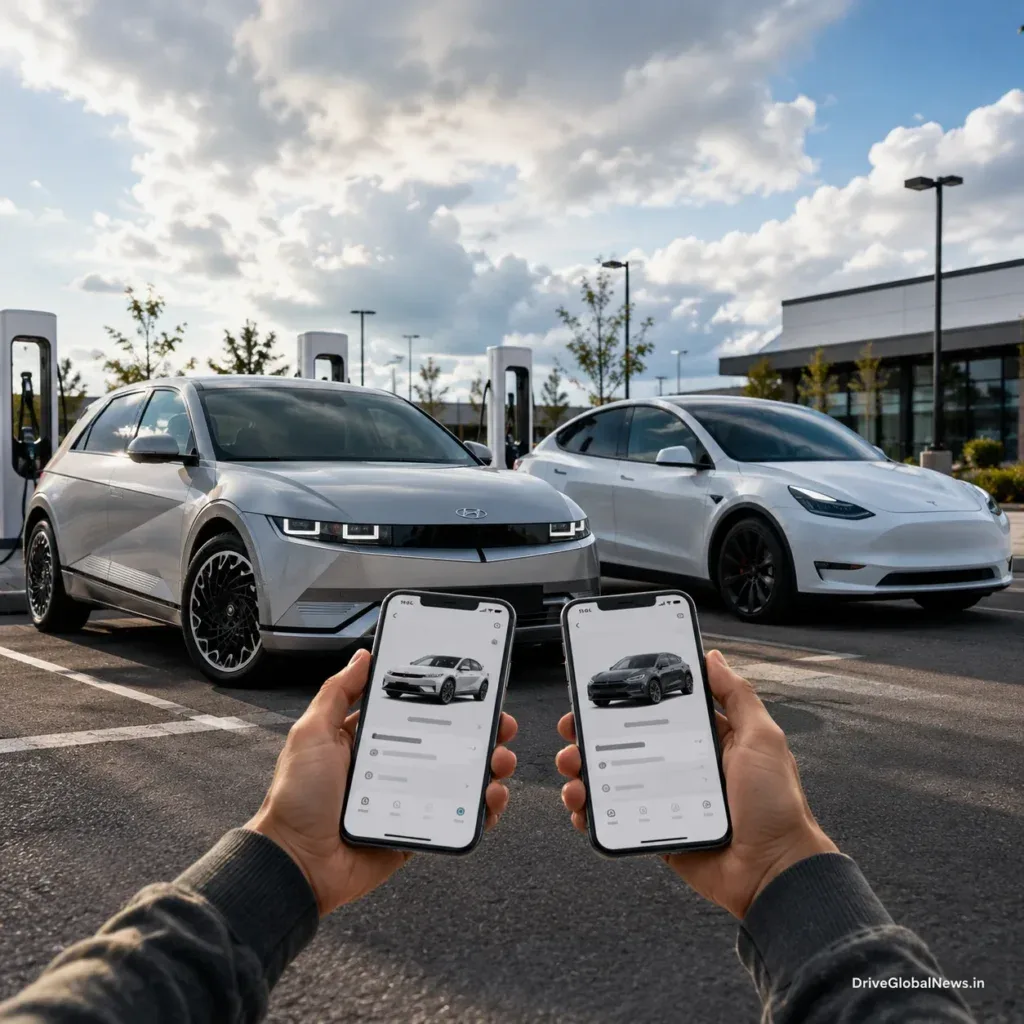
The $35,000 vs $44,990 headline is not a fantasy matchup. It is the cheapest Ioniq 5 against the Model Y many buyers actually configure once they want the nicer interior, better range, and the Tesla look they came to shop. That is where the $10,000 shows up.
Hyundai is also running 0% APR on some trims and lease deals that have started under $300 a month. Tesla does not play the dealer-incentive game the same way.
Range and Charging — Tesla Goes Farther, Hyundai Refills Faster
Long-range Ioniq 5 RWD: up to 318 miles EPA.
Standard Range Ioniq 5: 245 miles.
AWD Ioniq 5: about 269–290 miles depending on wheels and trim.
Model Y RWD: up to 321 miles.
Premium RWD: up to 357 miles.
That is Tesla’s clearest advantage.
Charging flips the argument.
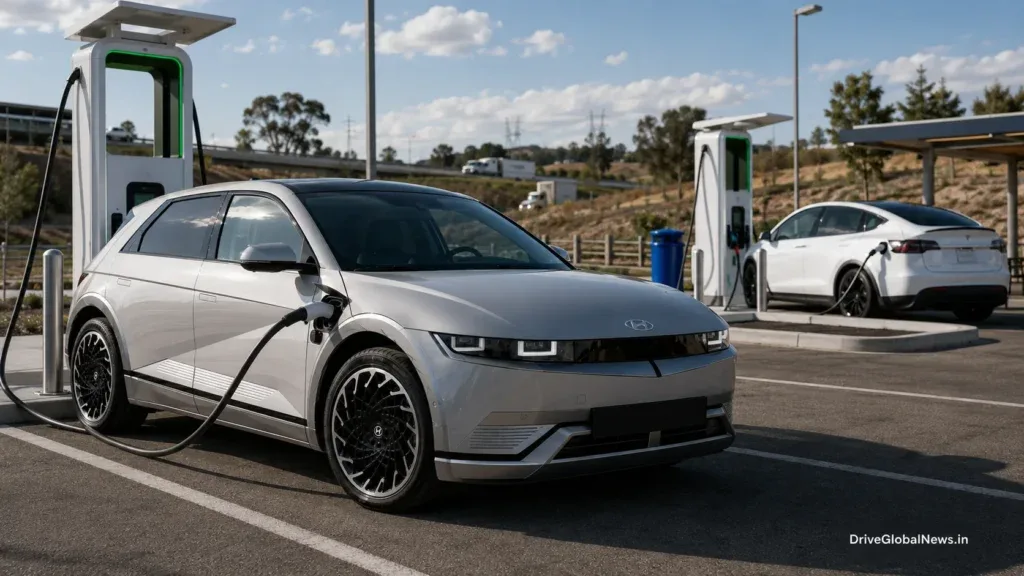
The Ioniq 5 uses an 800-volt architecture and can take up to 350 kW. A 10–80% DC fast charge is often around 18 minutes on a capable station. The Model Y is still a 400-volt car. Peak rates look fine on paper. Average rates in independent tests are slower. Plan on closer to 25–30 minutes for the same 10–80% window.
Both now use NACS. The 2026 Ioniq 5 can plug into Superchargers without hunting for an adapter. Tesla still has the better network reliability and one-app payment flow. Hyundai now has the faster plug-in when the charger is actually delivering high power.
If your life is mostly home charging and 40-mile commutes, range barely matters. If you road-trip twice a month, the Ioniq 5’s shorter stops start to feel like the better product.
What You Sit In and What You Own
The Ioniq 5 is the more conventional car. Physical buttons still exist. The cabin feels designed by people who have used other cars. Rear seat space is excellent. Vehicle-to-load can run a campsite or a power tool. Hyundai’s warranty is the adult in the room: 5 years/60,000 miles basic, 10 years/100,000 miles powertrain.
The Model Y is the more efficient package. Better highway economy. More cargo volume with the seats down. A bigger frunk. Over-the-air updates that actually change the car. Autopilot is standard. Full Self-Driving is still an $8,000 extra that some owners love and some treat like a novelty.
Tesla’s warranty is shorter on the car itself: 4 years/50,000 miles basic, 8 years/120,000 miles on the battery and drive unit for most Model Y variants.
Service is the split that does not show up on a spec sheet. Tesla service is appointment-based and uneven depending on the city. Hyundai is a normal dealer — which can be good or bad, but at least you know the model.
The One Answer That Saves You $10,000
Buy the Ioniq 5 if the job is transportation.
A $35,000–$39,800 Hyundai with 318 miles of range, 18-minute fast charges, a 10-year powertrain warranty, and Supercharger access is the rational 2026 EV. That is the car that replaced the tax credit with a lower sticker instead of hoping buyers would not notice.
Buy the Model Y if the job is the Tesla ecosystem.
You want the app, the Supercharger habit, the resale story, the software cadence, and the badge. You are paying extra for that stack, not for a dramatically better daily SUV. The extra money is real.
Apples-to-apples, a loaded Ioniq 5 SEL RWD at $39,800 still undercuts a Model Y Premium. A base Model Y RWD at $39,990 undercuts a loaded Ioniq 5 Limited. The $10,000 save appears when you refuse to let Tesla’s mid-trim become the default “I guess that’s what a Model Y costs.”
In 2026, the cheap EV is no longer a compromise hatchback. It is a 318-mile crossover with an 800-volt battery that Hyundai decided to price like it still had to fight for every sale.
Tesla is still the default recommendation in a lot of American driveways. The math is no longer automatic.
Which one would you actually put in the garage — the $35,000 Hyundai, or the Tesla you keep talking yourself into?