The Mitsubishi Lancer hasn’t been sold in America since 2017.
Nine years. The brand that gave enthusiasts the Evo — one of the greatest driver’s cars ever built — went quiet on sedans and focused entirely on the Outlander SUV and the Eclipse Cross crossover. Loyal fans moved on. The Lancer became a nostalgia conversation rather than a buying consideration.
This summer, that changes.
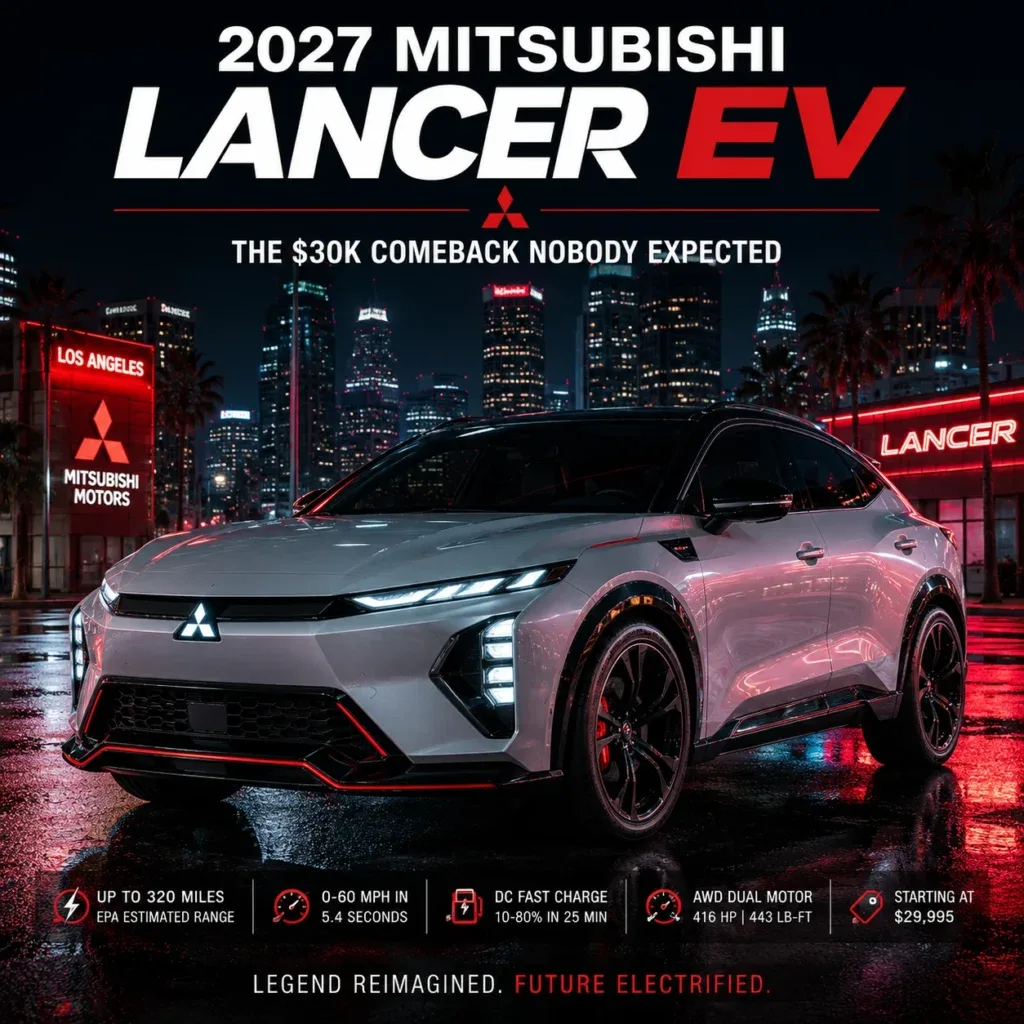
Mitsubishi confirmed the Lancer EV — officially called the Lancer Sportback EV, though the final name hasn’t been locked — debuts in summer 2026 as a 2027 model year vehicle. It’s an electric compact SUV-coupe starting at approximately $30,000. And it’s built on the new third-generation Nissan Leaf platform — the most capable and sophisticated platform Mitsubishi has ever had access to for an affordable vehicle.
This is either the most exciting thing to happen to the Mitsubishi brand in a decade. Or it’s a $30,000 Nissan Leaf in a different suit.
The truth, based on what’s been confirmed, is somewhere more interesting than either extreme.
Why the Nissan Leaf Platform Is Actually Good News
When people hear “derived from the Nissan Leaf,” the instinct is skepticism. The outgoing Leaf had real weaknesses — slow charging, modest range, aging technology. Why would a new Mitsubishi built on that platform be different?
Because the third-generation Leaf is nothing like its predecessors.
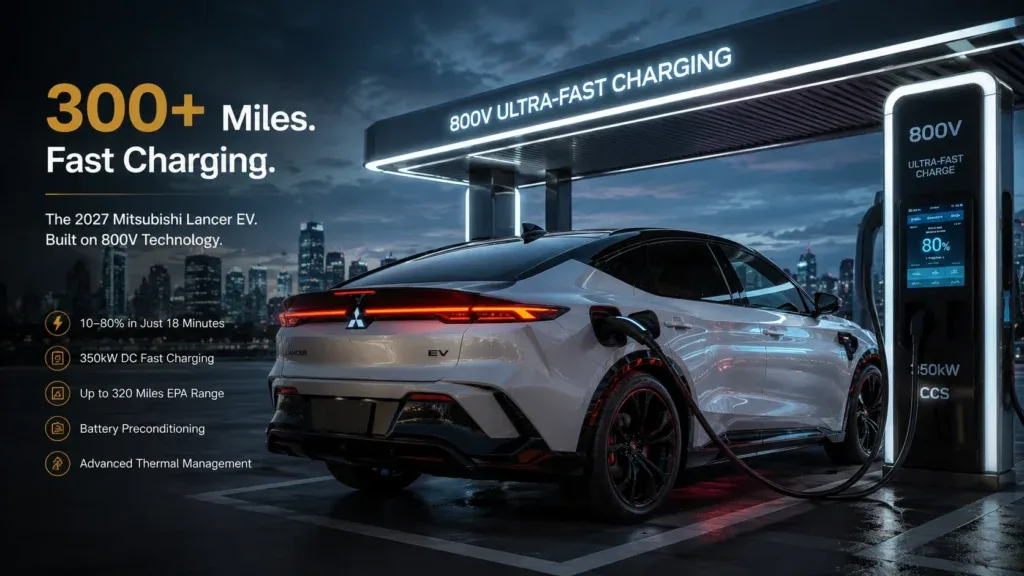
The new Nissan Leaf — which Nissan has been developing as part of its broader Re:Nissan turnaround — moves to a completely updated platform with 800-volt electrical architecture, DC fast charging up to 150 kW, and a range target above 300 miles. Nissan isn’t recycling the old Leaf. They’re rebuilding it from scratch.
Mitsubishi gets to use that new architecture at a price point that makes the Ioniq 5 look expensive. The Renault-Nissan-Mitsubishi Alliance — one of the largest automotive groups in the world — spreads development costs across three brands. That’s how a $30,000 Mitsubishi can offer technology that would cost $10,000 more in a standalone development program.
also read : https://driveglobalnews.in/nobody-expected-toyota-to-beat-hyundai-in-ev/
What Lancer Means for the Design
The Lancer name carries real weight for a specific generation of enthusiast. The Evo VIII and IX are still considered benchmarks for accessible performance cars. The nameplate has identity that most brands would pay dearly for.
The Lancer EV uses it wisely. The SUV-coupe body style — higher than a sedan, lower than a traditional SUV, with a sloping roofline — gives it a sporty character that the Outlander’s upright SUV shape doesn’t deliver. Think of the proportions of a Kia EV6 or a VW ID.5. The Lancer EV is positioned to be the driving enthusiast’s choice in the $30,000 EV segment — not because it’s the fastest, but because it looks and feels like it was designed for someone who cares about their car.
Mitsubishi’s design team in Japan has been producing genuinely sharp work recently. The new Outlander and Eclipse Cross look far better than their predecessors. If that design quality carries through to the Lancer EV — and the early renderings suggest it will — the car could punch visually well above its price point.
also read : https://driveglobalnews.in/toyota-camry-hybrid-vs-honda-accord-hybrid-in/
The $30,000 Segment Is Wide Open Right Now
Here’s the context that makes the Lancer EV’s timing significant.
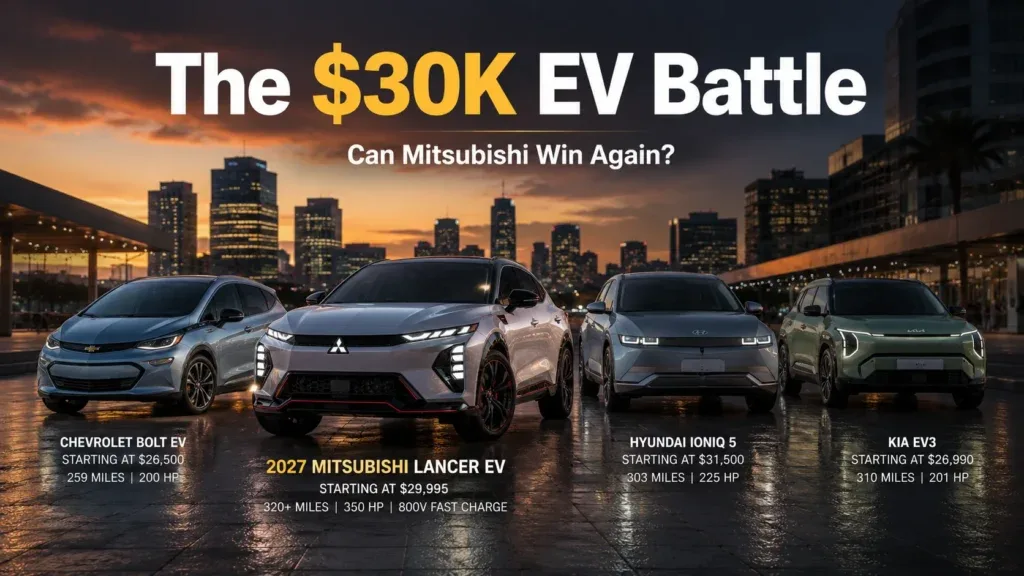
At $30,000, the competition for an electric vehicle is surprisingly thin in May 2026. The Chevrolet Bolt starts at $27,600 but is FWD only, with modest power and 255 miles of range. The Nissan Leaf itself starts around $31,500 but hasn’t fully updated yet. The Hyundai Ioniq 5 starts at $35,000. The Kia EV3 is coming but hasn’t arrived. The VW ID.3 doesn’t sell in the US.
A well-designed Mitsubishi Lancer EV at $30,000 with 300+ miles of range, a sporty SUV-coupe body, and modern charging architecture walks into a gap in the market that several brands have been too slow to fill.
The obvious risk: Mitsubishi’s US dealer network is thin. Service coverage isn’t what Toyota or Honda offers. For a first-time EV buyer choosing between a $30,000 Lancer EV and a $35,000 Ioniq 5 — the Hyundai’s larger dealer network, better warranty, and established EV reputation are real factors.
But for a buyer who wants something different, something with a name that means something, and something that doesn’t look like everything else on the road — the Lancer EV has a conversation to start this summer.
Compare your monthly payment options with our Car Loan EMI Calculator.