
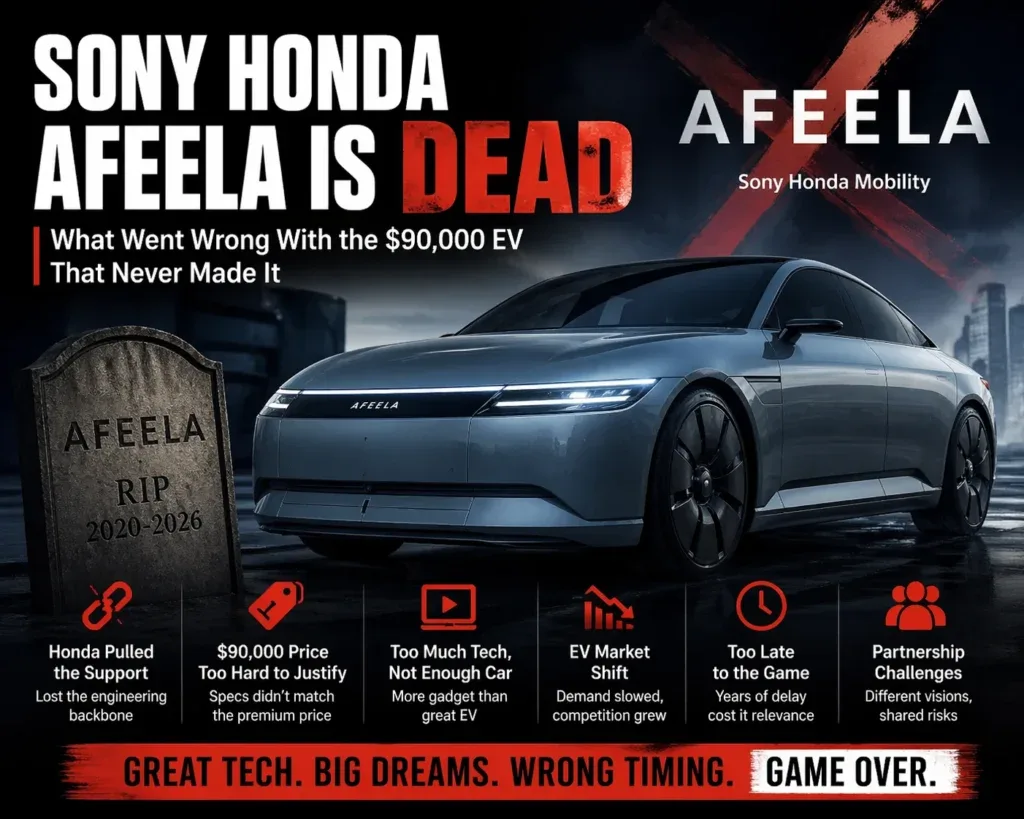
Sony Honda Afeela Is Dead What Went Wrong With the $90,000 EV That Never Made It : It was supposed to be one of the most exciting new car launches of 2026. The Afeela 1 — a technology-laden electric sedan from Sony Honda Mobility, a joint venture between two of Japan’s most iconic companies — had generated enormous press coverage, more than 100,000 showroom visitors, and 24,000 in-vehicle demonstrations at its California studios. Reservations had opened. Production trial runs had taken place at Honda’s East Liberty Plant in Ohio. A California launch was just months away.
Then, on March 25, 2026, everything stopped.
Sony Honda Mobility announced it had decided to discontinue the development and launch of the Afeela 1 and a second planned Afeela model. Autobody News Honda said it will record charges of up to almost $16 billion tied to the cancellation — a substantial hit that underscores the financial cost of abandoning the program. THE SHOP
The story of the Afeela is a cautionary tale about ambition, timing, and the brutal economics of launching an EV startup in 2026.
What Was the Afeela 1?
The Afeela 1 was conceived as a technology showcase on wheels — a vehicle where Sony’s expertise in entertainment, AI, and sensors would combine with Honda’s manufacturing capability to produce something genuinely different from every other EV on the market.
The production version, unveiled at CES 2025, was a mid-size electric liftback sedan featuring:
- 40 onboard sensors including 18 cameras, 1 LiDAR, and 9 radars powering the Afeela Intelligent Drive ADAS system
- A Qualcomm Snapdragon Digital Chassis — the most powerful automotive computing platform available
- Built-in PlayStation Remote Play for gaming while parked
- Sony’s AI-powered Afeela Personal Agent and entertainment ecosystem
- Manufacturing at Honda’s East Liberty Auto Plant in Ohio — a domestic build that protected it from import tariffs
Pricing started from $89,900, with the Signature trim starting deliveries in mid-2026 and the base Origin model planned for 2027. Headlight
At CES 2026 in January, Sony Honda Mobility was still presenting confidently. Shugo Yamaguchi, president and CEO of Sony Honda Mobility of America, confirmed the Afeela 1 was still on track for a release later in 2026, still priced at $90,000 to start, and still set to be built at Honda’s Ohio factory. New York International Auto Show The company also debuted an SUV prototype called the Afeela Prototype 2026, targeting a 2028 production launch.
Less than three months later, it was all over.
Why Did It Fail? Three Critical Reasons
1. Honda’s EV strategy collapsed underneath it.
The Afeela’s fatal blow came not from any product failure but from a strategic reversal at Honda itself. As a result of Honda’s reassessment of its automobile electrification strategy announced on March 12, 2026, Sony Honda Mobility would not be able to utilize certain technologies and assets that were originally planned to be provided by Honda at the time of initial business planning. Autobody News
Honda’s broader pullback from electrification — driven by weak EV demand, the expiration of the $7,500 federal tax credit, and rising costs — effectively pulled the rug from under the Afeela program. The joint venture had been built on assumptions about Honda’s technology contributions and supply chain access that Honda could no longer honor.
2. The EV market shifted dramatically against premium-price newcomers.
When the Afeela was conceived in 2022, EV demand was surging, federal tax credits were intact, and technology-forward premium EVs seemed like a natural growth segment. By early 2026, the landscape looked completely different.
The companies pointed to several reasons for the decision, including newly imposed US tariffs, a slowdown in EV demand, and weaker-than-expected product appeal in parts of Asia. THE SHOP
Launching a brand-new luxury EV brand at $90,000 in a market where the Hyundai Ioniq 5 starts at $35,000 and Genesis’s Electrified GV70 competes at well under $70,000 required exceptional product differentiation and a buyer base willing to take a chance on an entirely unproven brand. As the EV market cooled, that buyer base shrank.
3. The $16 billion cost of walking away tells the real story.
Honda will record charges of up to almost $16 billion tied to the cancellation. THE SHOP That staggering figure reflects not just Afeela-specific costs but the full write-down of Honda’s broader EV investment program — development costs, retooling, partnership commitments, and sunk capital that cannot be recovered. For perspective, $16 billion is larger than Honda’s entire annual R&D budget in most years.
The scale of the write-off reveals how aggressively Honda had committed to an all-electric future just two years ago, and how completely that vision has been revised in response to market realities.
What Happened to Reservation Holders?
Customers who had placed $200 refundable reservations through the Afeela website will receive full refunds. Sony Honda Mobility confirmed the refund process is being handled directly by the company.
The more than 24,000 people who completed in-vehicle demonstrations at Afeela Studio locations across California experienced a genuinely impressive vehicle. Industry observers who drove pre-production units consistently praised the technology integration, the sensor suite, and the Qualcomm-powered infotainment. The Afeela’s failure was commercial and strategic, not technical.
Is There Any Future for Afeela?
Sony has not confirmed whether the Afeela nameplate or technology platform will be revived under a different partnership structure. Honda, meanwhile, is redirecting its electrification focus toward hybrid vehicles — where demand is strong — rather than continuing to chase ambitious pure EV programs at premium price points.
For the American EV market, the Afeela’s cancellation is the latest in a string of high-profile EV failures including Fisker, Canoo, Lordstown, and Electric Last Mile Solutions. Each failure has the same essential shape: massive early enthusiasm, capital raised on ambitious projections, then an encounter with the gap between what buyers say they want and what they actually buy.
The car that was supposed to make you rethink what a vehicle could be never got the chance to prove it.
Looking for a luxury EV that’s actually available now? Our EV Tax Credit Calculator 2026 shows what state incentives apply. Our Car Loan EMI Calculator helps plan monthly payments, and our Car Ownership Cost Calculator compares total annual costs across competing luxury EVs.