
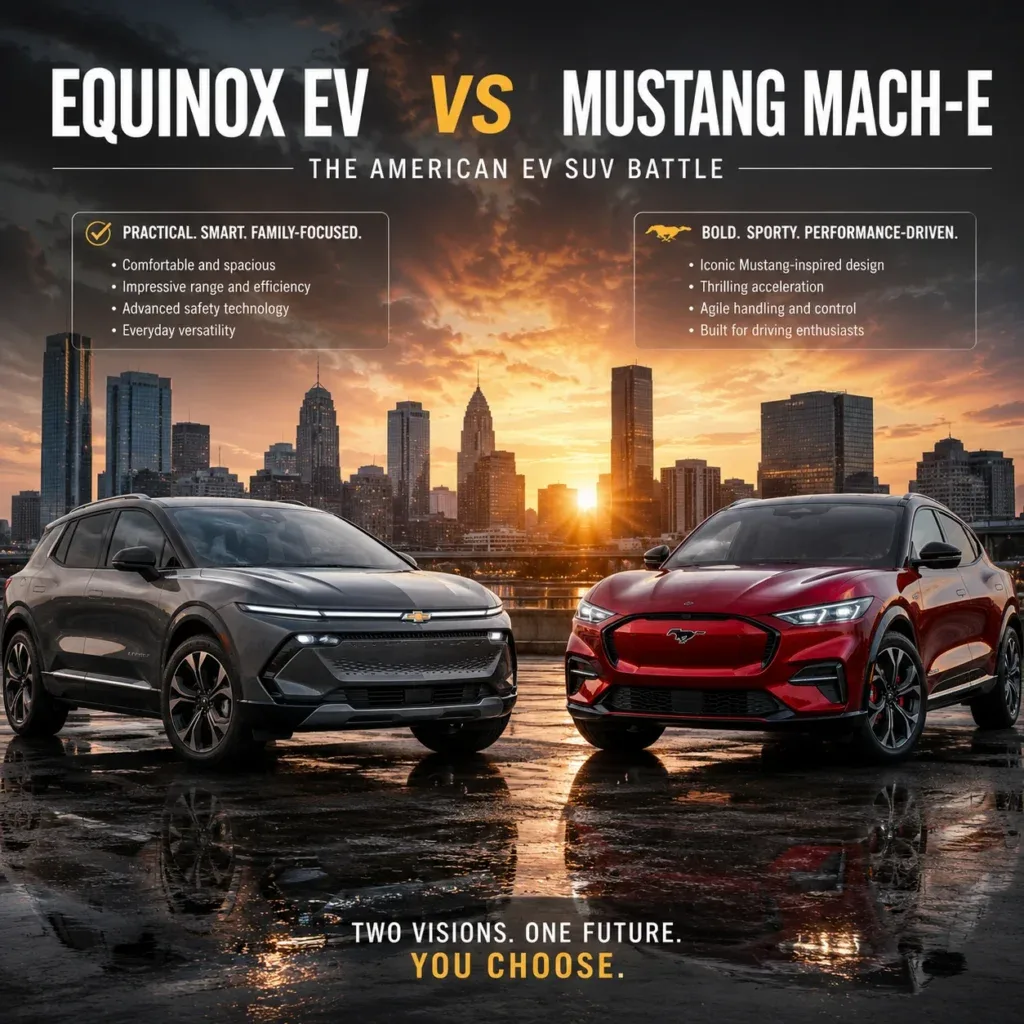
Two American-brand electric SUVs. Both priced under $45,000. Both trying to be the answer for buyers who want an EV but don’t want to buy Korean or buy Tesla.
The Chevrolet Equinox EV and the Ford Mustang Mach-E have been competing for this exact buyer since 2022. Both have improved significantly. Both deserve serious consideration.
But they are not equally good cars in 2026 — and the reasons why might surprise you.
The Numbers
| Chevy Equinox EV LT AWD | Ford Mustang Mach-E Select AWD | |
|---|---|---|
| Starting Price | ~$36,495 | ~$42,995 |
| EPA Range (AWD) | 319 miles | 260 miles |
| Horsepower | 213 HP | 266 HP |
| 0-60 mph | 6.5 seconds | 5.8 seconds |
| Peak Charging | 150 kW | 150 kW |
| Cargo Space | 57.3 cu ft | 59.7 cu ft |
| Built | Ramos Arizpe, Mexico | Cuautitlan, Mexico |
| Towing | 1,000 lbs | 2,000 lbs |
Two numbers define this comparison. The Equinox EV has 59 more miles of EPA range at the equivalent price point. The Mach-E is $6,500 more expensive for a comparable configuration.
The Case for the Chevy Equinox EV
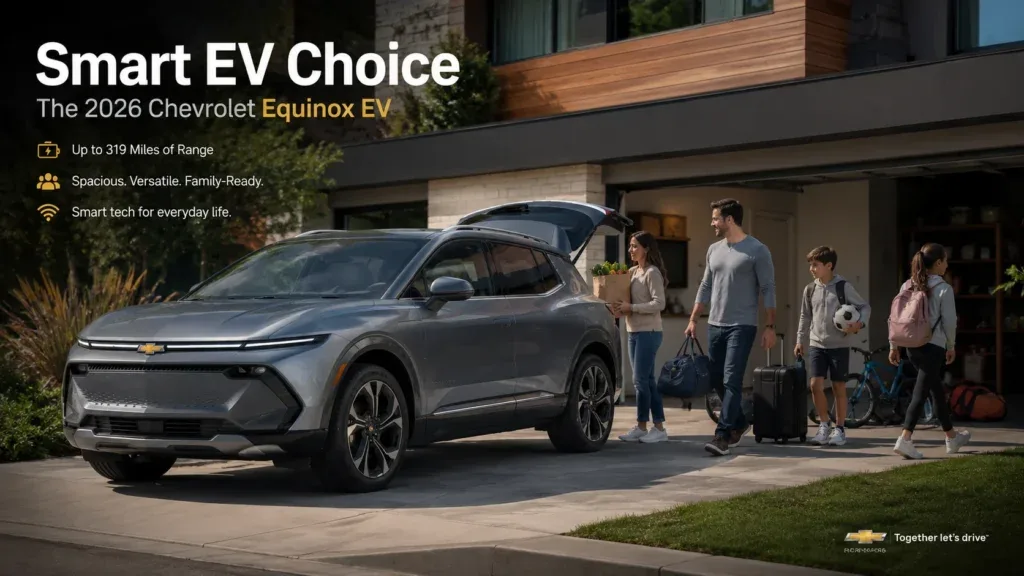
The Equinox EV’s story in 2026 can be summarized in three words: value, range, practicality.
At $36,495 for the AWD LT — the most popular configuration — it undercuts every meaningful electric SUV competitor except the Hyundai Ioniq 5 at $35,000. For an American-brand domestic-automaker alternative to the Korean offerings, the Equinox EV’s price is its single most important selling point.
319 miles of EPA range is the headline spec. That’s more range than the Mach-E, more than the BMW iX3, and within 19 miles of the Hyundai Ioniq 5 Long Range at $37,500. For a $36,495 vehicle, that range is genuinely competitive with everything in its class.
The Equinox EV’s 57.3 cubic feet of total cargo space is excellent — more practical interior volume than many rivals, reflecting GM’s decision to prioritize family utility over sporty styling.
GM’s build quality on the Equinox EV has improved meaningfully from the troubled early 2023 production run. The interior, while not as premium as the Ioniq 5, is genuinely acceptable — a properly finished car rather than a science project. The Ultifi software platform and Google built-in integration bring the infotainment up to competitive standards.
The honest weakness: 213 HP feels underwhelming behind the wheel. The Equinox EV is competent but never exciting. At 6.5 seconds to 60 mph, it accelerates at exactly the pace you’d expect from a practical family crossover — which it is. But for buyers who want their EV to feel like a reward for the purchase price, the Equinox doesn’t deliver that feeling.
Buy the Equinox EV if: Budget is the priority, range anxiety matters, you want American-brand engineering without Korean or German alternatives, and you don’t need a car that accelerates dramatically.
The Case for the Ford Mustang Mach-E
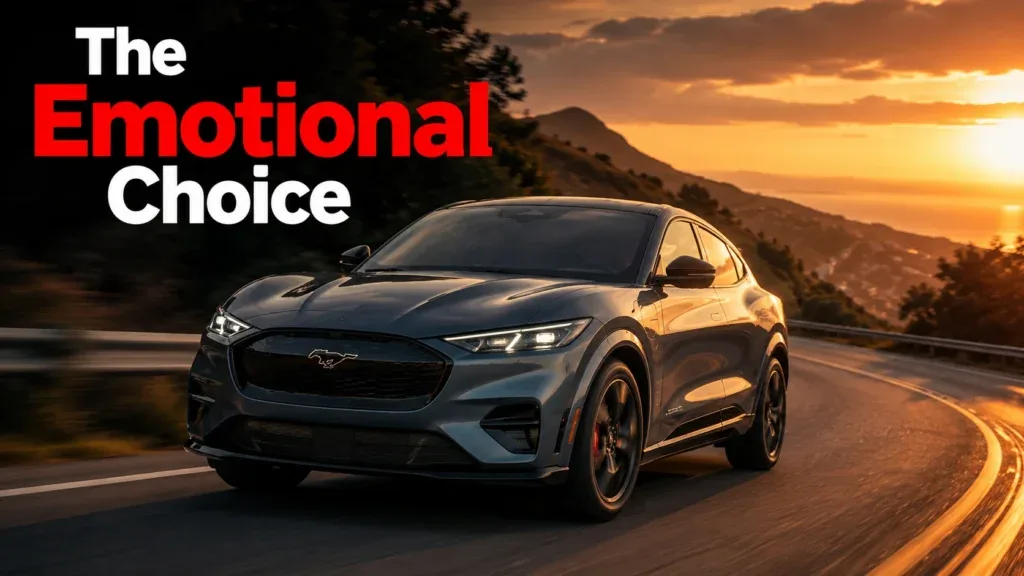
The Mach-E’s problem in 2026 is not the car. The car is genuinely good. The problem is value.
At $42,995 for a comparable AWD configuration, the Mach-E costs $6,500 more than the Equinox EV for 59 fewer miles of range and a 0.7-second 0-60 advantage. On paper, that’s a difficult trade to justify.
But paper misses what the Mach-E does well.
It drives like a proper car. 266 HP and 5.8-second 0-60 give the Mach-E a personality that the Equinox lacks. The steering has weight and feedback. The chassis communicates what the road is doing. Ford’s chassis engineers built something that rewards driving in a way that most family electric SUVs — including the Equinox — deliberately don’t.
The Mustang badge is real. This matters to a specific buyer — someone who has always driven American performance vehicles and isn’t ready to entirely abandon that identity for an efficient Korean crossover. The Mach-E looks like a performance vehicle. It drives like one. The Mustang name isn’t just marketing.
The GT Performance Edition — the range-topping Mach-E with 480 HP and a 3.5-second 0-60 time — is genuinely one of the most exciting vehicles at its price point. The base models don’t feel that way, but knowing the platform can produce that performance is relevant context.
Towing: 2,000 lbs versus the Equinox’s 1,000 lbs. For buyers who occasionally tow a small trailer, bike rack, or boat — the Mach-E has double the capability.
The honest weakness: The $6,500 price premium over the Equinox EV for less range is genuinely hard to rationalize unless the driving experience and the badge specifically matter to you. And both are built in Mexico, meaning neither has the domestic manufacturing advantage of the Georgia-built Ioniq 5.
Buy the Mach-E if: Driving feel matters, the Mustang identity resonates, you occasionally tow small loads, and you’re willing to pay $6,500 more for the experience difference.
The Honest Verdict
In 2026’s economic environment — $4.50 gas, falling real wages, no rate cuts coming — financial logic matters more than brand sentiment.
The Equinox EV at $36,495 with 319 miles of range is the rational choice. Better range. Lower price. Acceptable interior. Enough practicality for most families.
The Mach-E at $42,995 with 260 miles of range is the emotional choice. More fun to drive. More visually interesting. More connected to American performance car heritage.
Neither is wrong. But the buyer who chooses the Mach-E over the Equinox needs to be honest about paying a premium for how the car makes them feel — not for how it stacks up on a spreadsheet.
In May 2026, with household budgets under real inflation pressure, that’s a premium worth examining closely before you sign.
See how the 5-year fuel savings stack up between these two with our EV vs Gas Cost Calculator.