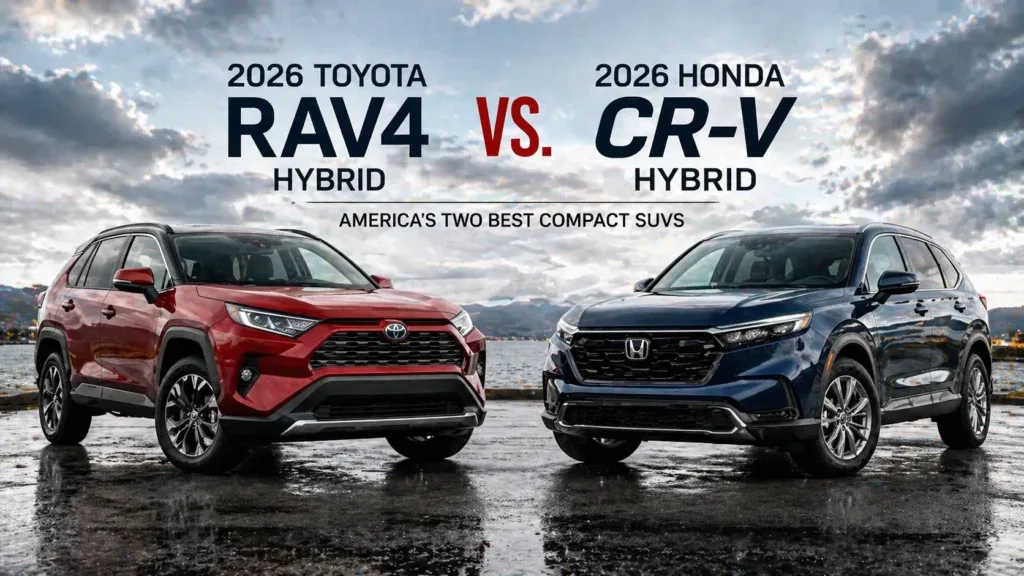
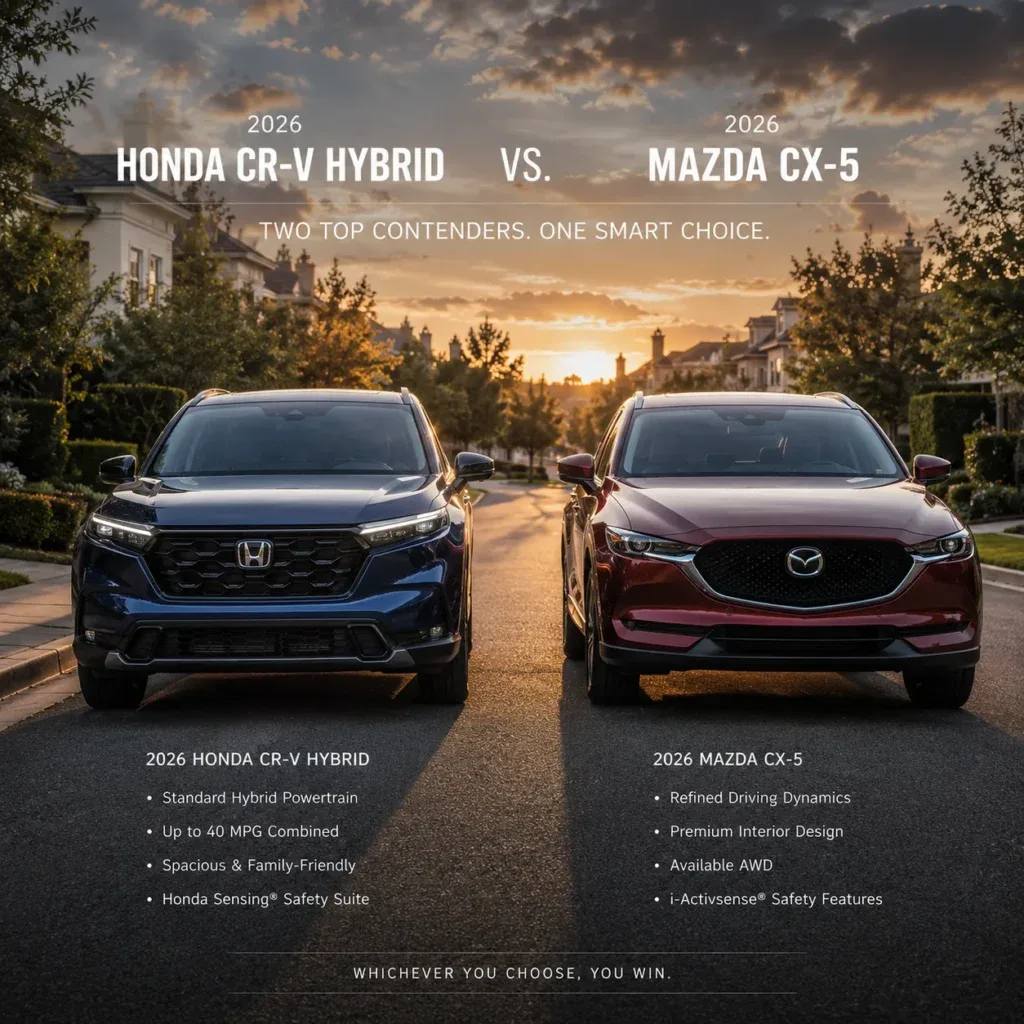
Everyone compares the CR-V to the RAV4. Everyone compares the CX-5 to the Tucson.
Nobody compares these two directly. And that’s a mistake. Because the Honda CR-V Hybrid and the Mazda CX-5 are fighting for the same buyer more directly than most shopping guides acknowledge — the person who wants a well-made compact SUV under $38,000 and cares about how it drives, not just how much it costs per mile.
Put them side by side honestly and you discover something interesting.
The Numbers
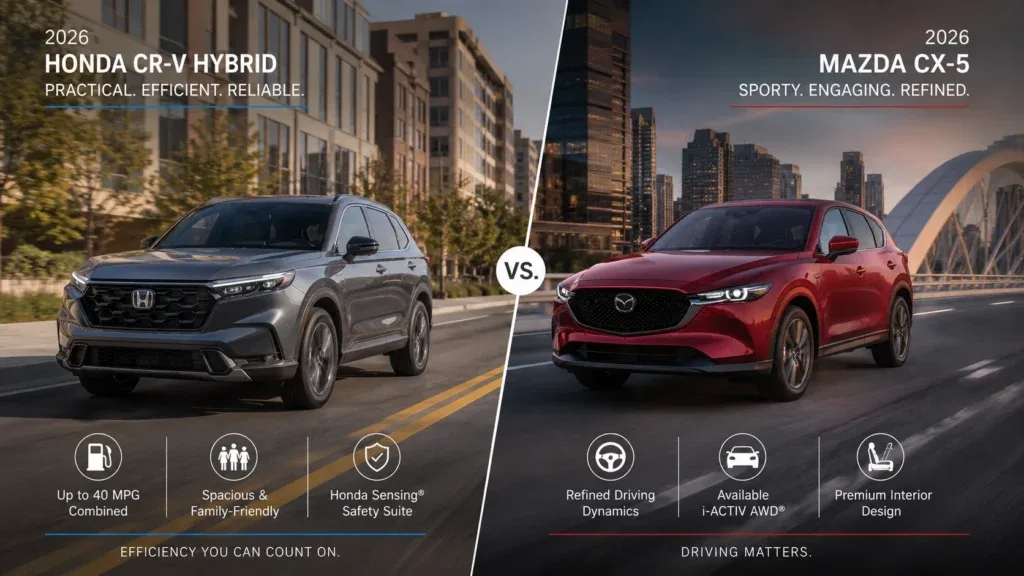
| 2026 Honda CR-V Hybrid | 2026 Mazda CX-5 | |
|---|---|---|
| Starting Price | $35,630 | $28,690 |
| Fuel Economy | 36 MPG combined | 25-28 MPG combined |
| Horsepower | 204 HP combined | 187-256 HP |
| Rear Legroom | 41.0 inches | 39.4 inches |
| Cargo (seats up) | 39.2 cu ft | 30.9 cu ft |
| Towing | 1,500 lbs | 2,000 lbs |
| AWD | Optional | Standard |
| Built | East Liberty, OH | Japan |
| Warranty | 5 yr/60K basic | 5 yr/60K basic |
The price gap is real and significant. The CR-V Hybrid starts $6,940 higher than the base CX-5. For a family on a real budget, that’s a car payment. That’s a summer of grocery bills. That’s not abstract.
But the comparison doesn’t end at the sticker price.
also read : https://driveglobalnews.in/iran-war-is-accidentally-helping-chinese-evs/
The Case for the Honda CR-V Hybrid
36 MPG versus 25-28 MPG. At $4.50 gas and 15,000 annual miles, that fuel economy gap saves approximately $600-$700 per year. Over seven years of ownership — roughly $4,500 in fuel savings. That closes the sticker price gap meaningfully.
The CR-V Hybrid’s 41 inches of rear legroom is the practical argument that wins for families with tall passengers. Nobody who regularly carries adults in the back seat of a compact SUV forgets how much rear legroom their car has. Forty-one inches is class-leading. The CX-5’s 39.4 inches is fine. The 1.6-inch gap sounds small until you’re 6’2″ on a three-hour drive.
The cargo area tells a similar story. The CR-V’s 39.2 cubic feet versus the CX-5’s 30.9 cubic feet is a meaningful practical difference. That’s the difference between fitting a stroller, a diaper bag, and groceries versus having to play three-dimensional Tetris with your week’s shopping.
Honda’s hybrid system is also genuinely impressive in day-to-day use. The CR-V Hybrid often runs in pure EV mode at low speeds. In city traffic, the engine frequently shuts off completely. The transition between electric and gas operation is so smooth that most passengers never notice it happening. For a family that spends significant time in urban stop-and-go traffic — this matters.
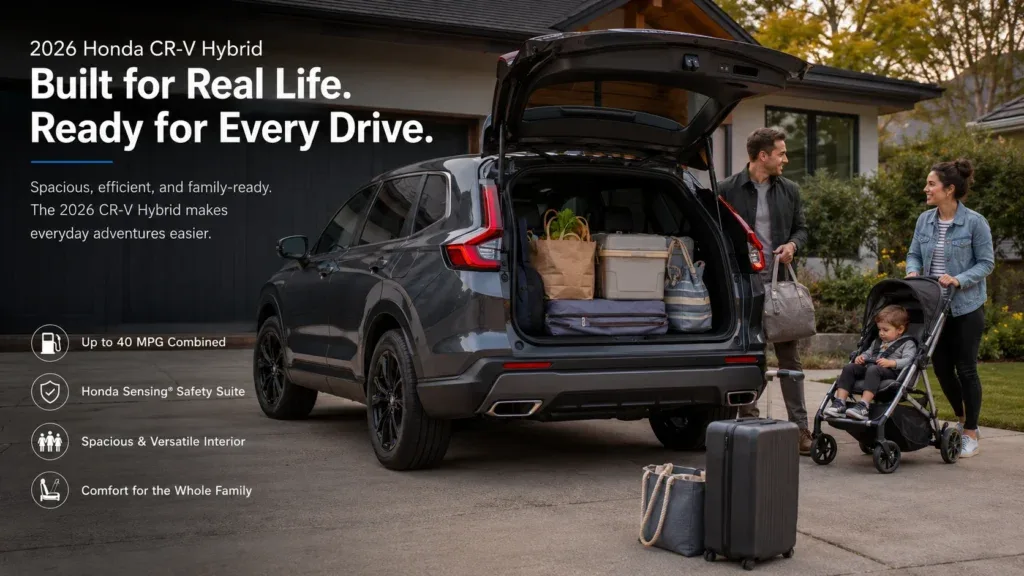
Buy the CR-V Hybrid if: You drive a lot annually, fuel economy genuinely affects your budget, you regularly carry adults in the back, or you need maximum cargo space.
aslo read : https://driveglobalnews.in/nissan-rogue-vs-toyota-rav4-in-2026-america/
The Case for the Mazda CX-5
The CX-5 is the best-driving compact SUV at any price under $40,000. That’s a strong claim. It’s been true for five years and the 2026 redesign hasn’t changed it.
The steering is the CX-5’s defining characteristic. Weight and feedback that no competitor at this price — not the CR-V, not the RAV4, not the Tucson — matches. Driving a CX-5 on a twisty suburban road feels like driving a sports car that happens to have four doors and a cargo area. The chassis communicates. The car responds to inputs. You feel like a driver, not a passenger.
The 2026 redesign added substance to that driving character: a bigger 12.9-inch touchscreen on upper trims, Google built-in, and noticeably improved material quality that makes the CX-5’s interior feel more premium than its price suggests. The cabin has always been beautifully designed. Now the technology keeps pace with the aesthetics.
AWD is standard on every single CX-5 trim — something the CR-V charges extra for. In states with real winters, that’s not a small thing. The base CX-5 at $28,690 comes with AWD included. The base CR-V Hybrid at $35,630 is FWD.
The turbo engine option — 256 HP from the 2.5T on upper trims — makes the CX-5 genuinely quick. Not hybrid-quick in a straight line, but satisfying in the way that a naturally responsive turbocharged engine feels in everyday driving.
The honest limitation: 25-28 MPG combined is noticeably worse than the CR-V Hybrid at current gas prices. The CX-5 is not an efficient vehicle by 2026 standards. At $4.50 gas, that matters to the monthly budget in ways it didn’t when gas was $2.80.
Buy the CX-5 if: Driving feel is genuinely important to you. Budget is tight and the $6,940 lower starting price is real. AWD is required at your base budget. Or you simply find the CX-5 the most attractive-looking compact SUV and that matters to you every day you drive it.
The Honest Verdict
This is one of the most personality-dependent comparisons in the compact SUV market.
Family with kids, high annual mileage, practical priorities: CR-V Hybrid. The fuel savings are real, the space is better, the hybrid system reduces running costs in city driving.
Driver who enjoys the act of driving, budget-conscious, lives in a snow state: CX-5. The driving character is worth something. AWD standard at $28,690 is genuinely hard to match. And if you’re keeping the car eight years, finding a good deal on the CX-5 and saving $7,000 upfront might fund more useful things than the fuel savings recover.
Neither choice is wrong. Both are excellent vehicles from brands with strong reliability records. Both will be satisfying daily drivers for a decade.
The CR-V Hybrid is the rational choice. The CX-5 is the emotional one. Those aren’t the same thing — and pretending they are doesn’t help you buy the right car.
Check your monthly payment difference between both with our Car Loan EMI Calculator.