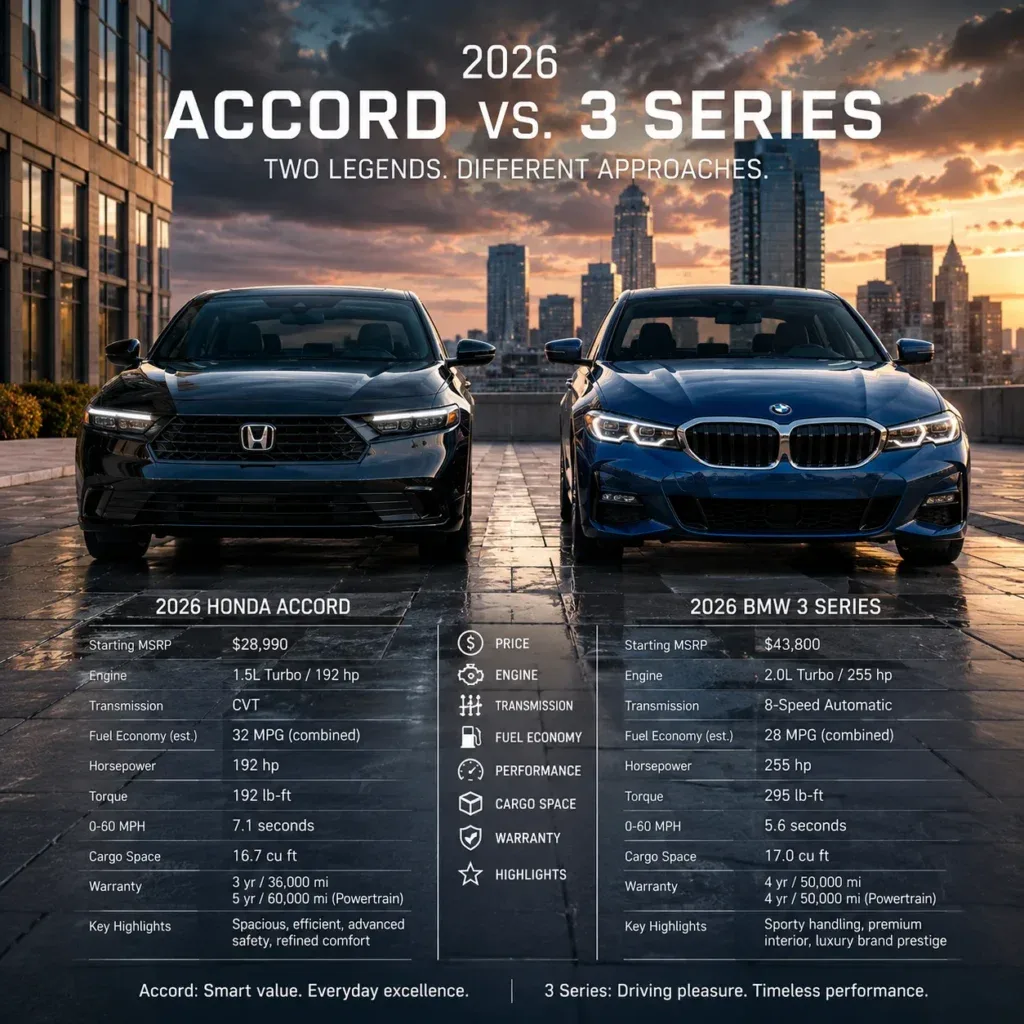
Edmunds published a comparison in April 2026 with a headline that’s been circulating in car shopping circles ever since: 2026 Honda Accord or BMW 3 Series — Is the Luxury Badge Worth Almost $10,000 Extra?
The sticker price gap between a well-equipped Accord and a base 3 Series is roughly $9,000-$10,000. That number gets discussed constantly. What doesn’t get discussed nearly enough: the insurance gap.
Because the insurance difference between these two cars is almost as large as the purchase price difference — and it compounds every single year you own them.
also read : https://driveglobalnews.in/cheapest-car-insurance-companies-in-2026/
The Insurance Numbers — Real 2026 Rates
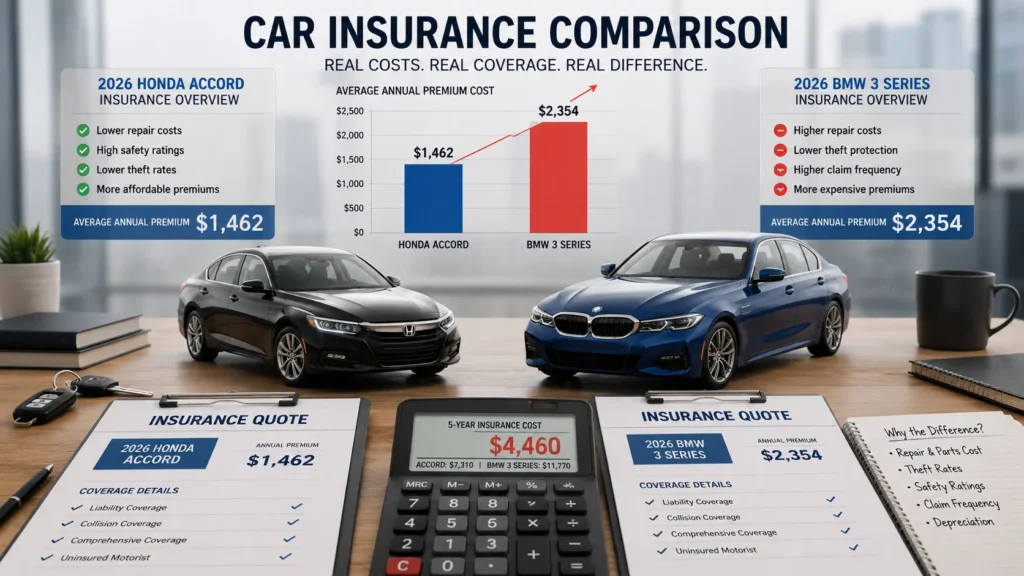
The Honda Accord averages $2,112 per year for full coverage in 2026. The BMW 3 Series averages $3,924 per year.
That’s a gap of $1,812 annually.
Over seven years of ownership — a realistic period for most buyers who finance a new car — that insurance difference totals $12,684. Add that to the $9,000-$10,000 purchase price premium and the true cost of choosing the BMW over the Accord approaches $22,000 before you factor in higher maintenance costs, pricier tires, and more expensive routine service.
That’s not an argument against buying a BMW. It’s an argument for knowing what you’re actually committing to.
Why the BMW Costs So Much More to Insure
Insurance pricing isn’t arbitrary. The $1,812 annual gap between Accord and 3 Series insurance reflects real cost differences that insurers have measured across millions of claims.
Repair costs. A BMW 3 Series fender bender that requires a bumper replacement costs roughly $2,800-$3,500 to repair. The equivalent Accord repair costs approximately $1,400-$1,800. BMW’s parts are more expensive. BMW-trained technicians bill higher labor rates. And modern 3 Series models have more sensors, cameras, and active safety systems embedded in bumpers and mirrors — all of which require recalibration after any collision, adding hundreds of dollars to every repair.
Parts availability. When an Accord needs a door panel, dozens of suppliers make compatible parts. When a BMW needs a specific module, the supply chain is narrower and wait times are longer — meaning the rental car costs during repair accumulate more. Insurers experience this directly in claims costs.
Theft rates. BMW models historically appear more frequently on most-stolen lists than Honda models. Insurers price for theft probability based on historical data.
Driver profile correlation. Insurance companies don’t just insure the car — they insure the driver who buys the car. Statistical analysis shows that buyers of performance-oriented luxury sedans have different claims profiles than buyers of mainstream family sedans. Whether or not you personally drive aggressively, your vehicle choice correlates with a higher-risk population, and that influences your rate.
also read : https://driveglobalnews.in/how-much-does-car-insurance-cost-for-a-new-driv/
The Full Financial Picture — Accord vs 3 Series Over 7 Years
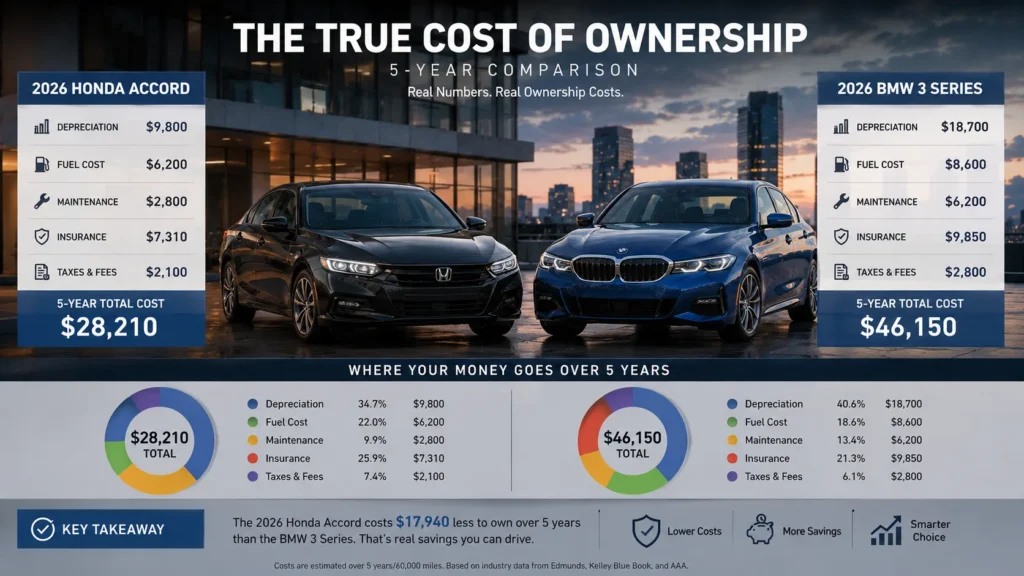
Let’s run the complete comparison for a 35-year-old buyer with a clean driving record financing over 60 months at 6.5%.
2026 Honda Accord Hybrid (well-equipped EX-L): Purchase price: $36,000 Monthly payment: approximately $700 Annual insurance: $2,112 Annual fuel (44 MPG, 15K miles, $4.50 gas): $1,534 Annual maintenance (oil changes, tires, scheduled service): $650 Total annual cost: $11,696
2026 BMW 330i (base, equivalent features): Purchase price: $46,000 Monthly payment: approximately $895 Annual insurance: $3,924 Annual fuel (30 MPG, 15K miles, $4.50 gas): $2,250 Annual maintenance (BMW dealer rates, iDrive service): $1,230 Total annual cost: $15,759
Annual difference: $4,063 Seven-year difference: $28,441
The BMW costs $28,441 more to own over seven years — for a car that costs $10,000 more to buy. The ownership premium is nearly three times the purchase price premium.
So Is the BMW Still Worth It?
For some buyers, absolutely.
If you drive enthusiastically and genuinely value the 3 Series’ steering feedback, chassis precision, and the rewarding quality it brings to every drive — that experience has real value that doesn’t appear in a spreadsheet. The BMW’s active suspension, the inline-six engine’s character, the way it responds to driver inputs — these are genuinely differentiated experiences that the Accord doesn’t deliver at the same level.
If your car is part of your professional identity — if you meet clients, attend events, or simply care that your vehicle communicates something specific about you — the BMW delivers that signal in ways the Accord doesn’t.
If you’re keeping the car three years and then leasing again — the seven-year ownership cost gap is less relevant. You’re paying for the experience, not the long-term economics.
But if you’re financing a new car, planning to keep it 6-8 years, and making decisions primarily on financial grounds — the Accord Hybrid wins this comparison decisively. $28,441 in ownership savings over seven years is genuinely life-changing money for most middle-class American households.
The BMW badge costs more than you think. The Accord badge costs less than you realize. Knowing the real number before you sign is the most useful thing this comparison can give you.
See your full 5-year ownership costs for any vehicle with our Car Ownership Cost Calculator.