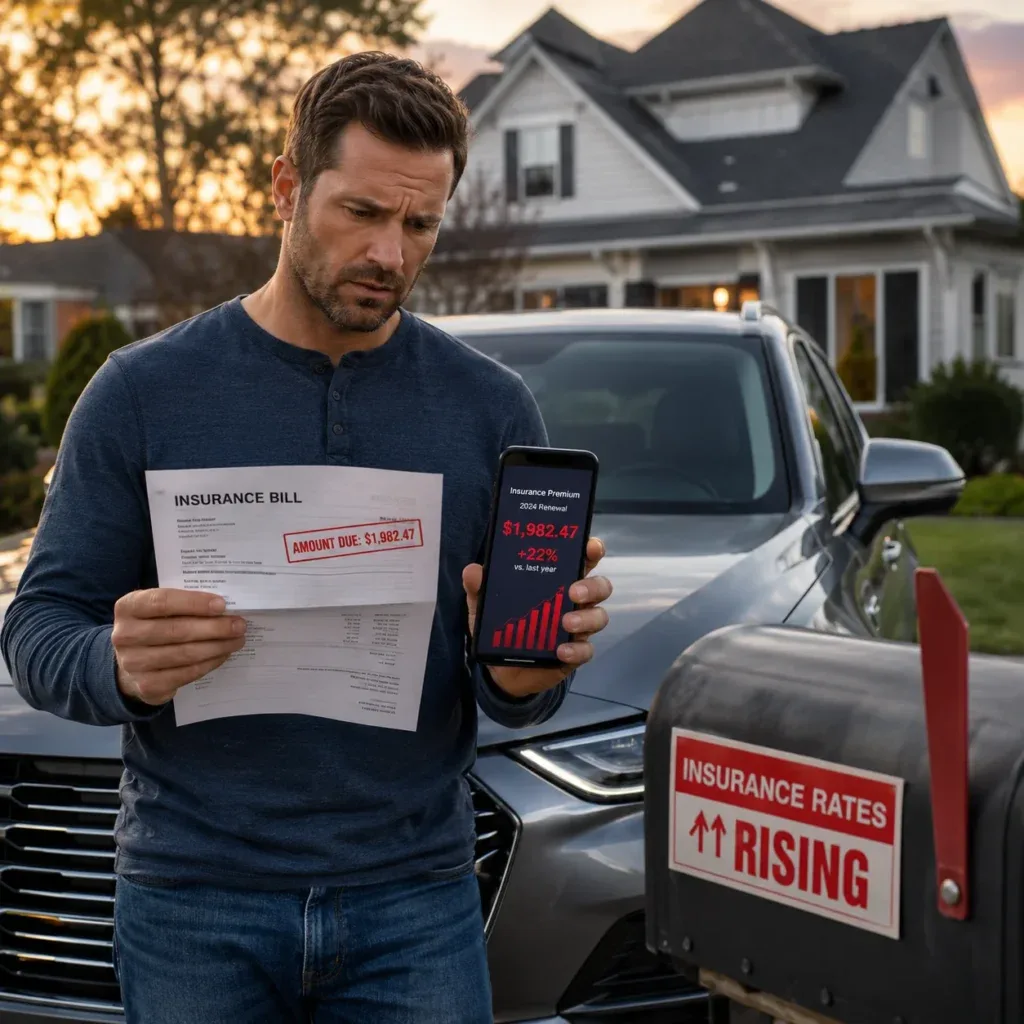
The average American overpays for car insurance by $700-$1,100 per year.
Not because insurance is universally unfair. Not because there are no good deals available. But because most people set up their policy years ago, got busy with life, and never revisited a decision that compounds into thousands of dollars of unnecessary spending over time.
Here are the five mistakes that are most likely making your bill higher than it needs to be — and exactly what to do about each one.
Mistake 1: Staying With the Same Insurer for Years Without Shopping

This is the single most expensive mistake and the most common.
Insurance companies offer their best rates to new customers. Loyalty, in the auto insurance industry, is financially punished — not rewarded. Insurers bank on the fact that most people won’t take the 20 minutes required to get competing quotes at renewal time.
The data is clear. A record 47.3% of all auto insurance policies in America were shopped at least once in the past 12 months in 2026 — according to LexisNexis. The Americans who are shopping are saving hundreds of dollars. The half who aren’t are subsidizing them.
The fix: Set a calendar reminder 30 days before every renewal date. Get quotes from at minimum: Travelers, GEICO, Progressive, and State Farm. Compare them to your current rate. Switch if the savings justify it. Repeat every 12 months without exception.
Average savings from switching: $700-$1,100 per year.
State Farm is cutting rates 4% in 2026. Allstate is raising them 1.98%. If you’re with Allstate and haven’t compared to State Farm recently — start there.
Mistake 2: Carrying Full Coverage on a Car That Doesn’t Need It
Full coverage — comprehensive plus collision — makes financial sense when your car is worth enough that a repair or replacement would be a significant financial hit.
It stops making sense when your car’s value drops below a certain threshold. The general rule used by financial advisors: if your annual comprehensive and collision premium exceeds 10% of your car’s actual cash value, you’re probably over-insured.
A 2015 Honda Accord with 90,000 miles might be worth $8,000. If you’re paying $120/month ($1,440/year) for full coverage including collision and comprehensive — you’re paying 18% of the car’s value annually to insure it. One bad year with a claim that totals the car would pay out roughly $8,000 minus your deductible. The math doesn’t work.
The fix: Check your car’s current value on KBB or CarGurus. Calculate what you’re paying annually for collision and comprehensive specifically — ask your insurer to break it out. If the ratio is over 10%, consider dropping to liability-only coverage and putting the premium savings in a small emergency fund instead.
The one caveat: if you’re still making loan payments, your lender requires full coverage. This calculation only applies when the car is paid off.
Mistake 3: Carrying the State Minimum Deductible
Most drivers, when they set up their policy, accept the default deductible — often $250 or $500 for collision and comprehensive. They’ve never revisited it.
Raising your deductible from $500 to $1,000 typically reduces your collision and comprehensive premium by 10-15%. On a $1,200 annual collision and comprehensive premium — that’s $120-$180 in annual savings.
You’re essentially paying $120-$180 per year to reduce your out-of-pocket exposure in a claim from $1,000 to $500. Whether that makes sense depends on your emergency fund.
The fix: If you have at least $1,000 in savings that you could access for an unexpected car repair — raise your deductible to $1,000. If you have $2,500+ available — consider a $2,500 deductible. The premium savings are real and recurring. The higher out-of-pocket only matters if you actually file a claim.
Mistake 4: Not Using Telematics When You’re a Safe Driver
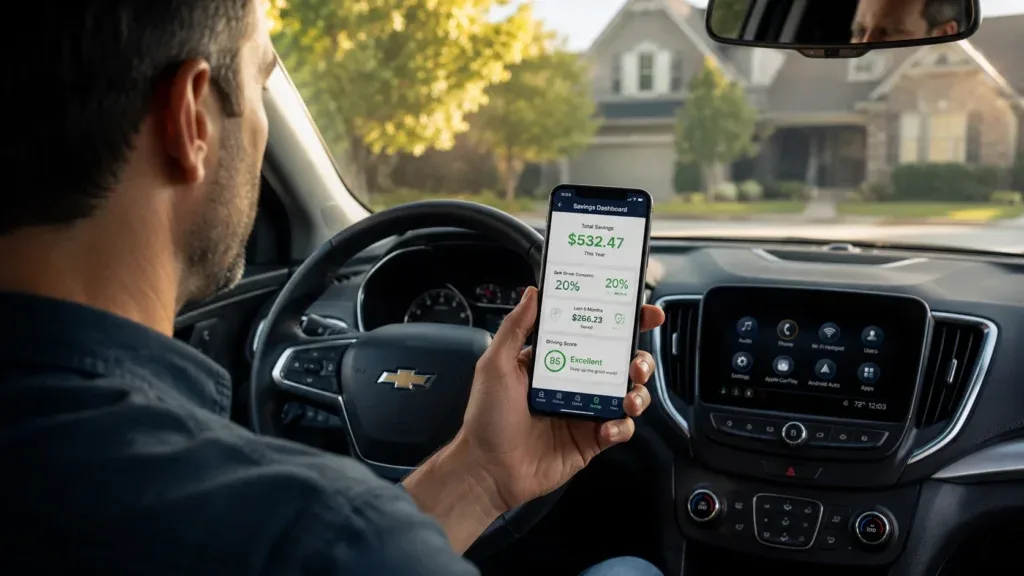
Every major insurer now offers a telematics program — an app or device that tracks your actual driving behavior and rewards safe habits with discounts.
Progressive Snapshot, State Farm Drive Safe & Save, and Allstate Drivewise all offer up to 30% off for safe driving profiles. That’s the ceiling, not the average — most safe drivers see 10-20% discounts. But on a $2,500 annual premium, 15% is $375 per year.
Most people don’t enroll because they worry about being tracked. Here’s the reality: the data collected is used only for pricing your premium, not shared with law enforcement. And the programs are universally opt-in — you can leave if you don’t like the result.
The fix: If you consider yourself a safe, average-mileage driver — enroll in your insurer’s telematics program. The worst outcome is you learn your driving habits don’t qualify for a discount and opt out. The best outcome is 10-30% off your annual premium for doing exactly what you were already doing.
Mistake 5: Paying Monthly Instead of Annually
This one is straightforward and almost nobody mentions it.
Most insurance companies charge a fee — sometimes called an installment fee, sometimes just embedded in the monthly pricing structure — when you pay month-to-month rather than annually. That fee typically adds 3-8% to your effective annual premium.
On a $2,500 annual premium paid monthly: the installment fees often add $75-$200 per year for the exact same coverage. You’re paying $75-$200 for the privilege of not paying a lump sum.
The fix: If you have the cash available, pay your annual premium in full. The savings are immediate and certain. If cash flow prevents it — ask your insurer about semi-annual payment, which often reduces or eliminates the installment fee while splitting the cost into two manageable payments.
The Bottom Line
None of these fixes are complicated. None of them require a financial advisor or a significant time investment.
Shopping at renewal: 20 minutes, once a year. Reviewing your coverage level: 10 minutes, once when the car is paid off. Raising your deductible: a single phone call. Enrolling in telematics: downloading an app. Paying annually: one bill instead of twelve.
Five simple actions. Combined annual savings potential for a typical driver: $500-$1,500 per year. Over five years — $2,500-$7,500 that stays in your bank account instead of going to an insurer you haven’t thought about in three years.
The money is there. Most people just never go looking for it.