
You have two drivers. Same age. Same car. Same zip code. Same driving record — clean, not a single ticket or accident.
One pays $212 per month for car insurance.
The other pays $590 per month.
The difference? Credit score. That’s it. Nothing else. The person paying $590 per month has never caused an accident. Has never filed a claim. Drives the exact same roads in the exact same car.
They pay $4,572 more per year because their credit score is lower.
This is not hypothetical. This is MoneyGeek’s actual data from June 2026 — comparing GEICO and State Farm rates for the same driver profile at different credit levels. The $378 monthly gap between the two insurers, for the same bad-credit customer, shows something even more disturbing: the insurer you choose matters as much as your credit score itself.
Most people don’t know any of this. And the insurance industry is not rushing to explain it.
How It Actually Works — The Part Insurers Don’t Volunteer

Every major car insurance company — GEICO, State Farm, Progressive, Allstate, Liberty Mutual — checks your credit before selling you a policy. This is legal in 47 out of 50 states.
But here’s the distinction that matters: they’re not checking your FICO credit score. They’re creating something called a Credit-Based Insurance Score (CBIS) — a proprietary formula that draws from your credit data but weights it differently. You cannot see your CBIS. You cannot request it. You cannot dispute it directly. It’s a number that affects what you pay every month, calculated by a formula that is not publicly disclosed.
The Federal Trade Commission has actually studied this and confirmed that credit-based insurance scores are “statistically valid predictors” of how likely someone is to file a claim. In other words: the data shows that people with lower credit scores do file more claims on average. The practice is actuarially defensible.
But actuarially defensible and morally comfortable are different things.
A person who lost their job in 2024, fell behind on credit card payments, and now has a 580 credit score — despite being a careful driver who has never caused an accident — pays $4,572 more per year for car insurance than someone with identical driving habits and an 800 credit score. The financial hardship that damaged their credit is now compounding into higher insurance costs. The hole gets deeper precisely when it’s hardest to climb out.
The Numbers That Should Be in Every Financial Education Class
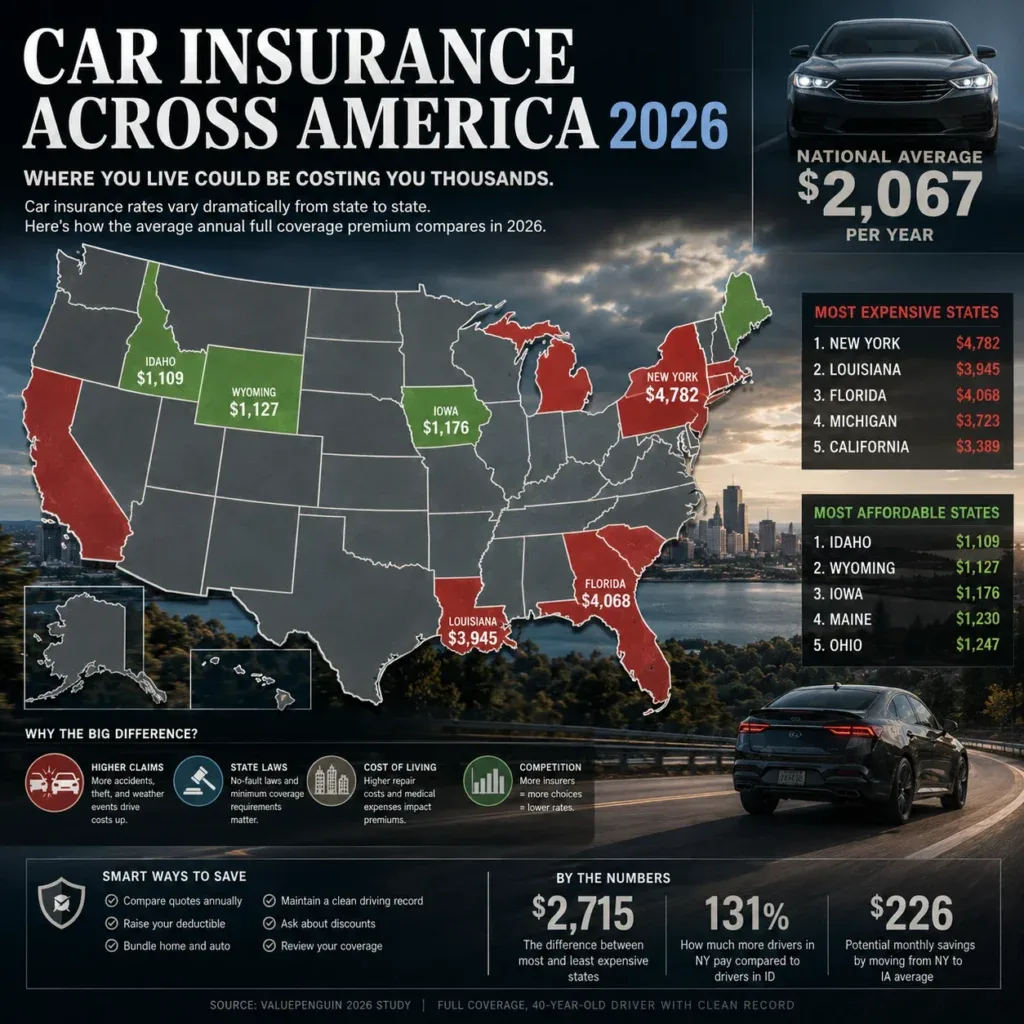
ValuePenguin ran a comprehensive 2026 analysis. The results across major carriers for a 30-year-old with a clean driving record:
Poor credit (below 580): $412 per month for full coverage — 98% more than good credit
Good credit (670-739): $208 per month for full coverage
Excellent credit (above 800): $186 per month for full coverage
The gap between poor and excellent credit: $226 per month. $2,712 per year. Every single year.
The Zebra’s analysis went further — comparing the very worst credit tier (below 523) to the very best (above 823). The gap: $4,581 per year. A 273% price difference. For the same coverage. For a driver who has never caused an accident.
And then there’s the state-by-state variation that makes this even more complicated:
In New York, poor credit drivers pay $273 per month versus $187 for excellent credit — an $86 monthly gap.
In Tennessee, the gap is smaller — $165 versus $118.
In California, Hawaii, Massachusetts, and Michigan — there is no gap. These four states have completely banned credit-based insurance pricing. In California, it doesn’t matter if your credit score is 450 or 850. Your insurer cannot use that number.
The Company You Choose Matters More Than Most People Realize

Here’s the thing the insurance comparison sites bury: different companies weight credit differently. Dramatically differently.
MoneyGeek’s June 2026 data showed this with a single example that is almost impossible to believe until you check it yourself.
Same driver. Same car. Same zip code. Same coverage. Same credit score — poor.
GEICO: $212 per month.
State Farm: $590 per month.
A $378 monthly difference. $4,536 per year. For identical coverage. The only variable is the company.
State Farm is not doing anything illegal. They weight credit more heavily in their pricing formula than GEICO does. Both companies have different internal CBIS formulas that reach different conclusions about how much risk a poor-credit driver represents.
This single data point contains the most important car insurance shopping advice available: always get quotes from multiple companies, especially if your credit is imperfect. The variation between companies for bad-credit drivers is not $20 or $50 per month. It can be $378 per month. Shopping is not optional — it’s the most powerful tool available to drivers with lower credit scores.
The Four States Where None of This Applies
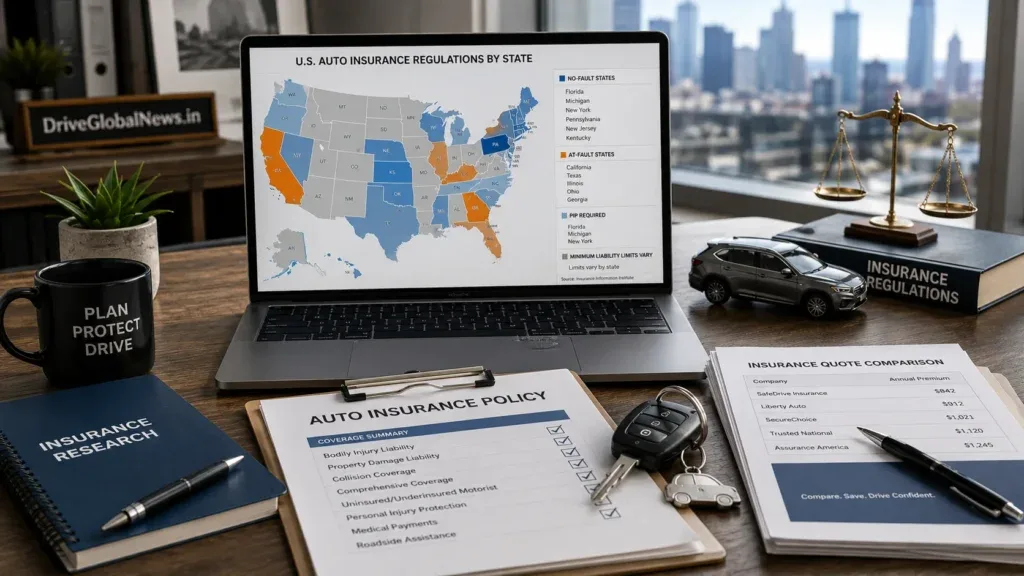
If you live in California, Hawaii, Massachusetts, or Michigan — your insurer cannot use your credit score. Period. These states recognized that credit-based insurance pricing disproportionately affects lower-income drivers and passed laws ending the practice.
The results in these states are instructive. Insurers still operate profitably. The market didn’t collapse. Rates didn’t skyrocket for everyone else. Credit-based pricing is a choice that insurers make in states that allow it — not an operational necessity.
For drivers in the remaining 46 states lobbying their state legislators on insurance reform: these four states are the proof that an alternative system works.
What You Can Actually Do About It

If your credit is poor: GEICO specifically is documented as penalizing bad-credit drivers less severely than most major carriers. Get quotes from GEICO, Progressive, and Travelers before assuming any rate you’ve been quoted is the market rate for your situation. The gap between the cheapest and most expensive insurer for bad-credit drivers can be $4,000+ per year.
If your credit is fair but improving: Timing matters. Request new insurance quotes every six months as your credit improves. A 50-point credit score increase can translate to a meaningful premium reduction at renewal — but only if you ask. Insurers don’t volunteer reductions when your CBIS improves. You have to shop to capture the savings.
If you’re rebuilding credit specifically: The single most impactful action for both your FICO score and your CBIS is on-time payment history. Not the balance. Not the credit utilization ratio. The payment history. Pay every bill on time, every month, without exception. This is the variable that moves both scores the fastest.
One thing that won’t help your credit score: paying your car insurance on time. Insurance companies don’t report on-time payment to credit bureaus. You get no credit benefit from a perfect insurance payment history. Only if you miss payments and go to collections does your insurance behavior affect your credit score — and then it hurts.
The system is not designed with your interests in mind. But understanding exactly how it works is the first step to navigating it better than most people do.