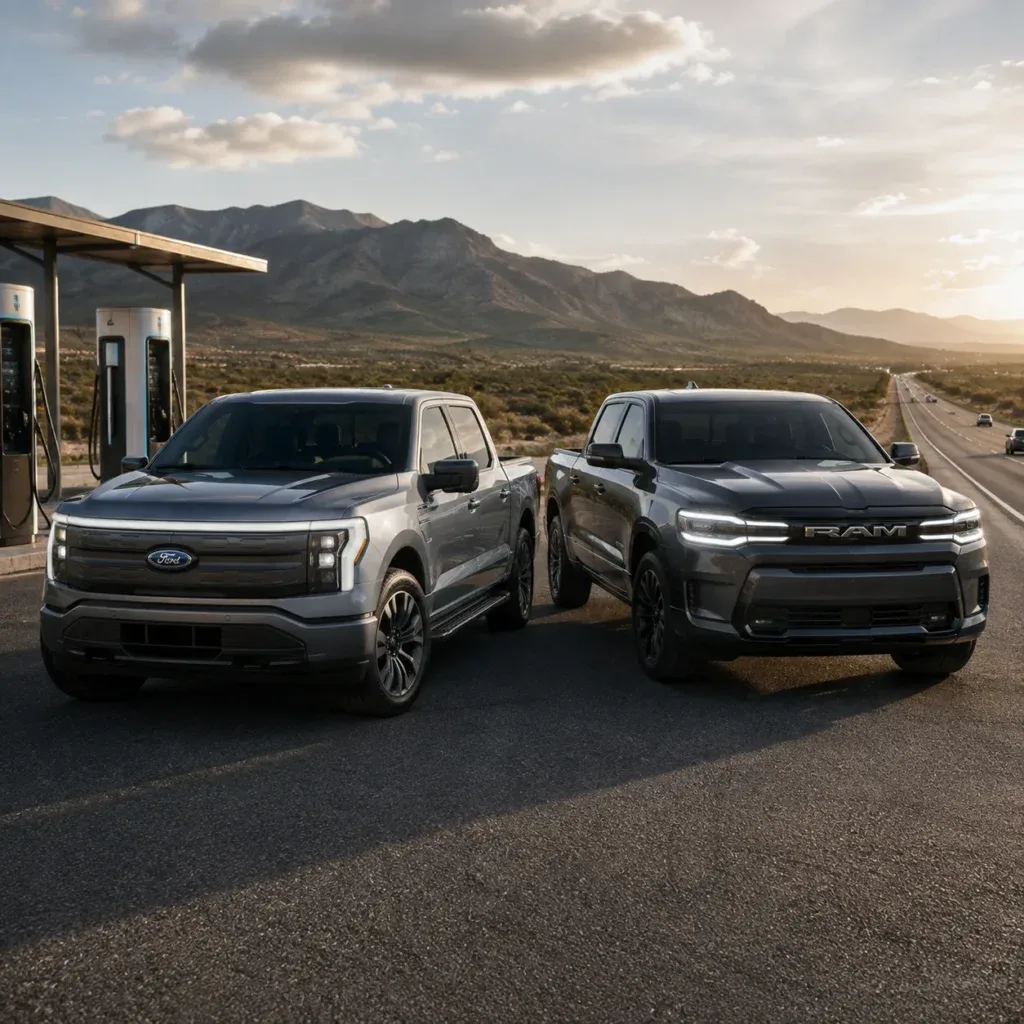
America’s full-size truck market is no longer just gas versus diesel. In 2026 two very different electrified Fords and Rams are competing for the same buyers. The F-150 Lightning is a battery-electric pickup with a familiar name and years of real-world use. The Ram 1500 Ramcharger is a range-extended electric truck that uses a gasoline V6 only as a generator. One maximizes simplicity and home charging. The other maximizes range and towing without range anxiety.
Here is how they stack up.
Powertrains and Range The 2026 F-150 Lightning uses dual electric motors and all-wheel drive. 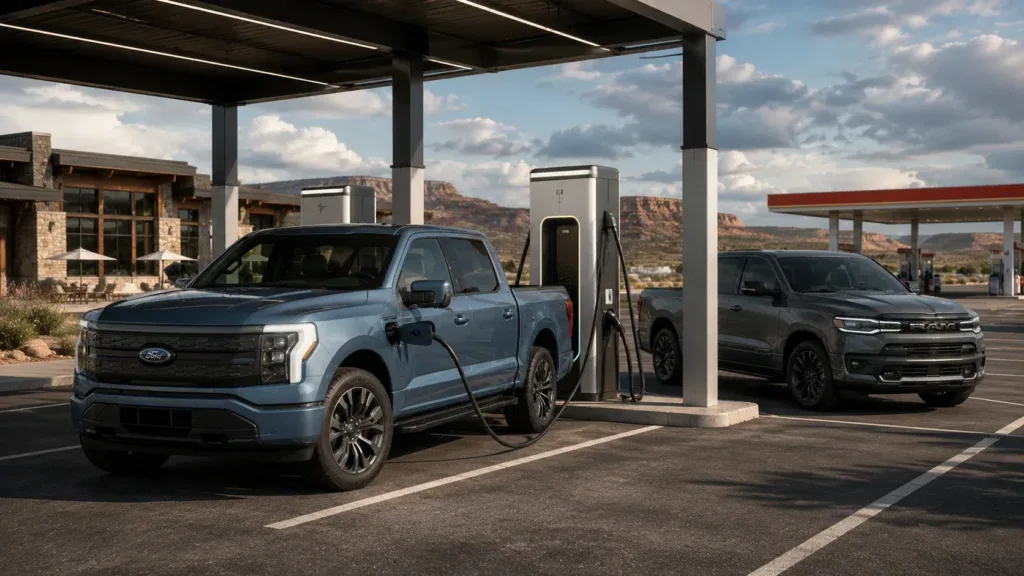
Output is 452 horsepower with the standard-range battery and up to 580 horsepower with the extended-range pack. Torque is 775 lb-ft in either case. EPA range is roughly 240 miles on the smaller battery and 300–320 miles on the larger pack. Real-world highway and towing range is lower, as with every current EV truck.
The Ramcharger takes a different path. Two electric motors drive the wheels (combined output in the mid-600-horsepower range with strong torque). A 3.6-liter Pentastar V6 never turns the wheels; it only generates electricity to feed the battery and motors. Electric-only range is estimated around 145 miles. Combined range with a full battery and full 27-gallon tank is claimed at about 690 miles. You can plug it in like an EV or treat the generator as a mobile power plant and refuel at any gas station.
Towing and Payload This is where the two concepts diverge most clearly for working truck buyers. The Lightning’s maximum towing is 10,000 pounds on properly equipped extended-range models (7,700 pounds on standard-range trucks). Payload is typically in the 1,800–2,200-pound range depending on configuration. Towing heavily cuts electric range dramatically.
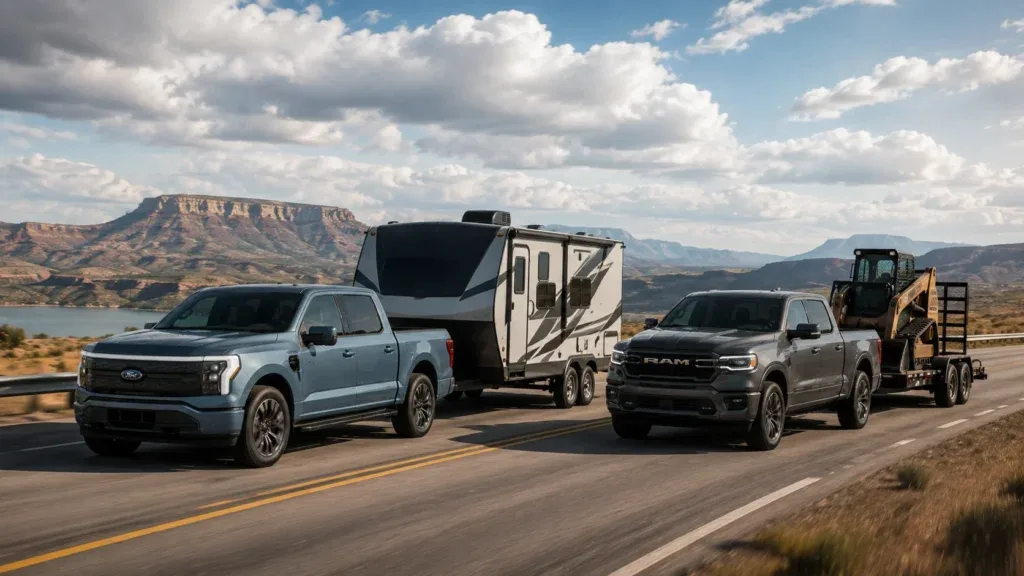
The Ramcharger targets 14,000 pounds of towing and around 2,625 pounds of payload. Because the generator can keep the battery supplied on the highway, the truck is designed to tow long distances without the same range collapse that pure EVs experience. That is the central promise of the range-extender approach.
Price and Positioning The Lightning starts in the mid-$50,000s for the Pro and climbs into the mid-$80,000s for Platinum. That makes the entry point more accessible than many early electric trucks.
Ram has indicated the Ramcharger will be priced slightly above the average transaction price of a conventional full-size pickup — commonly interpreted as the low-to-mid $70,000s for a well-equipped example. Exact trim pricing was still settling at the time of writing, but it is not positioned as a bargain EV. It is positioned as a capable truck that happens to be electrified.
Daily Driving and Charging The Lightning is the simpler EV. Charge at home overnight, use public DC fast charging on trips, and enjoy instant torque and a quiet cabin. Pro Power Onboard lets it run tools or a job site. The frunk adds useful storage. The limitations are charging time on the road and the drop in range when towing or driving at highway speeds in cold weather.
The Ramcharger can be driven as an EV for shorter trips and commutes, then rely on the generator for longer hauls. You never have to find a charger if you do not want to. The trade-off is complexity, a gasoline engine that still needs maintenance and fuel, and a vehicle that is heavier than a conventional Ram 1500. It is not a traditional hybrid in which the engine can drive the wheels; it is an EV with a built-in generator.
Which One Makes More Sense?
Choose the Ford F-150 Lightning if:
- You can charge at home most nights
- Your typical towing is moderate and trips are planned around charging
- You want a simpler, proven electric truck with a lower starting price
- Instant torque and quiet operation matter more than maximum range
Choose the Ram 1500 Ramcharger if:
- You tow heavy loads over long distances
- You want EV-like driving without depending on public charging
- 690-mile total range and 14,000-pound towing capability are non-negotiable
- You are willing to pay more and accept a gasoline generator as part of the package
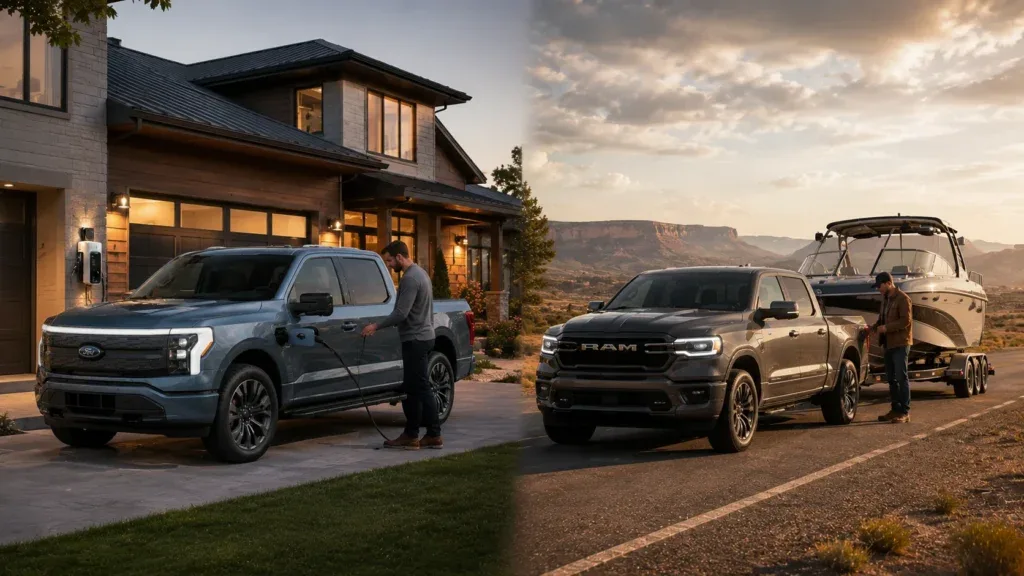
The Bottom Line The 2026 F-150 Lightning and Ram 1500 Ramcharger are not the same kind of truck. The Lightning is a straightforward electric pickup that works best for owners with home charging and realistic towing needs. The Ramcharger is a range-extended EV built to solve the two biggest objections to electric trucks: range and heavy-duty towing.
Ford has the advantage of years of customer data and a lower entry price. Ram is betting that a generator-equipped electric truck will feel more like a traditional pickup when the work actually starts. Both will sell. The interesting part of the war is that they are attacking the problem from opposite directions.
If you need a truck that can leave home, tow a trailer across several states, and never hunt for a charger, the Ramcharger is the more complete answer on paper. If you want the cleanest, simplest electric truck experience and can live within its range, the Lightning remains the more proven and more affordable choice.
Which approach do you trust more for real truck work — a big battery or a battery plus a gas generator?