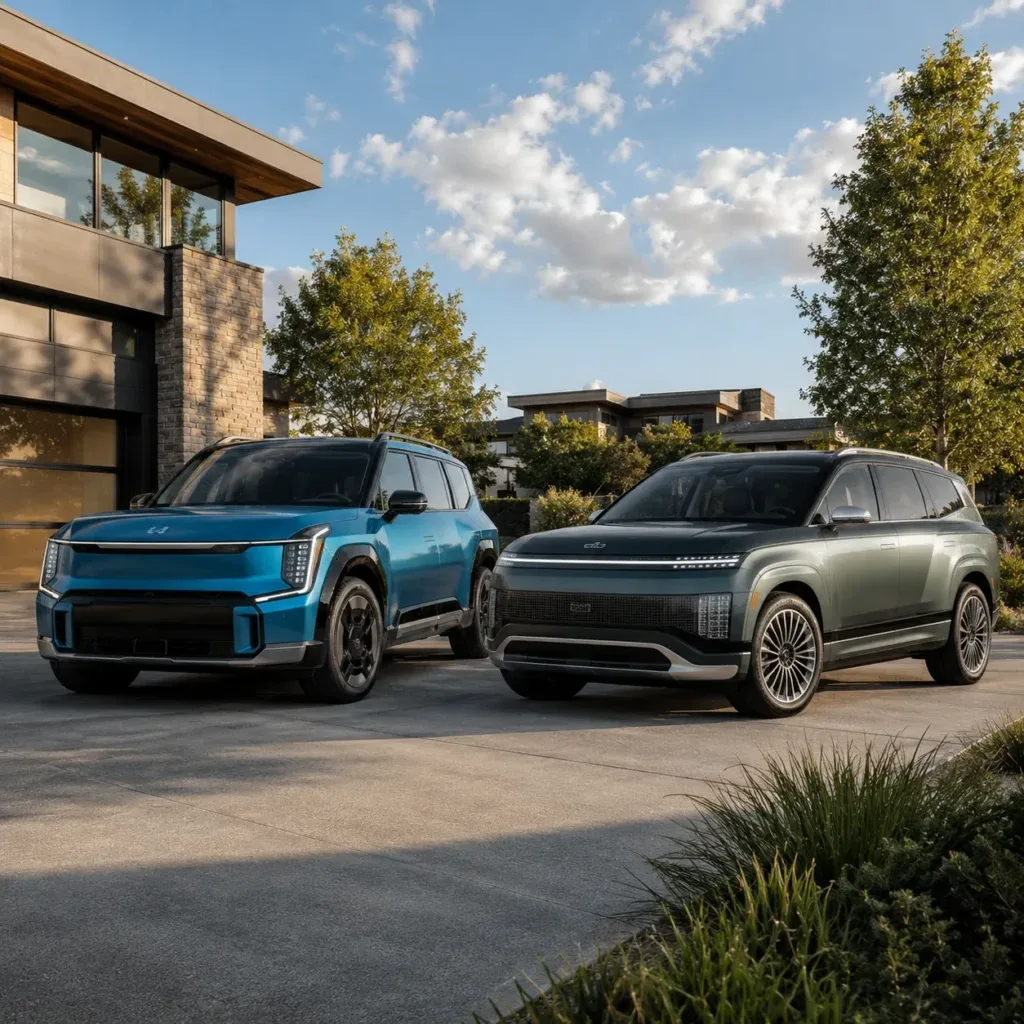
Hyundai and Kia share a kitchen. They do not share a sticker.
The 2026 EV9 Light still opens at $54,900 before destination — roughly $56,500 with freight on common quotes. Long-range Light dropped into the high $57,000s. Wind and Land climb through the $60s. GT-Line tops out around $72,000 before dest.
The 2026 Ioniq 9 S is $58,955 plus $1,600 destination: $60,555. That is the Georgia-built three-row with a 110.3 kWh pack and an EPA 335 miles on rear drive. SE AWD is about $64,300–$64,400 with dest — still the under-$65,000 conversation if you stay off Calligraphy.
Same parent. Two answers. September lots have been throwing $10,000 customer cash at both nameplates. Ignore MSRP theater until you see the signed pencil.
Range Is the Real Split
Ioniq 9 does not offer a short-range battery. Every trim is the big pack. S RWD: 335 miles. SE/SEL AWD: 320. Performance 21-inch cars: 311. Independent tests have shown the Hyundai stretching farther than the sticker when you drive like a parent, not a press car.
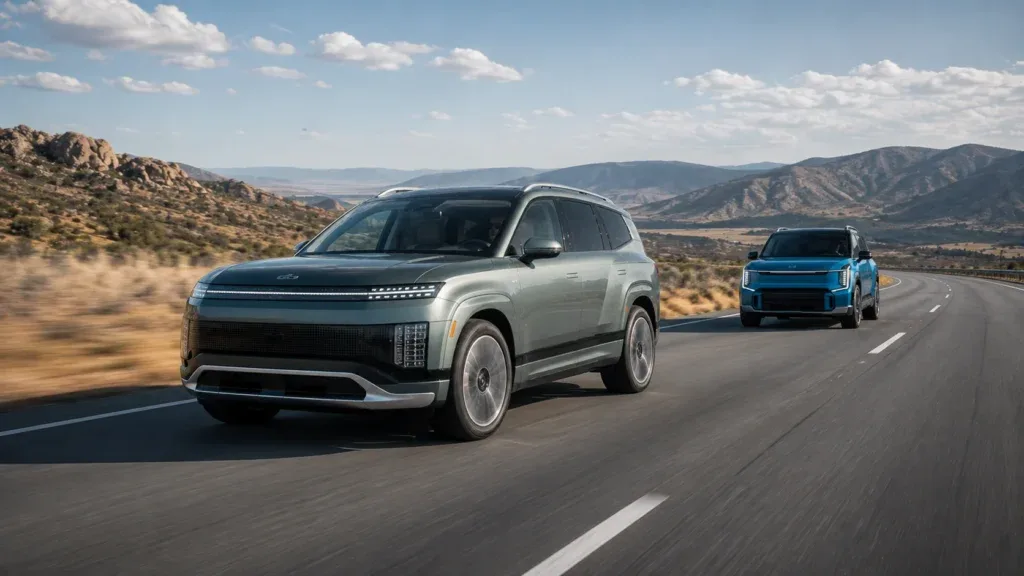
EV9 still sells a 76 kWh-class Light that EPA-rates around 230 miles. That is a grocery EV with a third row, not a vacation EV. Long-range EV9 uses up to a 99.8 kWh pack and tops out about 305 miles. Dual-motor cars make 379 hp and 516 lb-ft. Fast. Thirstier.
If your week is 40 miles and a Level 2 in the garage, the cheap EV9 Light wins on money. If you do Atlanta to the beach with kids and a cooler, the Ioniq 9 S is the one that does not turn the last hour into a charger app.
Cabin and the Third Row
EV9 is the box. Telluride energy. Seven seats on every trim. Captain’s chairs if you want six. The second row is the reason people cross-shop it with a gas three-row.
Ioniq 9 is the smoother one — longer hood, less refrigerator. Six or seven depending on trim. Georgia Metaplant build is the sentence Hyundai will say twice. EV9 production is a different map. “Assembled in America” is not trivia after a year of tariff talk. It is resale and parts.
Both get NACS. Both can 10–80% in the mid-20-minute range on a real 350 kW cabinet. Superchargers will be slower than the brochure. Home 240-volt is how families actually live.
Warranty is the same speech: 10-year/100,000-mile battery language on both if you stay inside the booklet.
Price After the Dealer
Four grand on the window is not four grand on the check. Ioniq 9 and EV9 have been living on the same incentive sheet all summer — fat lease cash, $10,000 purchase cash on some scans, 0% when the captive is hungry.
Out-the-door on a loaded Wind versus a loaded SE is the comparison that matters, not Light versus S. A $56,000 EV9 Light with 230 miles is not a $60,000 Ioniq 9 S with 335. Those are different cars.
Performance Ioniq 9 at 422 hp is the hot one. EV9 GT-Line is the styled one. Neither is the family answer. The family answer is the mid pack you can charge at the in-laws’.
The One Answer
Buy the Ioniq 9 S or SE if you want one battery, 300-plus miles on every window sticker, and a Georgia VIN. That is the three-row EV that replaced the excuse.
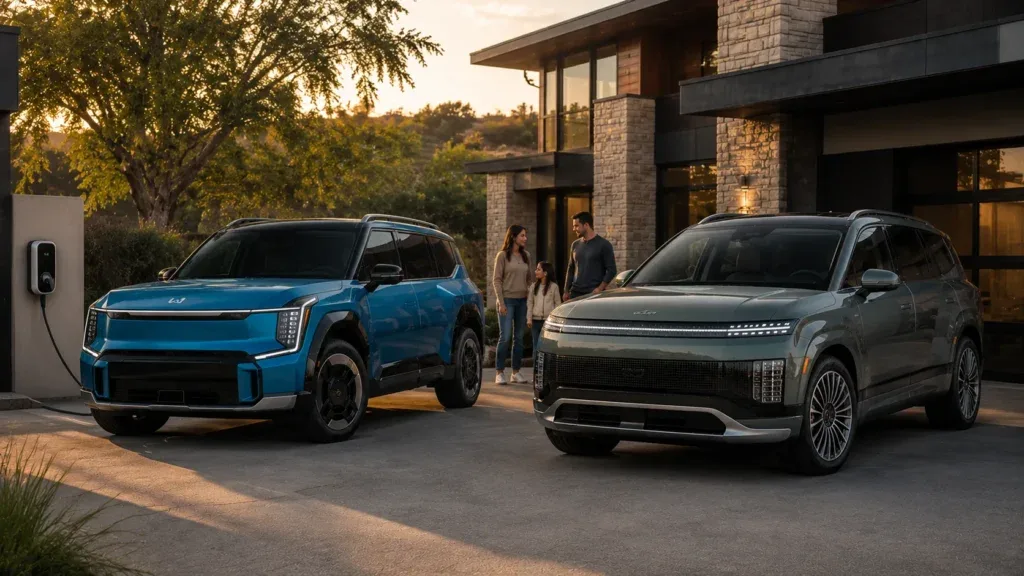
Buy the EV9 Light Long Range or Wind if the dealer is $4,000 cheaper after cash, you want seven seats without a package hunt, and 300 miles is enough.
Do not buy the short-range EV9 Light unless your life is a suburb and a 240-volt plug. Three-row range anxiety is just minivan math with a prettier app.
Same family. One winner per driveway. Range if you travel. Invoice if you don’t.
Would you pay $4,000 more for 30 extra EPA miles and a Georgia plant — or take the EV9 and the cash?
Related: EV vs Gas Savings Calculator