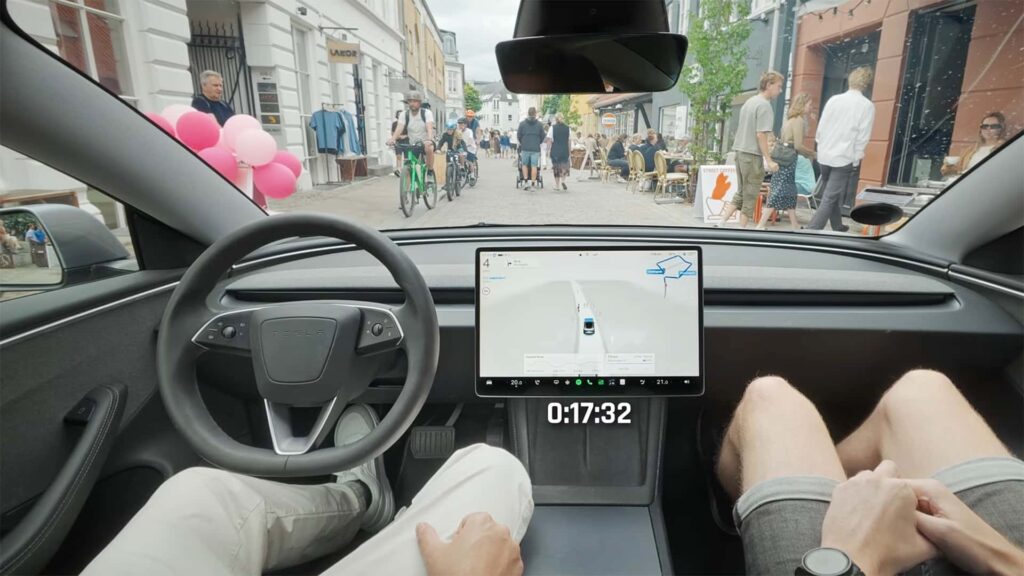
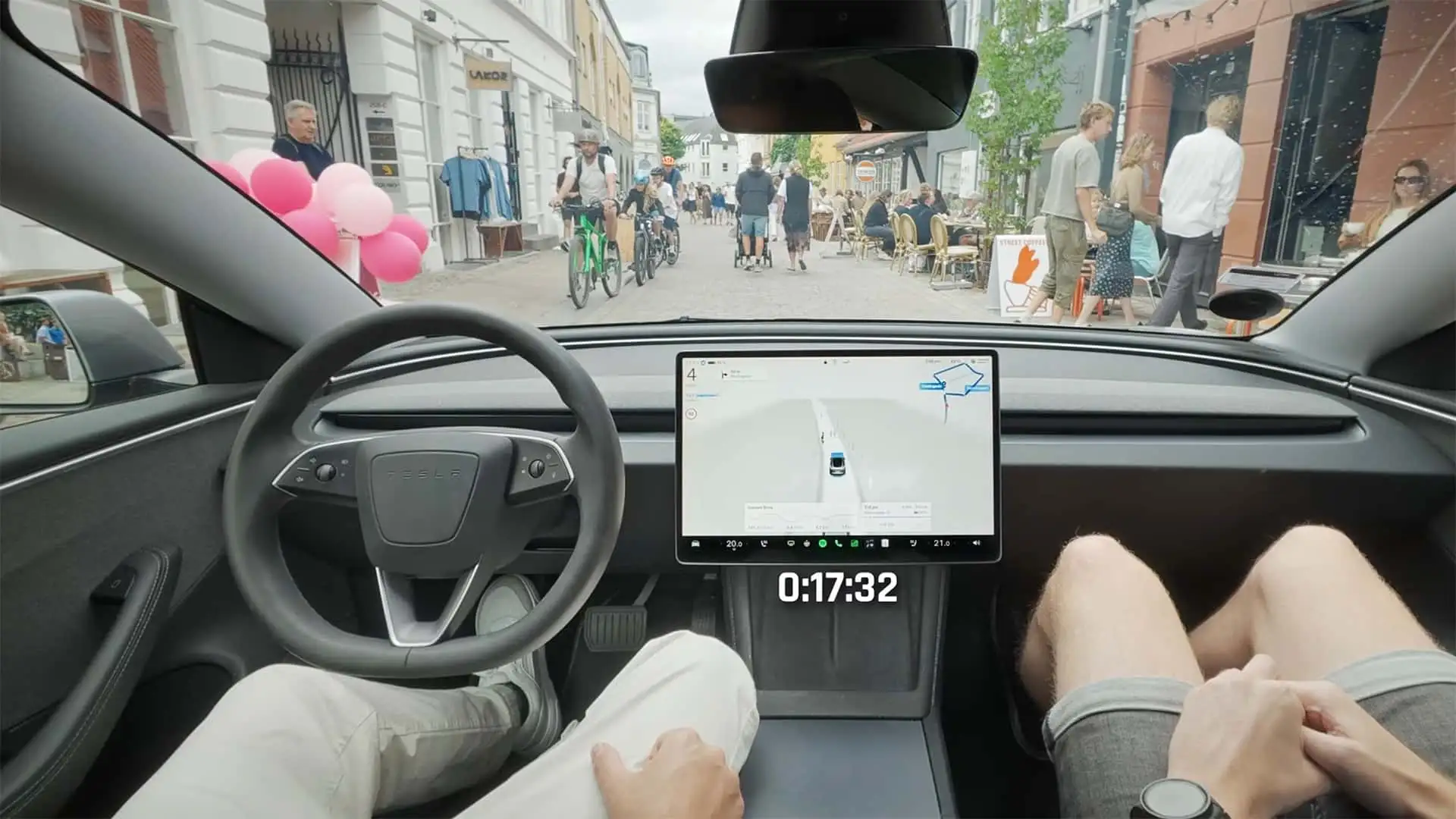
Tesla FSD: The math on Tesla’s Full Self-Driving beta just got a lot more interesting: zero human interventions across a 100% urban route completion on narrow Danish streets shared with cyclists and pedestrians. That’s not a highway cruise with a clear lane. That’s Copenhagen’s chaotic ballet of bike messengers, cobblestones, and sudden crosswalks—and the software apparently didn’t flinch. But before you wire $8,000 to Tesla’s coffers, let’s pump the brakes. This impressive European demo might be the worst possible predictor of how FSD will perform on your morning commute through Atlanta or Phoenix.
Watching FSD v12 thread a needle between a parked delivery truck and an oncoming cyclist is genuinely impressive. The system handled narrow streets, roundabouts, and pedestrian crossings without a single disengagement. Full stop. That’s a level of urban competence that didn’t exist in earlier versions, which would have panicked at the first sight of a bike lane.
But here’s the rub: European traffic is fundamentally different from American roads. Danish drivers follow strict right-of-way rules, cyclists are predictable in their dedicated lanes, and the infrastructure is designed for density, not speed. The software isn’t just learning to drive—it’s learning a specific cultural dance. Ask yourself this: when was the last time a US driver signaled before changing lanes, let alone yielded to a cyclist without being forced to?
The demo proves FSD can handle one of the world’s most challenging urban environments. It doesn’t prove it can handle a strip mall parking lot in Ohio where the lines have faded and a lifted truck blocks your sightline. Those are two completely different problem sets.
The $8,000 Question Nobody Wants to Answer
Let’s talk money, because that’s where FSD gets uncomfortable. The upfront $8,000 purchase price or $99 monthly subscription is just the entry fee. The real cost comes when you factor in insurance premiums that may spike because your car has autonomous hardware that hasn’t been crash-tested in European traffic. Insurers don’t like unknowns, and Tesla hasn’t disclosed FSD’s safety record in these conditions.
Consider the hardware too. Those cameras and sensors aren’t cheap to replace. A fender bender that would cost $2,000 on a Honda Civic could easily run $5,000+ on a Tesla because the calibration and parts are proprietary. The monthly subscription adds up to $1,188 annually, which buys a lot of Uber rides for the days you don’t trust the software.
And The trade-off is clear: that Tesla won’t put in a press release: FSD still requires driver supervision. That means you’re paying thousands for a system that demands your attention anyway. The math doesn’t lie. It just isn’t pretty.
Who Should Actually Buy This Beta
Let’s be brutally honest about the target buyer. FSD beta is for tech enthusiasts with disposable income who treat software like a hobby. If you have a $50,000+ annual income earmarked for toys, a short commute, and genuine curiosity about AI development, this might be worth the gamble. You’re essentially paying to be a beta tester, and that’s a legitimate choice for early adopters.
But families relying on their car for school runs, grocery trips, and weekend errands should walk away. Not because FSD is dangerous—the Danish demo suggests it’s capable—but because it’s not finished. You can’t trust it fully in dense urban environments, and the consequences of a misread intersection with kids in the back seat are too severe to gamble on software updates.
What about the financial stakes? Beyond the subscription, you’re betting that Tesla continues improving FSD at its current pace. If development stalls or regulators crack down, you’re stuck with a $8,000 option that doesn’t deliver full autonomy. That’s a risky bet on a company that’s notorious for overpromising timelines.
The Counter-Intuitive Truth About US Roads
Here’s the twist that changes everything: FSD’s success in Denmark may actually hurt its prospects in America. European roads are designed with clear hierarchies—pedestrians, then cyclists, then cars. US roads are a free-for-all where a cyclist might be on the shoulder, the sidewalk, or the wrong way down a one-way street. The software learned Danish discipline, not American chaos.
Consider infrastructure differences. Danish intersections have dedicated turn lanes, protected bike paths, and traffic calming measures that reduce speeds. American cities often have six-lane arterials with 45 mph speed limits, no bike lanes, and drivers who treat red lights as suggestions. FSD’s neural network trained on European data may not generalize to these conditions.
So what does that mean for your purchase decision? It means the Danish demo is a technical achievement, not a promise of performance. The system that navigated Copenhagen flawlessly might struggle in a place like Houston, where the roads are wider, faster, and far less predictable. Don’t let a viral video convince you otherwise.
The Verdict: Buy the Car, Skip the Beta
Here’s my decisive take: Tesla makes excellent electric vehicles, and you should absolutely consider one for your next purchase. But FSD beta at $8,000 or $99 monthly is a speculative investment in software that hasn’t proven itself on American roads. Wait for the safety data, wait for regulatory approval, and wait until Tesla takes liability for its system. Until then, the standard Autopilot features are more than adequate for highway driving, and you’ll save thousands on a bet that might not pay off. The Danish demo is impressive. Your commute is different. Don’t confuse the two.
Frequently Asked Questions
Q: How much does Tesla FSD cost?
Tesla FSD costs $8,000 upfront or $99 per month subscription. This price may increase with future updates.
Q: When will Tesla FSD be fully autonomous?
Tesla has not announced a specific date for full autonomy. Currently, FSD requires active driver supervision and is not fully self-driving.