
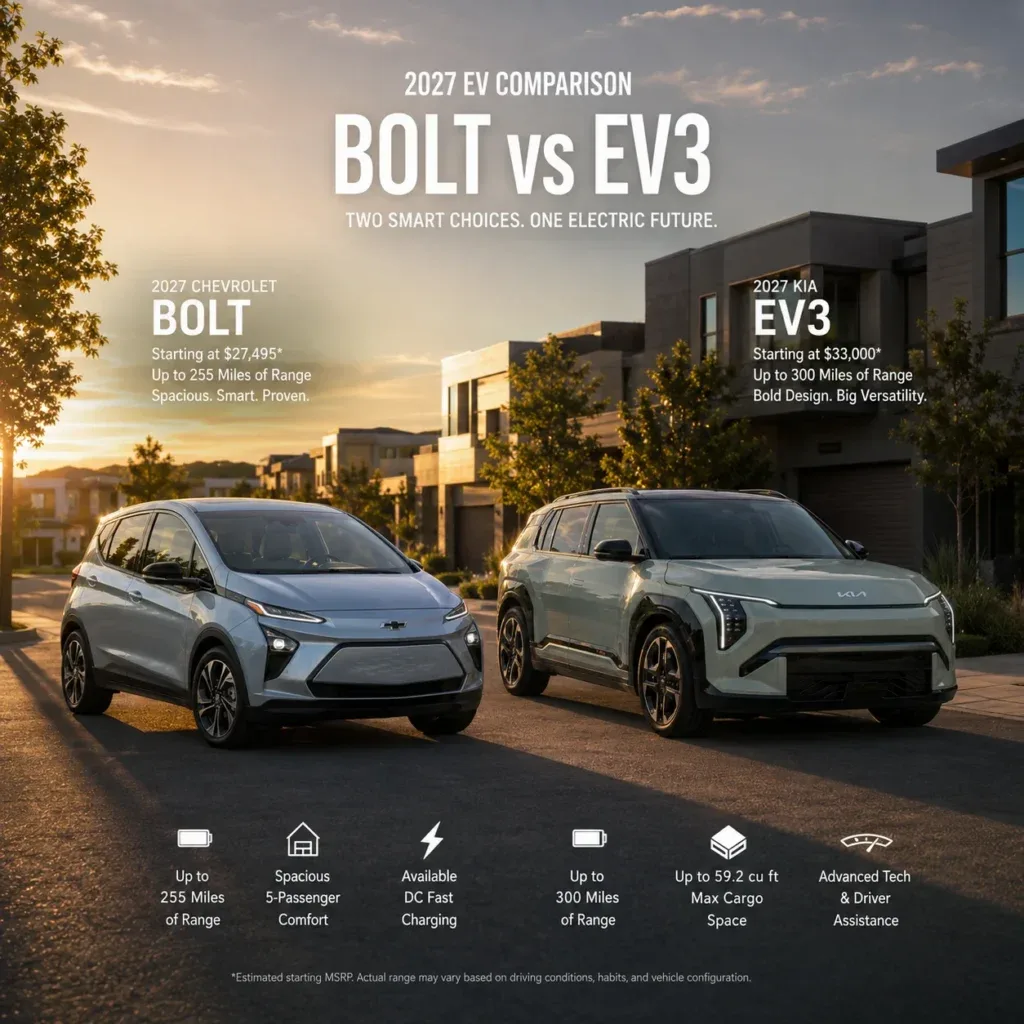
Most EV comparisons live in a world that most Americans can’t afford.
Tesla Model Y vs Ioniq 5. BMW iX3 vs Genesis GV70. Rivian R2 vs Porsche Cayenne Electric. All excellent cars. All starting at $45,000 or more.
The comparison that matters for the majority of American families who are genuinely considering their first EV is different. It sounds like this:
“I have $30,000-$35,000. I want an EV. What do I actually buy?”
In 2026, that question has two real answers. The 2027 Chevrolet Bolt at $27,600. And the Kia EV3 arriving late 2026 at around $35,000.
Here’s the honest breakdown.
The Numbers
| 2027 Chevrolet Bolt | Kia EV3 Long Range AWD | |
|---|---|---|
| Starting Price | $27,600 | ~$35,000 |
| EPA Range | 300 miles | 320 miles |
| Horsepower | 200 HP | 215 HP |
| Peak Charging | 150 kW | 120 kW (400V) |
| AWD Available | No | Yes |
| Built | Orion Township, MI | South Korea |
| Bidirectional Charging | Yes (optional) | Yes (standard) |
| Available | Now | Late 2026 |
The Bolt is $7,400 cheaper and available right now. The EV3 has AWD and arrives in six months.
That’s the entire comparison in two sentences for most buyers. But the details matter.
also read : https://driveglobalnews.in/top-5-family-cars-in-2026-that-are-actually/
The Case for the Chevy Bolt — Buy It This Weekend
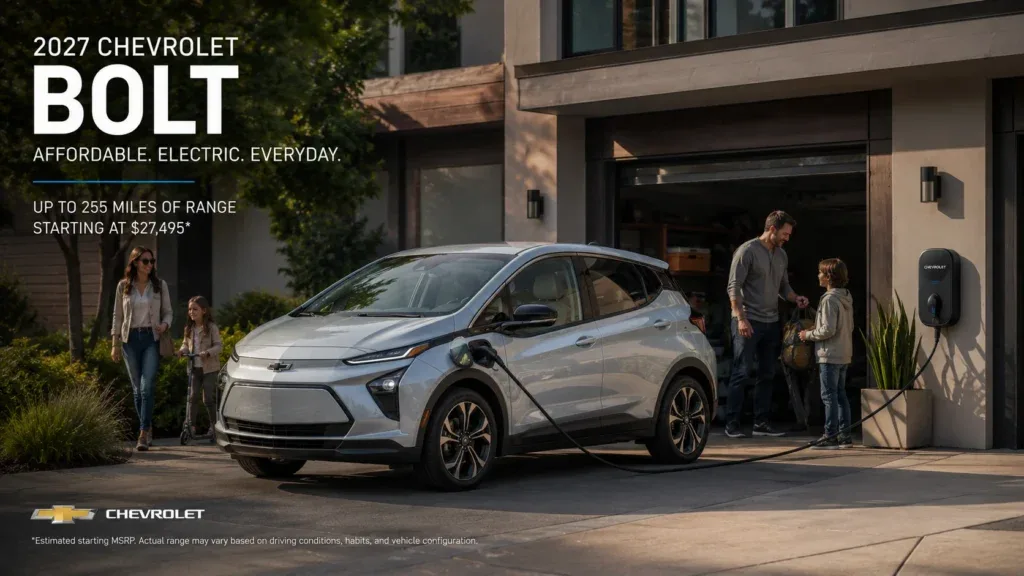
$27,600 for a car with 300 miles of range, bidirectional home charging, and a heat pump that actually works in winter.
The 2027 Bolt fixed the things that made the old Bolt frustrating. 150 kW DC fast charging — up from 55 kW on the previous generation. A heat pump that prevents the cold-weather range collapse that made early Bolts miserable in Minnesota winters. An LFP battery that degrades less over time and handles repeated fast charging better than the old chemistry. And GM’s first mainstream bidirectional charging setup — meaning with the optional $2,371 package, your Bolt can power your house during an outage.
At $27,600, the math for a first-time EV buyer is genuinely compelling. Monthly payment on a 60-month loan at 6.5%: approximately $540 per month. At $4.50 gas and 15,000 annual miles, the fuel savings versus a 28 MPG gas car: roughly $1,620 per year. The Bolt essentially earns $135 per month in fuel savings — reducing the effective monthly cost to around $405.
That’s the cheapest real EV in America right now. And “real EV” is doing real work in that sentence. 300 miles of range is genuinely adequate for almost every American’s daily life.
The honest limitations: FWD only. No AWD option at any price. 150 kW charging, while a massive improvement, is still slower than the Ioniq 5’s 350 kW. The interior is comfortable but nobody is going to call it premium. This is a practical, sensible, excellent-value EV. It is not exciting.
Buy the Bolt if: You want to buy an EV right now. Budget is real. AWD isn’t necessary where you live. You charge primarily at home.
also read : https://driveglobalnews.in/2026-subaru-uncharted-the-36000-electric-suv/
The Case for the Kia EV3 — Wait Six Months
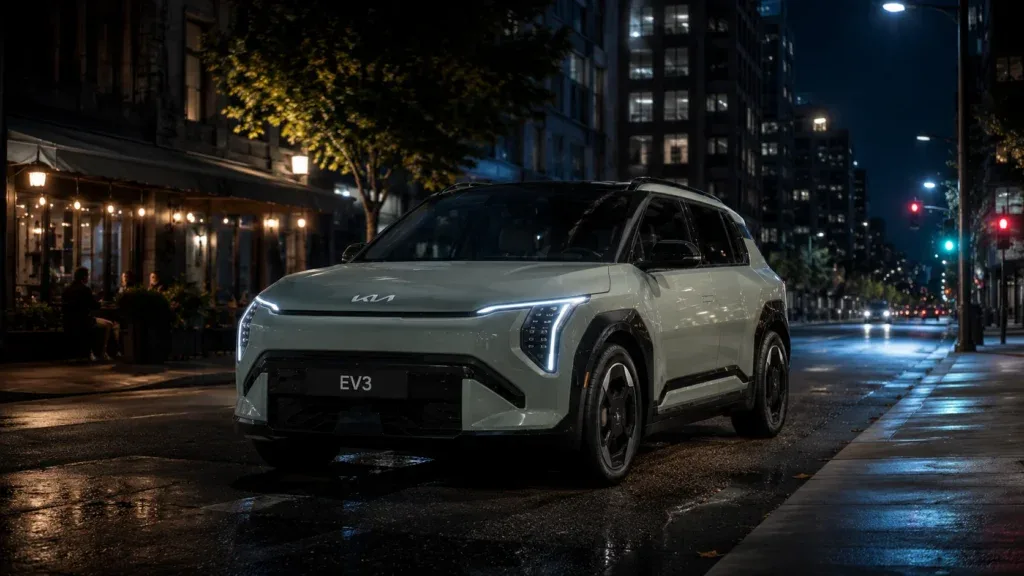
The EV3 doesn’t exist yet in American showrooms. It’s confirmed for late 2026 delivery at around $35,000 for the base FWD model, rising to approximately $40,000-$45,000 for the Long Range AWD — the variant that makes the most sense for buyers who want to justify choosing EV3 over Bolt.
For the buyer who needs AWD — Minnesota, Vermont, Colorado, mountain states where winter driving demands all-four traction — the EV3 AWD is the argument. The Bolt FWD simply isn’t an option for that buyer. The EV3 Long Range AWD at ~$40,000-$42,000 with 290-300 miles of AWD range is the affordable AWD electric SUV that didn’t exist six months ago.
The interior is the other argument. EV3’s cabin was designed for the 2026 market — large curved display, twist gear selector, materials that feel genuinely premium for the price. The Bolt is honest about being a value-focused car. The EV3 is genuinely impressive inside for its price.
V2L (Vehicle-to-Load) bidirectional charging comes standard on every EV3 — not as a $2,371 option like on the Bolt. For camping families, remote workers, or anyone in storm-prone areas who wants their car as an emergency power source — that’s a real daily-life advantage.
Wait for the EV3 if: You need AWD. You want a more premium interior. You’re in no rush to buy right now. And you can wait until late 2026 for delivery.
The One Question That Decides It
Do you live somewhere that requires AWD?
If yes — wait for the EV3. There’s no other affordable AWD electric SUV at this price doing what the EV3 does.
If no — buy the Bolt. Seven thousand dollars is not a small difference. The Bolt is available today, has 300 miles of range, charges at 150 kW, and will outlast most buyers’ patience with any car. It is not the most exciting vehicle on the road. It is a genuinely good car at an unprecedented price for an EV.
In 2026, with gas at $4.50 and family budgets squeezed by inflation — the Bolt at $27,600 is the most financially democratic EV in American history.
The EV3 is a better car. The Bolt is the right car for more people right now.
Check your monthly payment on either one with our Car Loan EMI Calculator.