
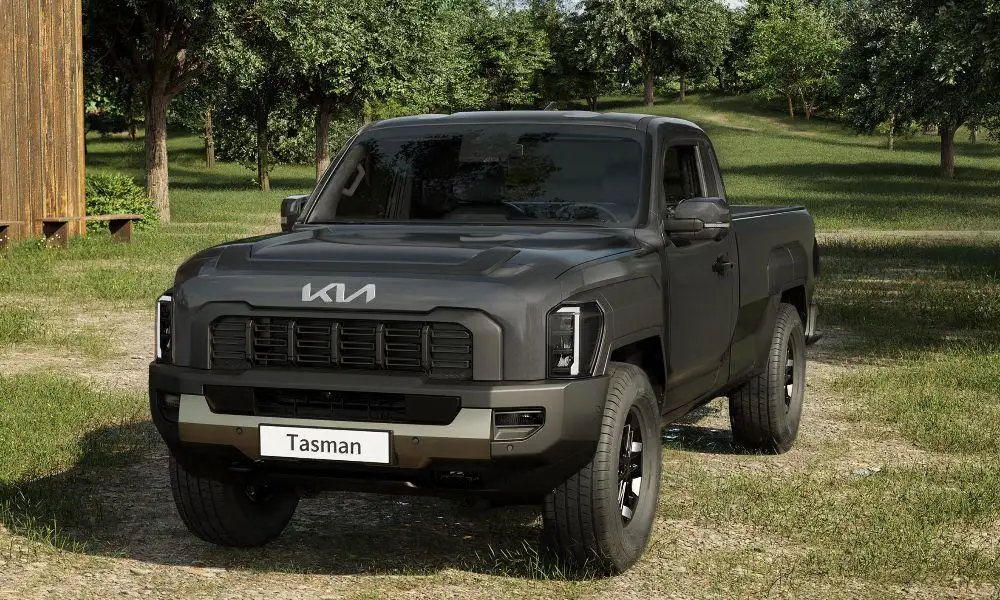
The American pickup truck market has a new challenger. At Kia’s 2026 CEO Investor Day held in Seoul on April 9, company president and CEO Ho Sung Song made a bombshell announcement: Kia will launch a US-specific midsize body-on-frame pickup truck by 2030, with hybrid and extended-range electric powertrains. The company is targeting 90,000 annual sales in North America and a 7% share of the midsize pickup segment by 2034.
This is not a test balloon. Kia entered the global pickup market last year with the Tasman truck in Australia and other markets, and it has been watching the North American landscape carefully. Now, with sister brand Hyundai having just revealed the Boulder Concept — a body-on-frame truck preview at the 2026 New York Auto Show — both Korean giants are mounting a coordinated assault on America’s most profitable vehicle segment.
Why Kia Is Entering the Truck Market Now
The timing of Kia’s announcement is no accident. The midsize truck segment in the U.S. has been one of the fastest-growing vehicle categories for the past decade. What was once a niche dominated only by the Toyota Tacoma and Nissan Frontier has exploded into a fiercely competitive battlefield with the return of the Ford Ranger, the revived Chevy Colorado and GMC Canyon, the Jeep Gladiator, and emerging entries like the Scout Terra.
Kia CEO Song was direct about the opportunity: “Accounting for approximately 20% of total demand, the U.S. pickup market represents a key strategic segment.” For a brand targeting 1.02 million annual U.S. vehicle sales by 2030 — up from 852,155 in 2025 — entering the truck segment is not optional. It’s essential.
The midsize segment is particularly attractive because it sits at a sweet spot of capability and practicality. These trucks are large enough to tow a camper or carry a load of lumber, yet compact enough to navigate city parking and suburban driveways. They attract a diverse buyer base: contractors, outdoor enthusiasts, young families, and anyone who wants truck utility without full-size truck dimensions.
What Kind of Truck Will It Be?
Kia confirmed several important details during the investor day:
Body-on-frame construction. This is the key architectural commitment. Unlike the Hyundai Santa Cruz — Kia’s corporate cousin’s unibody mini-truck that prioritizes car-like handling over pure payload capacity — Kia’s North American truck will sit on a traditional ladder-frame chassis. This is the same architecture used by the Tacoma, Ranger, Colorado, and every serious American truck. It enables superior towing capacity, better durability under heavy loads, and genuine off-road capability.
Hybrid and EREV powertrains. Kia is not building a traditional gas truck. The company confirmed both a conventional hybrid electric (HEV) powertrain and an extended-range electric vehicle (EREV) option. The EREV setup is particularly interesting — it’s a configuration where a gasoline engine charges the battery pack but never directly drives the wheels. This gives buyers EV-like daily driving on electricity, with a gas engine eliminating range anxiety for long hauls or heavy towing. Ram has recently pivoted to a similar EREV strategy with the Ram REV, and it’s an increasingly popular choice in the electrified truck space.
At least one US-built variant. With the infamous Chicken Tax imposing a 25% tariff on foreign-built pickup trucks, building in North America isn’t just patriotic — it’s an economic necessity. Kia’s Georgia plant (Kia AutoLand Georgia) is the likely production home for at least one trim level, possibly all. Hyundai has already committed to building its Boulder-based truck from American steel in America, and Kia is expected to follow the same path.
Shared platform with Hyundai. The Kia truck will share its body-on-frame architecture with Hyundai’s upcoming Boulder-derived production pickup. This platform-sharing strategy lets both brands spread development costs while tailoring their trucks to distinct customer profiles — Hyundai leaning into off-road adventure identity, Kia potentially emphasizing technology, value, and daily usability.
The Competition: A Crowded But Lucrative Field 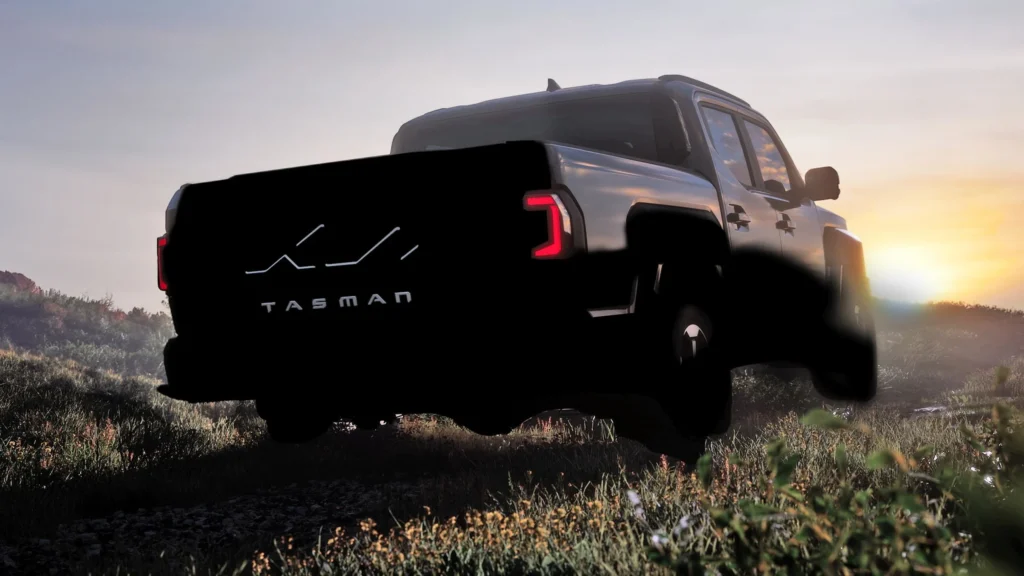
By the time Kia’s truck arrives by 2030, the midsize pickup landscape will look dramatically different from today. Here’s what Kia will be competing against:
Toyota Tacoma — still the segment benchmark with legendary reliability, now available with hybrid powertrains. The most loyal customer base in the segment.
Ford Ranger — strong seller with Raptor off-road variant and good brand recognition. Available with hybrid option.
Chevy Colorado/GMC Canyon — General Motors’ solid mid-sizers with strong ZR2 off-road variants.
Jeep Gladiator — the only open-air convertible truck, fiercely loyal Jeep fanbase.
Scout Terra — Volkswagen’s newly revived Scout brand is entering with all-electric and EREV versions of the Terra truck, a direct rival to Kia’s planned EREV setup.
Hyundai Boulder Truck — Kia’s own corporate sibling. Both brands will be competing in the same segment from the same parent company, likely differentiated by price point, styling, and powertrain emphasis.
Does Kia Have What It Takes?
The skeptical view: Kia has never sold a pickup in America. Truck buyers are famously brand loyal, and earning their trust is a multi-decade process. The Kia Tasman’s early struggles in Australia — the brand aimed for 20,000 annual sales but moved only 3,700 by mid-2025 — raise legitimate questions about execution.
The optimistic view: Kia is not the brand it was ten years ago. It has consistently won J.D. Power reliability awards, built a passionate American customer base with the Telluride, Sportage, and EV6, and shown a genuine ability to disrupt segments it enters. The EV3 at $35,000 is positioned to do exactly that in the compact electric space. A well-designed, competitively priced hybrid truck with Kia’s technology reputation could attract buyers who are curious about going Korean but haven’t had a truck option.
The EREV powertrain angle is potentially the brand’s biggest differentiator. If Kia can offer a midsize truck that runs on electricity for most daily driving, eliminates range anxiety on longer hauls, and delivers genuine towing capability — at a price below the Rivian R1T — it fills a market gap that nobody has cleanly addressed.
Whether Kia can shake up America’s most conservative vehicle segment remains the open question. But with the announcement now official and the 2030 clock ticking, the truck wars are about to get a lot more interesting.
Comparing what a hybrid truck would cost to operate versus a gas or electric pickup? Our EV vs Gas Cost Calculator gives you real numbers. Our Road Trip Cost Calculator shows fuel costs on your regular long drives. And our Car Ownership Cost Calculator breaks down total annual cost of ownership so you can compare apples to apples.