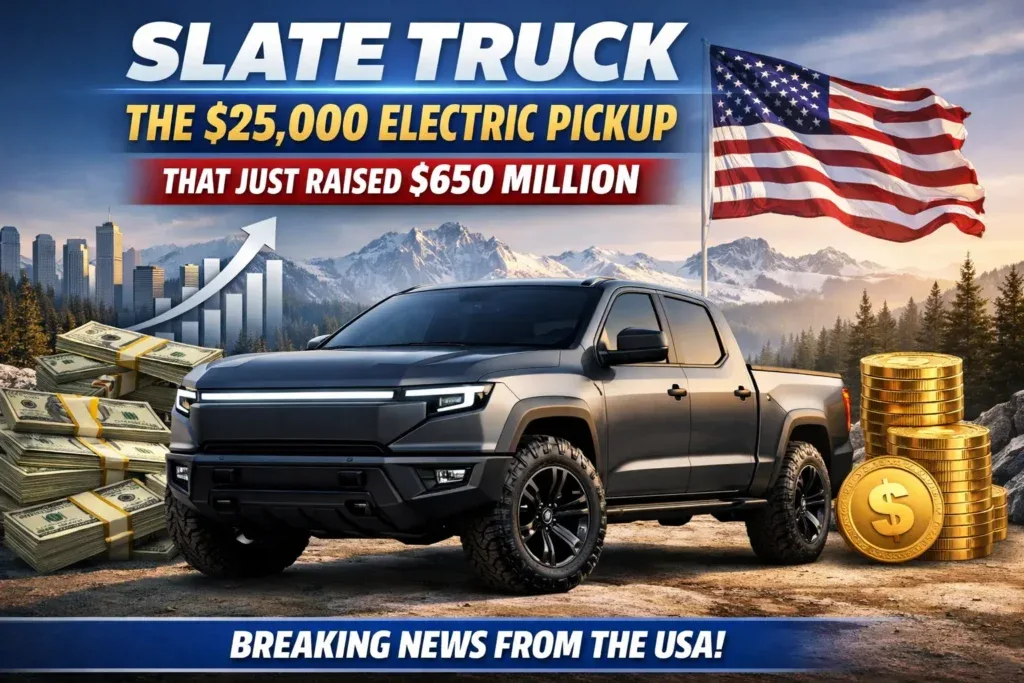
Slate Truck: The $25,000 Electric Pickup : The most talked-about electric vehicle of 2026 might be one you’ve never heard of — and that’s by design. Slate Auto, an EV startup backed by Amazon founder Jeff Bezos and a roster of serious tech investors, just raised $650 million in a Series C funding round on April 14, 2026, bringing its total funding to approximately $1.4 billion. The company has a single goal: build a genuinely affordable electric pickup truck priced around $25,000 and begin deliveries in the United States by late 2026.
With over 160,000 reservations already on the books and a factory in Warsaw, Indiana being retooled for production, Slate Auto is no longer a concept. It’s a company about to make vehicles — and if it pulls it off, it could reshape the entire affordable EV conversation.
What Is the Slate Truck?
The Slate Truck is a minimalist, modular electric pickup designed from scratch with one primary objective: get the price as low as possible without sacrificing the core utility of a truck. It is not a premium adventure vehicle like the Rivian R2. It is not a tech showcase like the Tesla Cybertruck. It is a work truck — practical, stripped-down, and deliberately simple — built for buyers who need a pickup and want it to run on electricity.
The founding philosophy is worth understanding. Slate Auto was founded in 2022 and emerged from stealth mode in 2025. Its founding team includes Jeff Wilke, formerly the CEO of Amazon’s consumer business, and Peter Faricy, formerly Amazon’s Marketplace VP. The company’s DNA comes from Amazon — an organization famous for relentlessly driving costs down through operational efficiency and scale. That same approach is being applied to an electric vehicle.
The result is a truck that starts with only what a buyer needs. No giant touchscreen. No over-engineered suspension. No features added purely for marketing impact. The Slate Truck is built as a configurable base platform — buyers can add exactly the options they want post-purchase, a modular approach that keeps the entry price dramatically lower than rivals that bundle features buyers may not need.
One of the most notable configuration options: an SUV conversion kit that transforms the truck into a passenger SUV — giving buyers two vehicles in one, depending on what they need at any given time.
The Price: $25,000 — With an Important Asterisk 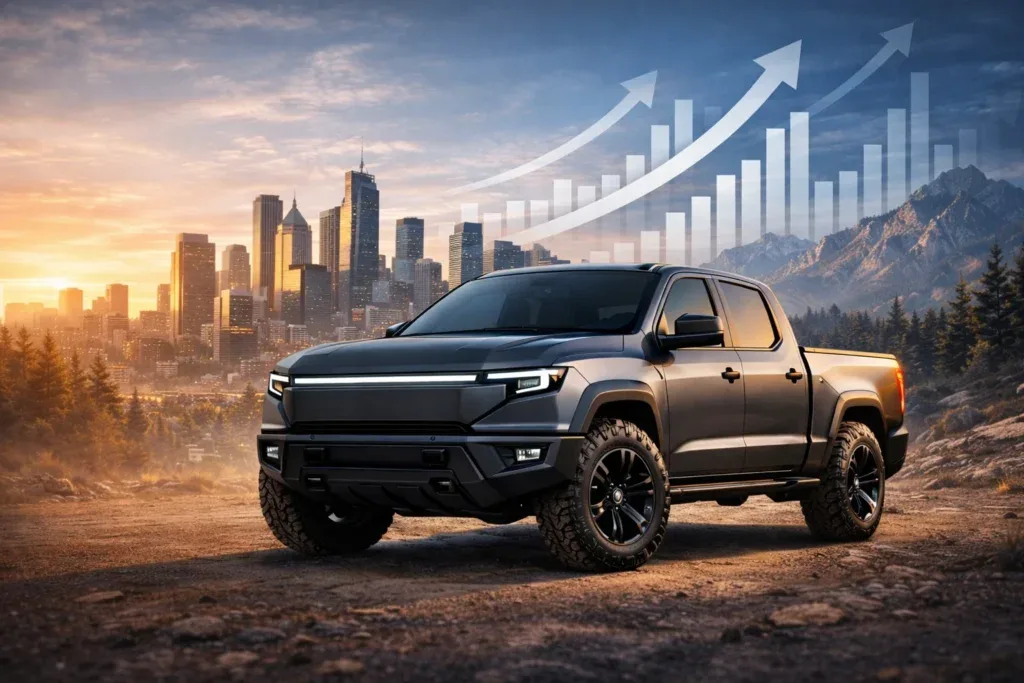
The target price of approximately $25,000 is what makes the Slate Truck headline news. For context, the next cheapest new electric vehicle in the U.S. right now is the Chevy Bolt at around $29,000, and the Nissan Leaf at $31,500. The Hyundai Ioniq 5 starts at $35,000 after its major price cut. The Rivian R2 Performance starts at $57,990. A $25,000 electric pickup would be genuinely transformative for EV accessibility in America.
Here is the important asterisk: Slate originally built its pricing model around the $7,500 federal EV tax credit that expired on September 30, 2025. With that credit gone, the effective out-of-pocket target has shifted upward to approximately $25,000 before state and local incentives — still a remarkable price point, but buyers in states without their own EV incentives will pay the full sticker.
Slate has confirmed it will announce the final manufacturer’s suggested retail price in June 2026, when customer pre-orders officially open. Given the company’s funding and production timeline, that announcement is just weeks away.
The Factory: Indiana, 2,000 Jobs, $400 Million Investment
Slate is retooling a former printing facility in Warsaw, Indiana into its manufacturing plant, with an expected investment of nearly $400 million. The project is projected to create more than 2,000 jobs in Kosciusko County and contribute an estimated $39 billion to Indiana’s economy over 20 years — numbers that have earned the company significant goodwill with state and local officials.
The Indiana location is strategically sensible. It’s within driving distance of major automotive supply chains centered on Detroit, and it positions Slate as a domestic American manufacturer — important both for avoiding import tariffs and for the marketing story of American-made electric trucks.
Production is targeted to begin by the end of 2026, with first customer deliveries following shortly after.
The Funding: $1.4 Billion and a Serious Investor List
The Series C round was led by TWG Global, the investment firm run by Guggenheim Partners CEO Mark Walter (who also owns the Los Angeles Dodgers and Chelsea FC) and investor Thomas Tull. TWG had previously led Slate’s $590 million Series B in 2024, indicating sustained confidence in the company’s direction.
Previous investors include:
- Jeff Bezos’ Bezos Expeditions — Bezos’ personal investment office
- General Catalyst — one of the most respected tech-focused VC firms in the U.S.
- Slauson & Co. — venture firm focused on underrepresented founders and communities
- Former Amazon executive Diego Piacentini
Total funding of $1.4 billion is significant — enough to fund factory retooling, vehicle development, and initial production ramp. For comparison, Rivian raised over $10 billion before its first delivery; Slate is attempting a far more capital-efficient approach by keeping the vehicle deliberately simple.
The Risk: Can It Actually Deliver?
Honest assessment: the EV startup graveyard is littered with companies that raised hundreds of millions and never delivered a single vehicle. Lordstown Motors, Fisker, Canoo, Electric Last Mile Solutions — all failed despite significant funding and genuine ambition.
Slate faces specific headwinds in 2026. EV demand in the U.S. is at 6.3% of the market — its lowest point since 2023, weighed down by the expiration of federal tax credits and persistent affordability concerns. Launching a new brand into this market is harder than launching into the 2021–2022 EV frenzy.
But Slate has several things going for it that many failed startups didn’t: a team with deep operational experience from Amazon, a product deliberately engineered for low-cost manufacturing, a factory already under construction, and 160,000+ reservations — proof of genuine demand even before pre-orders officially open.
The next three months will be defining. June’s pre-order opening and MSRP announcement will tell a lot about whether Slate has the pricing discipline and production readiness to turn those reservations into deliveries.
Curious whether a $25,000 electric truck makes financial sense vs. a gas pickup? Use our EV vs Gas Cost Calculator to run real numbers. Our Car Ownership Cost Calculator compares total annual costs, and our Car Loan EMI Calculator helps you estimate monthly payments before pre-orders open in June.