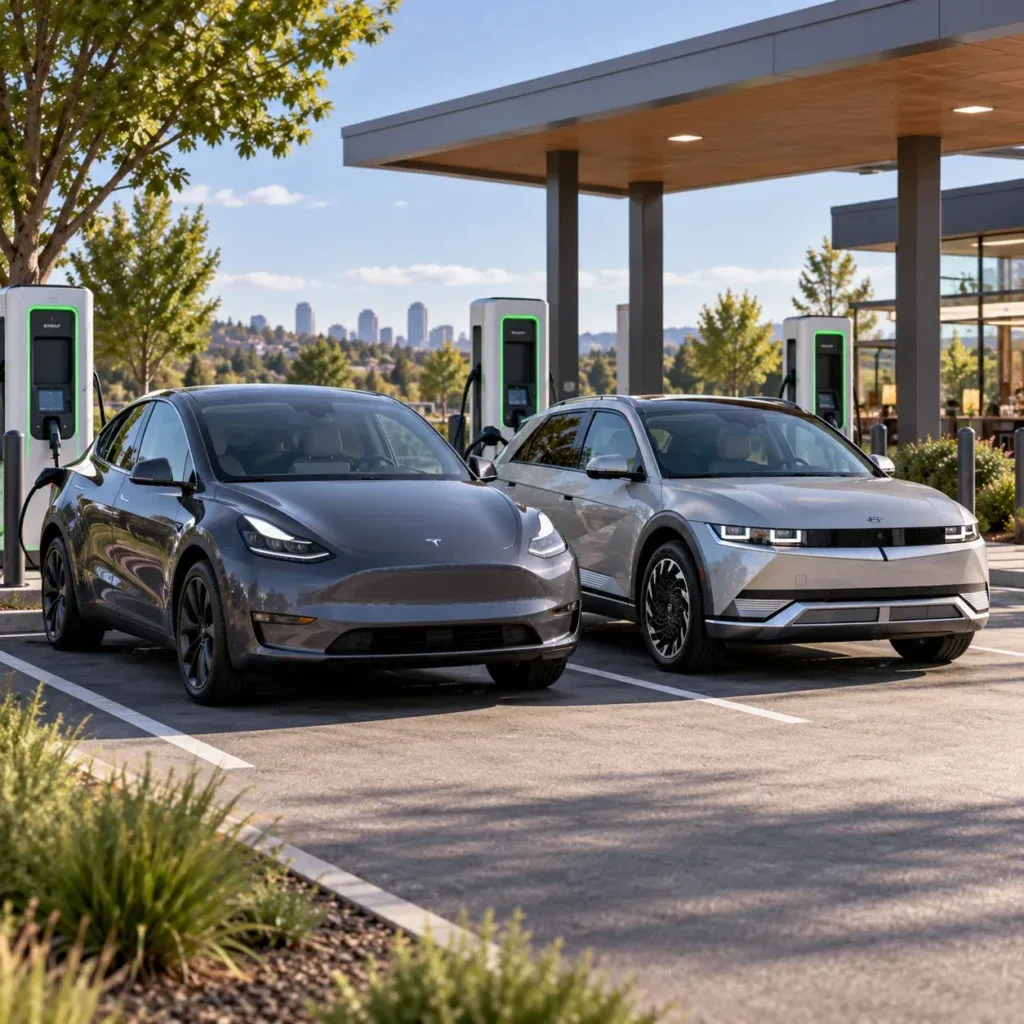
Tesla Model Y vs Hyundai Ioniq 5 : Let me be honest with you: I’ve driven both.
And while the Model Y has been the default choice for years—the best-selling EV on the planet, the safe bet, the one everyone buys—I think that default status has made a lot of people stop shopping. They just assume the Tesla is the right answer.
But something fundamental changed in 2026.
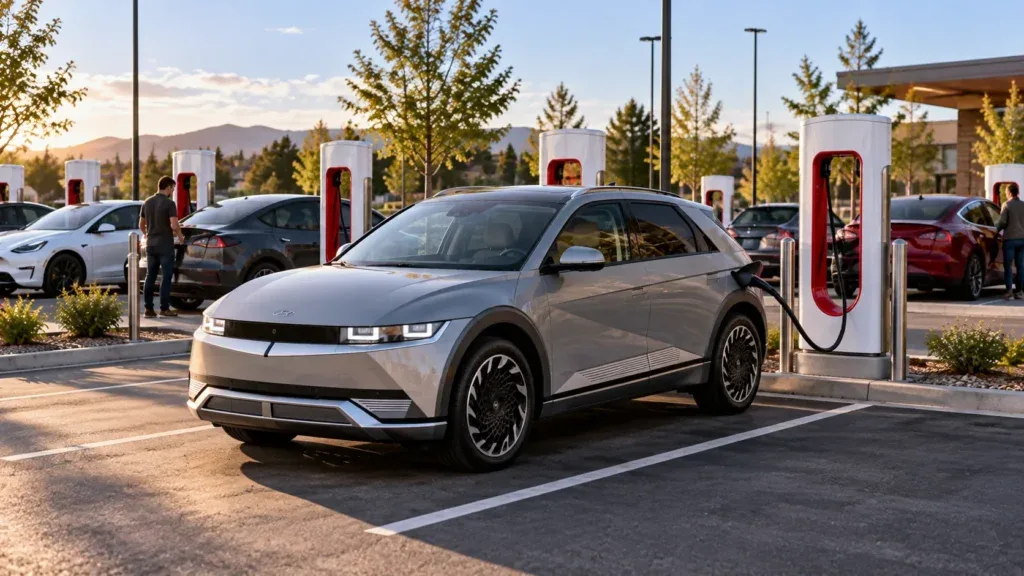
The Hyundai Ioniq 5 now plugs into Tesla Superchargers. Natively. No adapter. No workaround. Just plug and charge, exactly like a Tesla.
The moment that happened, the biggest reason to default to a Model Y lost most of its force. And the Ioniq 5’s advantages—which were always there—suddenly moved to the front of the conversation.
So here’s what I’d do with my own money. And why.
The Price Difference Is Bigger Than You Think
Start with the sticker.
The 2026 Ioniq 5 begins at $37,500. The Model Y starts at $44,990.
That’s a $7,490 difference before you add any options.
Now, the base Ioniq 5 SE Standard Range has a shorter range (245 miles) than the base Model Y (321 miles). And that gap is real—76 miles is significant.
But here’s where it gets interesting.
For $39,100, you can get the Ioniq 5 SE RWD with the larger 84 kWh battery. That gives you 318 miles of range for a price that’s still thousands below the Model Y.
And for $41,400, the Ioniq 5 SEL RWD adds wireless charging, power front seats, blind-spot collision-avoidance, and rear A/C vents—all at a price that undercuts the base Model Y by over $3,500.
So let’s be honest—if you’re shopping the $40,000 to $45,000 range, you’re not getting the same car at a similar price. You’re getting more car for less money. Full stop.
The Charging Story Changed
The Model Y’s trump card was always Supercharger access. That used to be a hard advantage that no competitor could match.
That’s gone now.
The 2026 Ioniq 5 has a native NACS port. It charges at Tesla Superchargers without an adapter.
Now let’s talk about speed. The Ioniq 5’s 800-volt architecture can charge from 10% to 80% in as little as 18 minutes on a 350 kW charger.
The Model Y’s 400-volt platform? It’s slower. Significantly slower.
So here’s the trade-off:
-
Model Y — longer range (up to 357 miles) and the largest charging network
-
Ioniq 5 — faster charging and now the same network access
Which matters more? If you road-trip constantly, the Model Y’s total range advantage matters. But for most people, the Ioniq 5’s faster charging—getting you back on the road 18 minutes after plugging in—is actually more practical for daily life.

The Ioniq 5 Does Things The Model Y Can’t
This is where the Hyundai really pulls ahead.
Vehicle-to-Load (V2L): The Ioniq 5 can power tools, appliances, or an entire campsite from its battery. The Model Y can’t do this at all.
Apple CarPlay and Android Auto: The Ioniq 5 has both. The Model Y forces you to live entirely in Tesla’s interface. For people who already have a phone setup they like, that’s a real downgrade.
Physical Controls: The Ioniq 5 has buttons. Actual buttons. You don’t have to dig through a touchscreen menu to adjust the climate or the radio. This seems small. It’s not.
The Warranty: Hyundai covers you for 5 years/60,000 miles bumper-to-bumper and 10 years/100,000 miles on the battery and powertrain.
Tesla offers 4 years/50,000 miles bumper-to-bumper and 8 years on the battery.
That extra two years of battery coverage? That’s real peace of mind.
Build Quality: Look, I’m going to say it. The Ioniq 5’s cabin feels better put together. Panel gaps are consistent. The materials feel premium. The retro-futuristic design actually has character rather than the Model Y’s “minimalist” (some would say sparse) interior.
Where The Model Y Still Wins
I want to be fair here. The Model Y isn’t losing this comparison across the board.
Range: The longest-range Model Y goes 357 miles. The Ioniq 5 tops out at 318. That’s a 39-mile difference. For people with long commutes or frequent road trips, that matters.
Software: Tesla’s app, route planning, and over-the-air updates are still a step ahead. The system is more mature. The interface is snappier.
Performance: The Model Y is quicker off the line. The AWD version hits 60 mph in 3.9 seconds. The Performance trim does it in 3.3 seconds. The Ioniq 5 AWD takes 4.4 seconds.
Resale Value: The Model Y holds its value better. That’s just the reality of being the best-selling EV in America.
The Bottom Line
The Tesla Model Y is still a great car. It has the range. It has the software. It has the network. If you road-trip constantly or resale value is your top concern, the Model Y is the defensible choice.
But for everyone else? The Ioniq 5 is the smarter buy.
It costs less. It charges faster. It has a better warranty. It has CarPlay. It has V2L. It has physical buttons. It has a more interesting design. And now it has Supercharger access too.
One car is the default. The other is the better value.
The question you have to answer isn’t which car has better specs. It’s which one fits the life you actually live. The Hyundai makes a stronger argument that it’s the one.
The real question was never whether the Ioniq 5 could compete. It was whether you were still waiting for permission to consider something other than a Tesla. That permission is granted. And you’d save thousands while you’re at it.