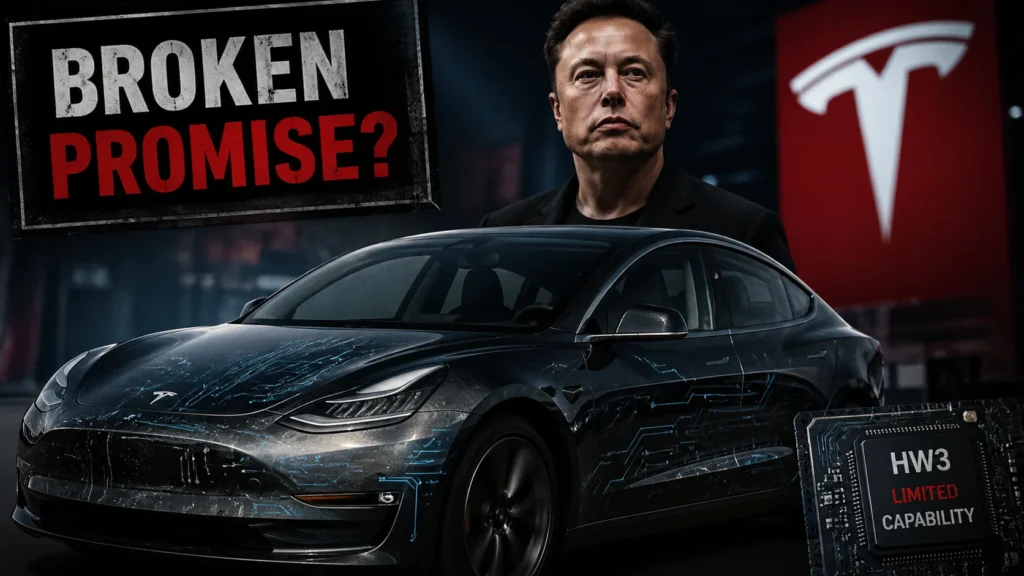
Tesla’s Biggest Broken Promise : For years, Tesla told its customers something very simple and very clear: every vehicle it sold contained the hardware necessary for full self-driving capability. Millions of people bought that promise. Some paid up to $15,000 for the Full Self-Driving software package on the strength of it. On April 22, 2026, at Tesla’s Q1 earnings call, Elon Musk finally said what had been becoming obvious for years:
“Hardware 3 simply does not have the capability to achieve unsupervised FSD.” THE SHOP
The admission is one of the most significant in Tesla’s history — not because it’s surprising to close observers, but because of what it means for the millions of owners who paid for FSD on Hardware 3 vehicles, and what Tesla is now offering them in response.
What Is Hardware 3 and Who Has It?
Tesla has used several generations of Autopilot/FSD computer hardware in its vehicles. Hardware 3 (HW3) launched in April 2019, and Tesla sold Full Self-Driving packages to owners on the understanding that the hardware was sufficient for full autonomy. Some owners paid between $8,000 and $15,000 for FSD during that period. CarBuzz
Tesla started installing Hardware 4 (AI4) computers in production vehicles in January 2023. CarBuzz That means every Tesla purchased between approximately April 2019 and early 2023 — a period of roughly four years — contains Hardware 3. Given Tesla’s sales volumes during that period, we are talking about millions of vehicles on U.S. roads today.
You can check which hardware generation your Tesla has by going to Controls > Software on the center touchscreen.
Why HW3 Cannot Do Unsupervised FSD: The Technical Explanation
Musk was unusually direct about the technical reason for the limitation. He stated: “Unfortunately Hardware 3 — I wish it were otherwise — but Hardware 3 simply does not have the capability to achieve unsupervised FSD. Relative to Hardware 4, it has only 1/8 of the memory bandwidth of Hardware 4. And memory bandwidth is one of the key elements needed for unsupervised FSD.” CarBuzz
Memory bandwidth is the rate at which a computer’s processor can read and write data from its memory. As FSD’s AI models grew more demanding, HW3 vehicles fell progressively further behind, eventually landing on FSD v12.6 in January 2025 while AI4 vehicles moved to v13 and then v14. Ford Authority
In simple terms: the AI models required to drive a car autonomously without human supervision require enormous amounts of data to be processed at very high speed. HW3’s memory system is an order of magnitude too slow to run those models safely. This is not something that can be fixed with a software update — it is a physical hardware limitation.
Tesla’s Broken Promise: The History 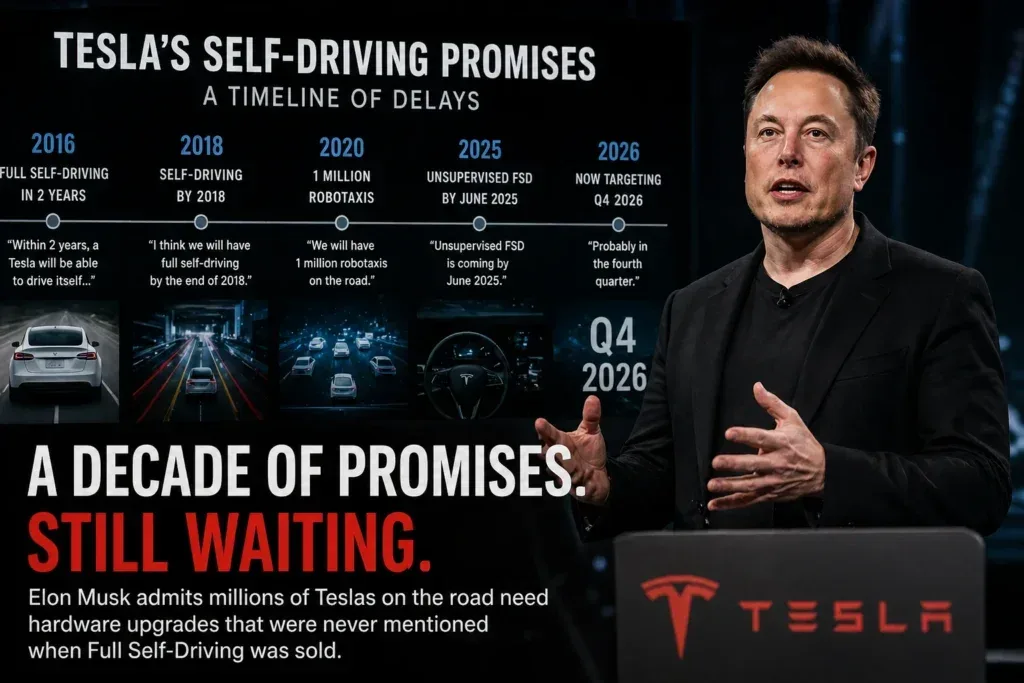
This admission matters so much because of what Tesla specifically promised. For years, Tesla sold cars with a promise printed directly on its website: every vehicle shipped with the hardware necessary for full self-driving. Millions of people paid for FSD on the strength of that claim. Headlight
This is not the first time Tesla has made — and then broken — a hardware promise. When Tesla decided that HW2 would not be capable of full autonomy, it allowed FSD owners to bring in their cars for a free upgrade to HW3 hardware. CarBuzz The same precedent was widely expected to apply when HW3 was found insufficient.
But this time, Tesla’s situation is far more complex. Upgrading the computer also requires replacing the cameras, and standard service centres handle this “extremely slowly and inefficiently.” Headlight The scale of the problem — millions of vehicles needing both a new computer and all-new cameras — makes a simple free-upgrade program extraordinarily costly.
What Is Tesla Offering HW3 Owners?
Tesla’s response to HW3 owners comes in three parts:
1. A discounted trade-in program. For customers who paid thousands of dollars for FSD on HW3 vehicles, Tesla is offering discounted trade-ins to HW4 cars. Ford Authority This means buying a new Tesla at a discount — not getting your existing car fixed for free.
2. A hardware upgrade path. Tesla is also offering a hardware upgrade path that requires replacing both the computer and all cameras. Ford Authority This is a full retrofit — not a simple chip swap.
3. Micro-factories to handle the volume. To do this efficiently, Musk explained that Tesla plans to set up “micro factories, or small factories, in major metropolitan areas” because “if it’s done at the service center it is extremely slow to do so and inefficient.” CarBuzz No timeline, locations, or pricing for these micro-factories has been announced.
4. A V14-lite software update by June. As a near-term consolation, Tesla’s head of Autopilot Ashok Elluswamy confirmed that a V14-lite will be coming to HW3 vehicles in late June, bringing all the V14 features currently running on AI4 hardware. THE SHOP This is a meaningful software update but does not enable unsupervised driving — it’s a supervised FSD improvement, not the autonomy that was promised.
When Is Unsupervised FSD Actually Coming?
During the Q1 2026 earnings call, Musk confirmed that unsupervised Full Self-Driving for consumer vehicles won’t arrive until Q4 2026 at the earliest, after years of broken promises. When asked directly, Musk replied: “I’m just guessing here, but probably in the fourth quarter.” Ford Authority
This represents the latest in a decade-long pattern of Musk overpromising and underdelivering on autonomous driving timelines. He promised full autonomy by 2018, a million robotaxis by 2020, unsupervised FSD by June 2025, and then moved the goalpost again in January 2026. Ford Authority
Even the Q4 2026 target comes with significant caveats. Musk acknowledged that releasing unsupervised FSD to consumer vehicles requires careful, geography-by-geography validation, meaning some regions may receive it well before others. Ford Authority
What Should Tesla HW3 Owners Do Right Now? 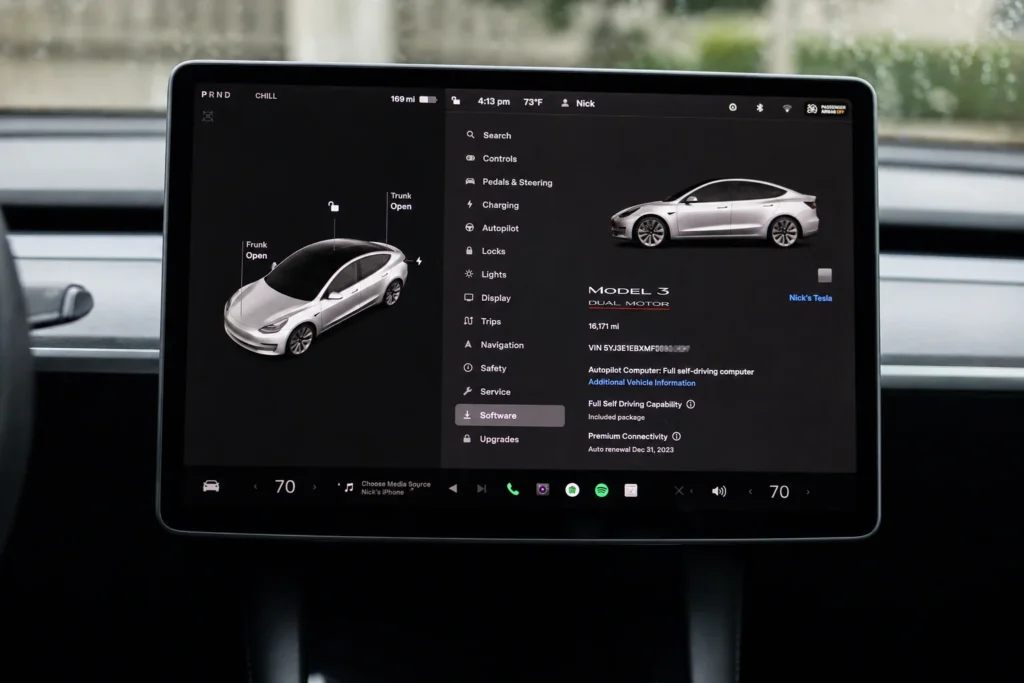
If you own a Tesla with HW3 and paid for FSD, here is the practical landscape:
Check your hardware first. Go to Controls > Software > Additional Vehicle Information on your touchscreen. If it shows “Autopilot computer: Full Self-Driving Computer” (HW3) rather than “Autopilot computer: AI4,” you have the affected hardware.
Expect the V14-lite update in late June. This will meaningfully improve your supervised FSD experience. It doesn’t give you autonomy, but it does give you access to improved lane changing, improved intersection handling, and other v14 features.
Wait for trade-in and upgrade pricing details. Tesla has not yet announced specific pricing for the discounted trade-in program or the hardware upgrade. Before making any decisions, wait for those specific numbers.
Consider legal options. The admission could open Tesla up to legal challenges from customers who bought Teslas on the belief that the cars were just one software update away from being able to drive themselves. THE SHOP Multiple law firms have already signaled interest in class action cases on behalf of HW3 FSD buyers.
The Tesla FSD hardware situation is one of the most significant consumer technology broken promises in recent automotive history. Whether Tesla makes it right for the millions of affected owners — and how — will define the company’s reputation for honesty with its customer base for years to come.
Planning your next vehicle purchase? Our Car Ownership Cost Calculator helps you understand total annual costs for any EV you’re considering. Use our Car Loan EMI Calculator to estimate monthly payments, and our EV vs Gas Cost Calculator to compare long-term running costs between EV and gas options.