The Hidden Cost of Owning a Large SUV : There are two moments when people fall in love with a large SUV.
The first happens at the dealership.
The second usually happens during a family road trip.
Everyone fits comfortably.
The luggage disappears into the cargo area.
The ride feels smooth.
The view over traffic feels commanding.
For a moment, it feels like the perfect vehicle.
And honestly, for many families, it is.
But there’s another side of large SUV ownership that rarely appears in advertisements.
It doesn’t show up in glossy brochures.
It isn’t mentioned during most test drives.
And it’s usually discovered one monthly payment at a time.
Because the true cost of owning a large SUV isn’t what happens on the day you buy it.
It’s what happens every day after.
The Price Tag Is Only The Entrance Fee
Most buyers focus heavily on the purchase price.
That’s understandable.
It’s the biggest number they’ll see.
But the purchase price is often just the beginning.
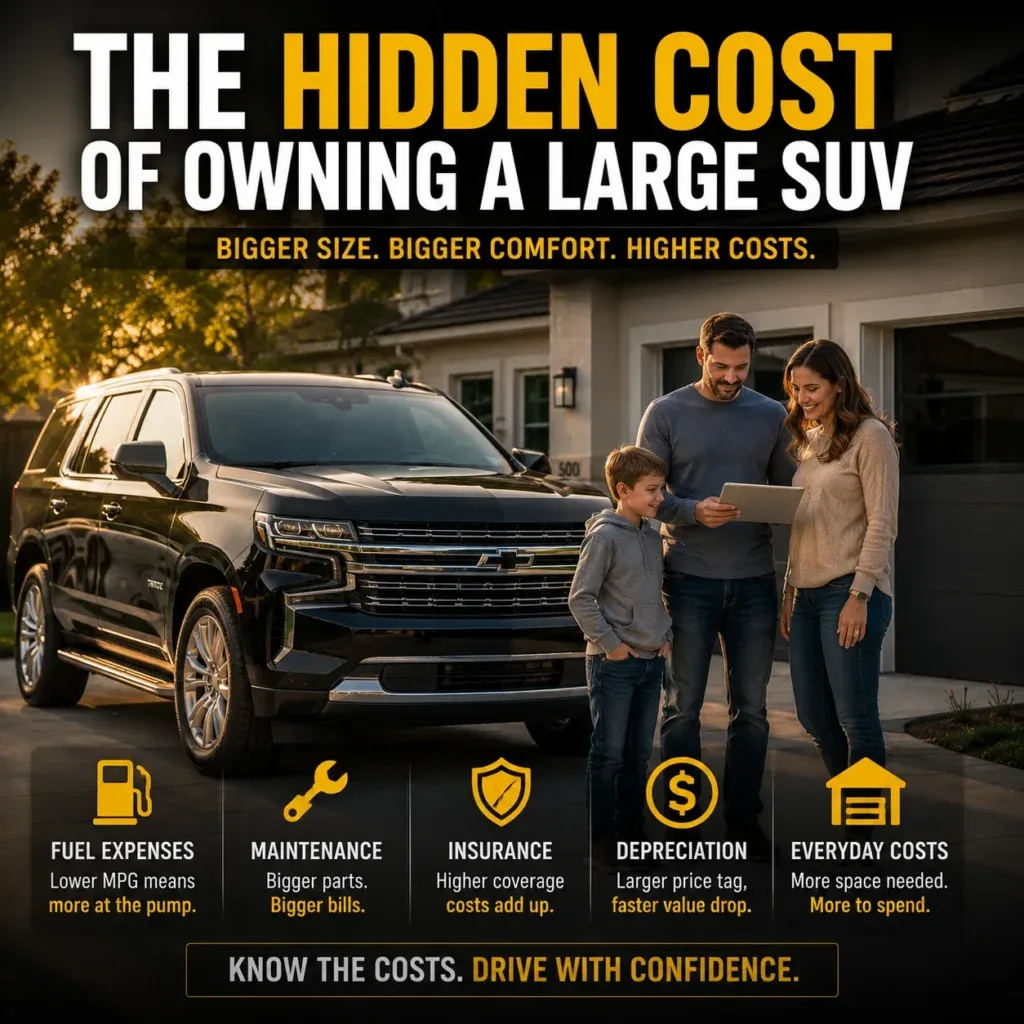
A large SUV isn’t simply a vehicle.
It’s an ongoing financial commitment.
Fuel.
Insurance.
Tires.
Maintenance.
Depreciation.
Repairs.
Registration fees.
All of these costs continue long after the excitement of ownership fades.
The SUV may leave the dealership once.
The expenses keep showing up.
Fuel Costs Add Up Faster Than People Expect
Let’s start with the obvious one.
Gasoline.
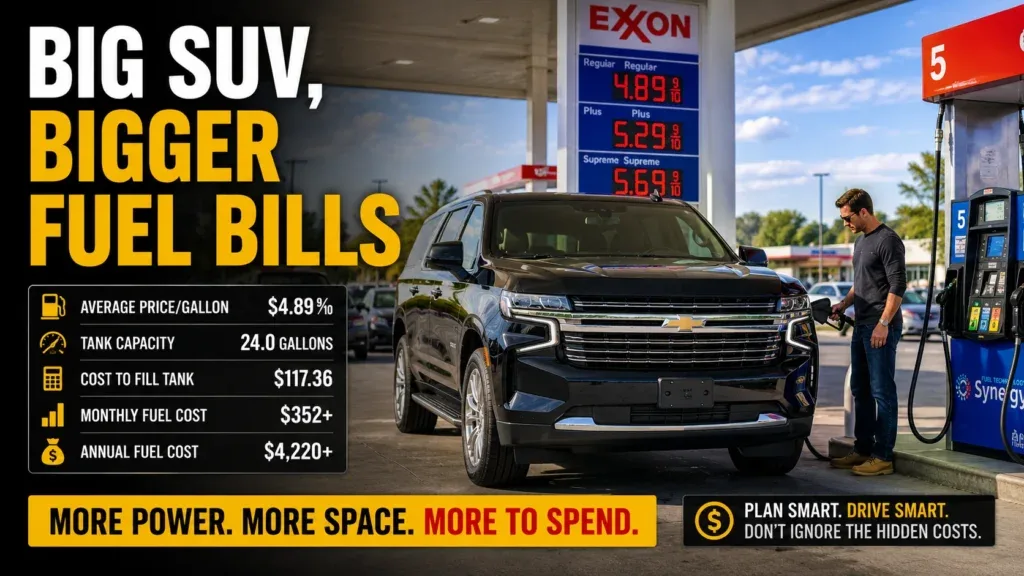
Many full-size SUVs average somewhere between 16 and 22 miles per gallon depending on driving habits and engine choice.
That doesn’t sound terrible until you start doing the math.
A family driving 15,000 miles per year can easily spend thousands more on fuel compared to someone driving a midsize hybrid SUV.
Not because fuel suddenly became expensive.
Because the difference compounds.
Week after week.
Month after month.
Year after year.
One fill-up doesn’t hurt.
Five years of fill-ups tell a different story.
Bigger Tires Come With Bigger Bills
Most people never think about tires while buying a vehicle.
Then one day they need four new ones.
That’s when reality arrives.
Large SUVs often use larger, more expensive tires than compact or midsize vehicles.
And replacement costs can surprise first-time owners.
Especially when premium trims require premium rubber.
The difference may only be a few hundred dollars per tire.
Until you multiply that by four.
Suddenly a routine maintenance item becomes a significant expense.
Insurance Companies Notice Size Too
Here’s something many buyers overlook.
Insurance companies don’t just insure your driving habits.
They insure your vehicle.
And larger SUVs often cost more to repair.
More expensive parts.
More expensive components.
Higher replacement values.
All of those factors influence premiums.
The difference isn’t always dramatic.
But over several years, even modest increases become meaningful.
That’s money leaving your bank account every month whether you think about it or not.
Parking Is A Cost Too
Not every ownership cost appears on a financial statement.
Some appear as frustration.
Large SUVs require larger spaces.
Tighter parking garages become stressful.
Downtown parking becomes less convenient.
Parallel parking becomes a skill instead of a simple task.
People rarely calculate inconvenience when buying a vehicle.
But they absolutely experience it.
And over years of ownership, those small frustrations add up.
Depreciation Is The Expense Nobody Talks About
This is where things get interesting.
Because depreciation is often the single largest ownership cost.
Not fuel.
Not maintenance.
Not insurance.
Depreciation.
The moment a vehicle leaves the dealership, it begins losing value.
Some large SUVs hold value extremely well.
Others don’t.
But every vehicle depreciates.
The challenge is that most buyers never see the cost directly.
It’s hidden.
Quiet.
Invisible.
Until trade-in day arrives.
Then suddenly thousands of dollars seem to disappear.
And that’s when many owners realize depreciation was costing them money all along.
Also Read:
https://driveglobalnews.in/the-biggest-mistake-suv-buyers-are-making-right-now/ – The ownership-cost mistake many Americans don’t realize they’re making.
The SUV Solves Problems You May Not Actually Have
This may be the most important point in the entire article.
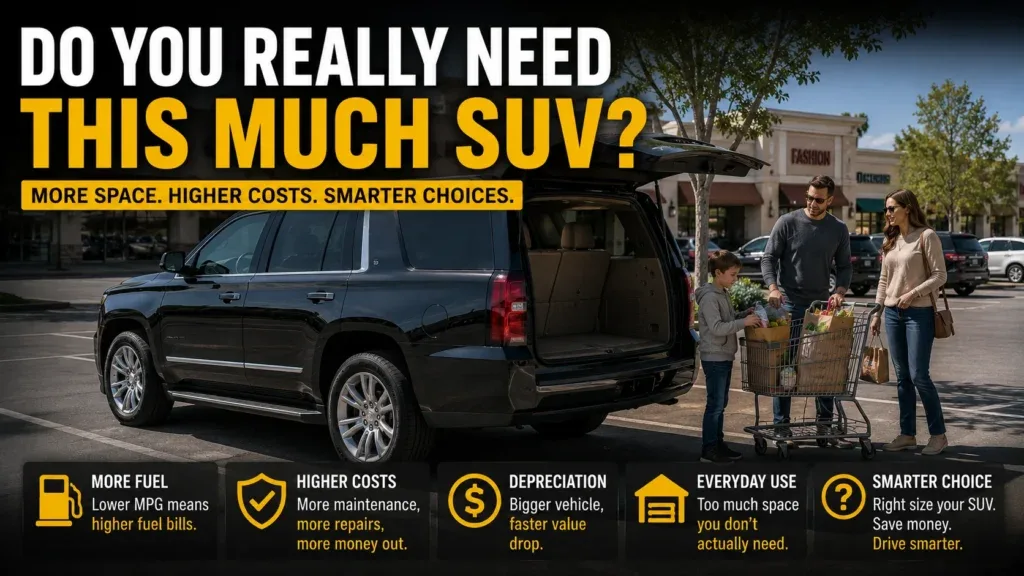
Many Americans buy large SUVs because of what they might need someday.
Maybe they’ll tow a boat.
Maybe they’ll take long family vacations.
Maybe they’ll need the third row.
Maybe.
The problem is that “maybe” often becomes expensive.
If you regularly tow, haul equipment, or transport seven people, a large SUV makes perfect sense.
If you don’t, things become more complicated.
You’re carrying around capability every day that rarely gets used.
And capability isn’t free.
The Emotional Side Of SUV Ownership
Let’s be fair.
Large SUVs aren’t popular by accident.
People love them for legitimate reasons.
They feel safe.
They feel spacious.
They handle family life well.
Long road trips become easier.
Weekend adventures become simpler.
That’s real value.
The mistake isn’t buying a large SUV.
The mistake is assuming those benefits come without trade-offs.
Every vehicle involves compromise.
Large SUVs simply hide those compromises better than most.
Why Some Owners Never Regret It
Interestingly, some owners never regret their large SUV.
Not once.
Why?
Because they genuinely use it.
The third row stays occupied.
The cargo area stays full.
The towing capacity gets exercised.
The space solves real problems.
Those owners understand exactly what they’re paying for.
And they’re happy to pay it.
That’s the difference.
The hidden costs only become painful when the benefits aren’t being used.
Also Read:
https://driveglobalnews.in/7-suvs-americans-regret-buying/ – The common SUV buying decisions that owners often wish they could take back.
The Real Question Buyers Should Ask
Most people ask:
“Can I afford this SUV?”
That’s the wrong question.
The better question is:
“Can I justify owning this SUV for the next five years?”
Those are very different conversations.
One focuses on the purchase.
The other focuses on ownership.
And ownership is where the real money gets spent.
The Bottom Line
Large SUVs aren’t bad vehicles.
In many cases, they’re fantastic vehicles.
The space is real.
The comfort is real.
The capability is real.
But so are the costs.
Fuel costs.
Insurance costs.
Tire costs.
Maintenance costs.
Depreciation costs.
The smartest buyers understand both sides of the equation.
They don’t just fall in love with the SUV.
They understand what living with it will actually look like.
Because the best vehicle isn’t necessarily the one with the most space.
It’s the one that fits your life so well that five years later, you’re still glad you bought it.
And that’s a calculation far more important than the sticker price.