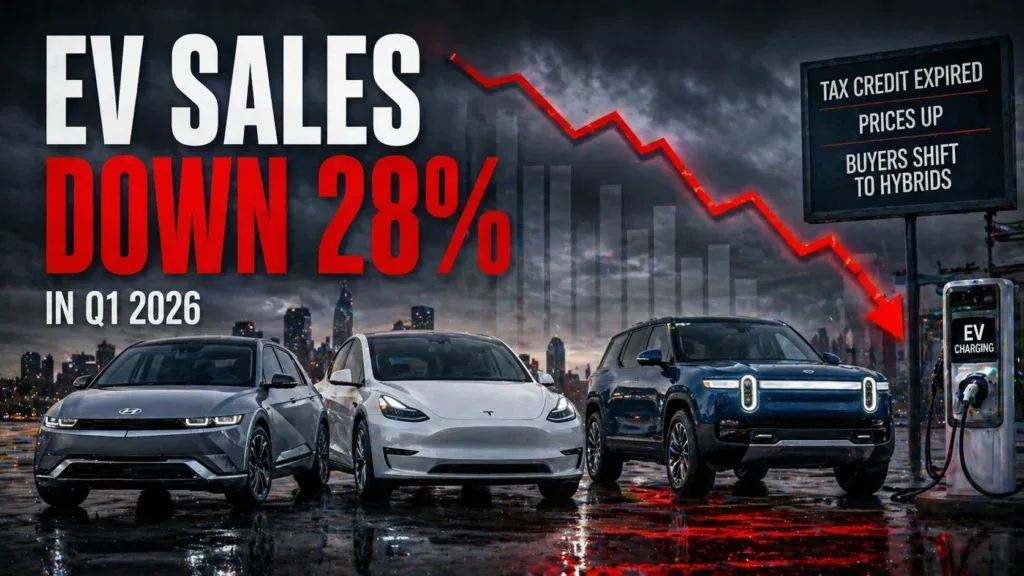
The Real Reason EV Sales Dropped 28% in Q1 2026 — EV sales fell 28% year-over-year in Q1 2026. That sounds catastrophic.
It’s not. But it does tell you something important about this market — and more importantly, about which EVs are actually worth buying right now.
What Actually Happened
The $7,500 federal EV tax credit expired on September 30, 2025. Overnight, every EV in America effectively got $7,500 more expensive.
The Q4 2025 sales spike was the tell. Buyers who were considering an EV rushed to take delivery before the deadline. Sales surged. Then January 2026 arrived and the hangover hit — buyers who would have bought in Q1 had already bought in Q4. The 28% decline looks dramatic but it’s partly just borrowed demand, paid forward.
The underlying demand for EVs hasn’t collapsed. It’s shifted.
also read https://driveglobalnews.in/scout-terra-vs-rivian-r2-comparison-2026/
Where Buyers Actually Went 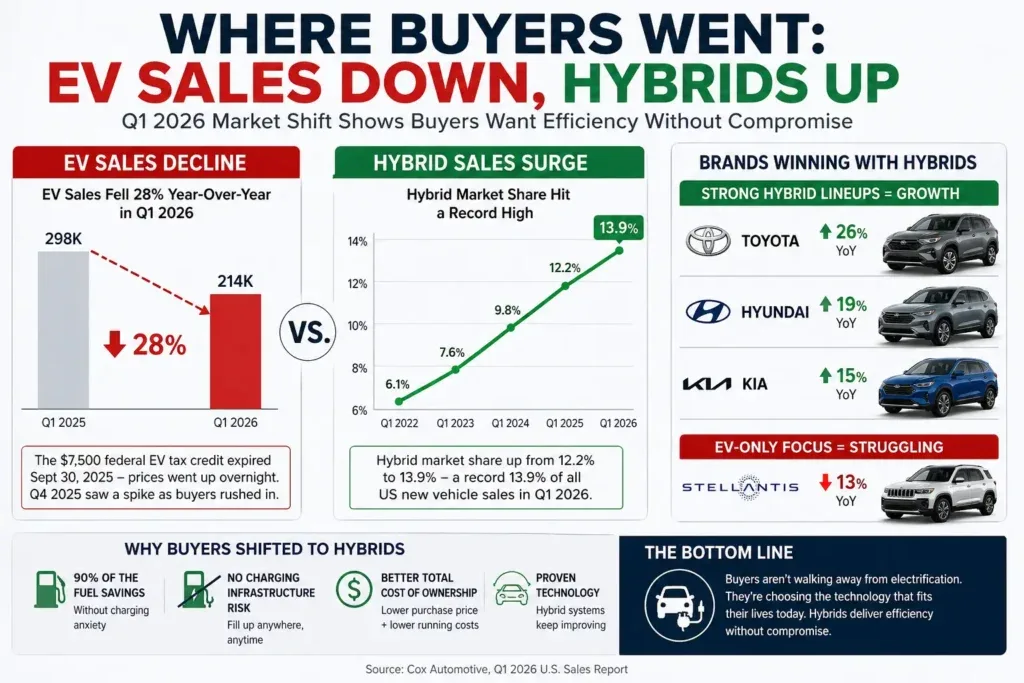
Here’s what’s interesting. The buyers who would have bought an EV in Q1 2026 didn’t go back to gas. Most of them bought hybrids.
Hybrid market share hit a record 13.9% of all US new vehicle sales in Q1 2026. Up from 12.2% a year ago. Brands that had strong hybrid lineups — Toyota, Hyundai, Kia — grew. Brands that bet everything on pure EVs — Stellantis, to a painful degree — struggled.
The message from buyers is clear: yes to electrification, no to charging anxiety, no to infrastructure risk. Hybrids give you 90% of the fuel savings with none of the downsides. That math works in 2026.
also read https://driveglobalnews.in/2026-toyota-rav4-hybrid-vs-honda-cr-v-hybrid/
The EVs That Are Actually Selling
Not all EVs are struggling. Some are genuinely thriving — and the difference tells you what buyers actually value.
Hyundai Ioniq 5 — Up 14% year-over-year. Built in Georgia, insulated from tariff headwinds, permanent price cut to $35,000. This is the blueprint for EV success right now: domestic production, aggressive pricing, excellent charging speed.
Tesla Model Y — Still America’s best-selling EV, despite everything. Brand recognition and Supercharger network access are moats that rivals haven’t crossed yet.
Rivian R1T and R1S — Holding steady. Adventure buyers are less price-sensitive and more committed to the EV lifestyle. Rivian’s customer retention is exceptional.
Chevy Equinox EV — Struggling. Priced similarly to the Ioniq 5, built in Mexico (tariff exposure), without the brand enthusiasm that moved Ioniq 5 units. This one needs a price cut.
Why Things Are About to Change 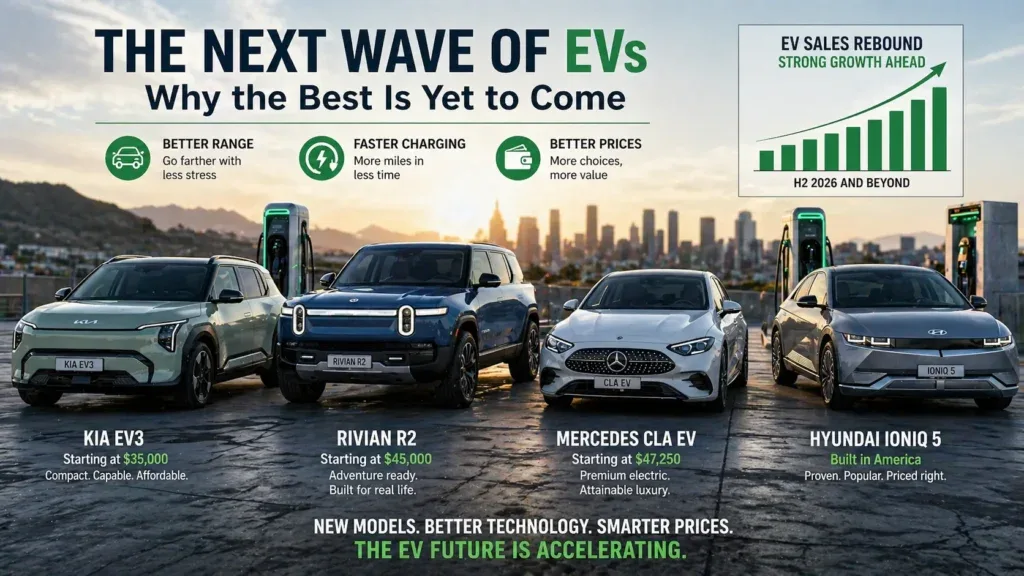
Three things are converging that will push EV sales back up in the second half of 2026:
also read https://driveglobalnews.in/the-real-reason-ev-sales-dropped-28-in-q1-2026/
New product arrivals. The Kia EV3 at $35,000. The Rivian R2 at $45,000-57,990. The Mercedes CLA Electric at $47,250. The slate of new EVs arriving in H2 2026 is genuinely compelling — better range, better charging, better prices than what launched in 2024-2025.
Gas prices. Regular unleaded above $4 nationally and climbing. Every dollar gas goes up converts fence-sitters into EV buyers.
Infrastructure maturity. Tesla’s Supercharger network is now accessible to virtually every new EV via NACS ports. The single biggest EV objection — “where do I charge on a road trip?” — is becoming less valid every month.
The 28% decline in Q1 is a story about tax credit expiry, not about Americans rejecting EVs. The buyers who actually want one are still out there. They’re just waiting for the right product at the right price.
Several of those products are about 90 days away.