
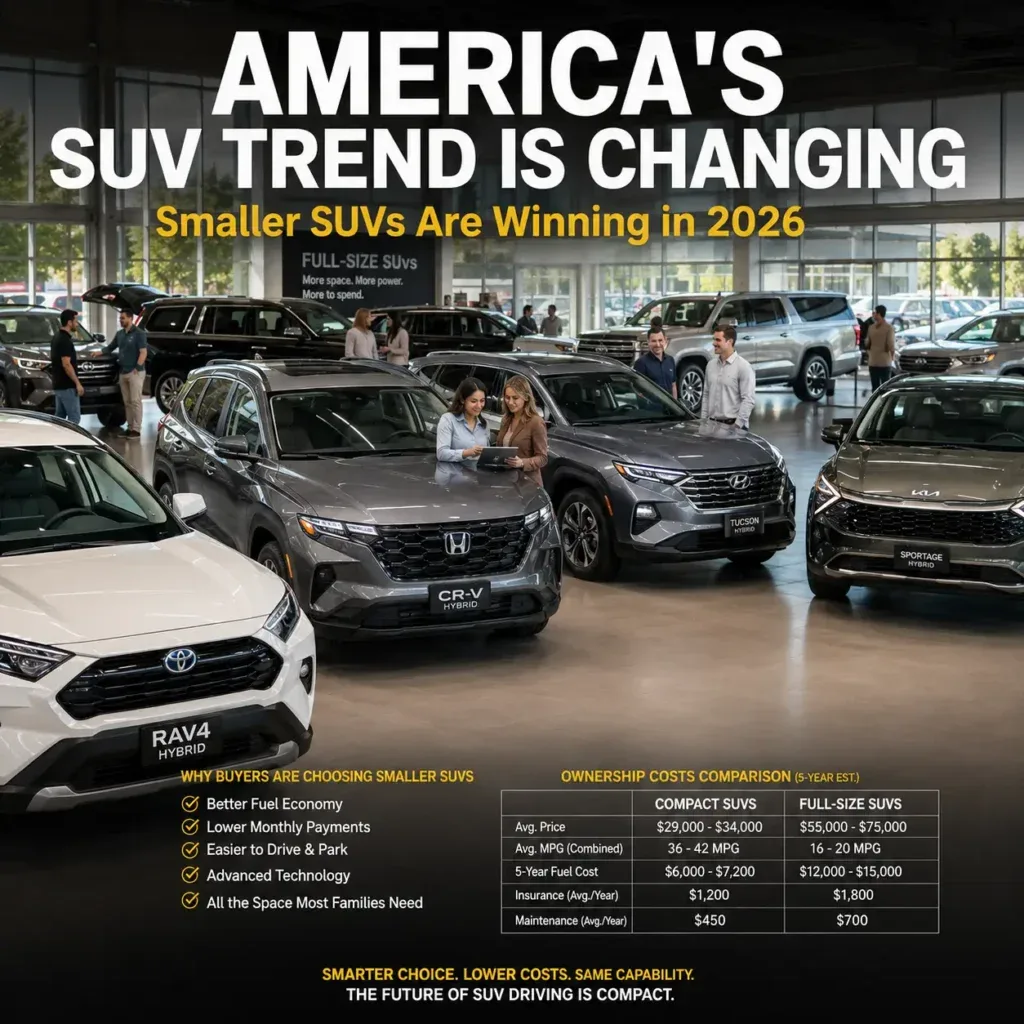
The SUV Trend Nobody Saw Coming in 2026 : There are two ways to look at the American SUV market.
The first is the traditional way.
Bigger SUV.
Bigger engine.
Bigger monthly payment.
The second is what’s actually happening right now.
And honestly, very few people saw it coming.
Because after spending years chasing larger vehicles, more Americans are quietly moving in the opposite direction.
Not into sedans.
Not into sports cars.
Not even into pickup trucks.
They’re buying smaller SUVs.
And they’re doing it for a reason that’s becoming impossible to ignore.
Money.
Not the purchase price.
The ownership cost.
That’s the trend quietly reshaping the SUV market in 2026.
Bigger Used To Feel Smarter
For a long time, buying a larger SUV felt like the responsible thing to do.
Families wanted extra seats.
Extra cargo room.
Extra capability.
Even buyers who didn’t need a large SUV often convinced themselves they might need one someday.
And automakers were happy to provide options.
Three-row SUVs became larger.
Luxury SUVs became larger.
Even compact SUVs started growing.
The market spent years moving in one direction.
Bigger.
Then something changed.
Americans Started Looking At Their Monthly Expenses

Most people don’t think about ownership costs while standing inside a dealership.
They’re focused on the monthly payment.
The test drive.
The technology.
The excitement of buying something new.
The ownership costs arrive later.
Fuel bills.
Insurance.
Maintenance.
Tires.
Registration fees.
And that’s where many buyers started noticing something.
Large SUVs are expensive to live with.
Not just expensive to buy.
Expensive to own.
Over time, that realization began influencing purchasing decisions.
And suddenly smaller SUVs started looking a lot more attractive.
The New Generation of Compact SUVs Is Better Than Expected
Part of this trend exists because compact SUVs improved dramatically.
A decade ago many smaller SUVs felt like compromises.
Today they don’t.
A modern Toyota RAV4 can comfortably handle a family road trip.
A Honda CR-V offers rear-seat space that would have impressed luxury buyers a few years ago.
Vehicles like the Hyundai Tucson and Kia Sportage provide technology that rivals much more expensive SUVs.
The practical differences between compact and larger SUVs became smaller.
The price difference didn’t.
That’s important.
Because consumers are increasingly asking a simple question.
“Why spend more if I don’t need to?”
Hybrid SUVs Changed The Equation

If there’s one category driving this shift, it’s hybrid SUVs.
Because hybrids solved a problem many Americans were trying to ignore.
Fuel costs.
A family driving a hybrid SUV can save hundreds, sometimes thousands, of dollars over several years compared to larger gas-powered alternatives.
That changes how buyers think.
Suddenly the conversation isn’t about horsepower.
It’s about household budgets.
And household budgets usually win.
The success of vehicles like the Toyota RAV4 Hybrid, Honda CR-V Hybrid, and Kia Sportage Hybrid shows exactly what’s happening.
Consumers aren’t abandoning SUVs.
They’re becoming more selective about which SUVs they actually need.
Families Are Making More Practical Decisions
Something else is happening.
Families are becoming more realistic.
A surprising number of buyers discovered they rarely used the third row they paid extra for.
Many realized they didn’t need maximum towing capacity.
Others noticed that carrying around a larger vehicle every day created more inconvenience than benefit.
Parking became harder.
Fuel costs increased.
Insurance costs rose.
Meanwhile compact SUVs kept improving.
Eventually practicality won.
Not because larger SUVs became bad vehicles.
Because smaller SUVs became good enough.
And “good enough” is incredibly powerful in the automotive market.
also read : https://driveglobalnews.in/7-hybrid-suvs-that-feel-more-premium-than-thei/
Automakers Are Paying Attention
Manufacturers have noticed the shift.
You can see it in product development.
You can see it in marketing.
And you can certainly see it in hybrid expansion.
Companies are investing heavily in compact and midsize SUVs because that’s where demand continues growing.
Consumers are telling automakers exactly what they want.
Efficiency.
Practicality.
Value.
And increasingly, hybrid technology.
The brands that respond fastest are likely to benefit the most.
also read : https://driveglobalnews.in/honda-hybrid-strategy-america-2026/
The Real Story
The most interesting part of this trend isn’t about SUVs.
It’s about consumers.
For years, Americans were told bigger was better.
More power.
More space.
More capability.
Now many buyers are asking a different question.
Better for who?
Because if a smaller SUV can handle school runs, grocery trips, vacations, commuting, and family life while costing less to own, the argument for going bigger becomes harder to make.
That’s why this trend matters.
Not because Americans stopped loving SUVs.
They clearly haven’t.
The roads are full of them.
The surprise is that many buyers are finally separating what they want from what they actually need.
And once they do that, something interesting happens.
The smaller SUV suddenly starts looking like the smarter SUV.
That’s the trend quietly unfolding across America in 2026.
And judging by current buying patterns, it may only be getting started.