Something unusual just happened in the American car market.
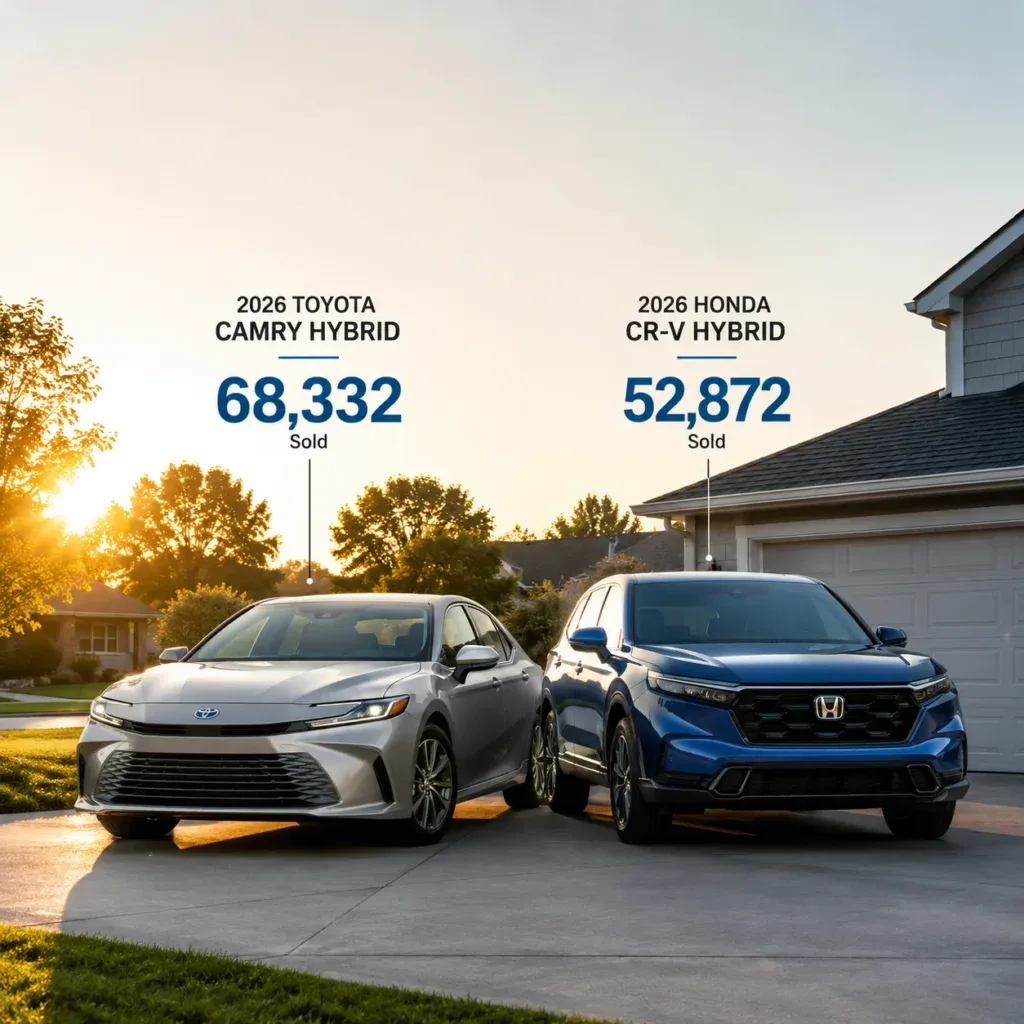
The Toyota Camry — a sedan — is the best-selling new vehicle in America as of June 2026. Not a truck. Not an SUV. A sedan. With 68,332 units sold in the last 45 days.
The Honda CR-V is the best-selling SUV with 52,872 units in the same period.
These two cars together tell the story of what American families are actually prioritizing right now — at $4.50 gas, with household budgets squeezed by inflation, with hybrid technology finally mature enough to be the obvious choice rather than a premium compromise.
And yet nobody is directly comparing them. So let’s do it properly.
The Question That Actually Matters
Before the specs: do you need an SUV?
Not “do you want an SUV.” Do you actually need one.
The honest answer for most American families is: probably not. The Camry Hybrid is 37.8 inches off the ground — the same height as most front doors. Getting in and out is easy. The trunk is 15.1 cubic feet — enough for four suitcases and a stroller. The back seat fits three adults.
If your reason for wanting an SUV is ground clearance for occasional snow, a taller seating position for highway driving, or psychological comfort from a larger vehicle — those are real preferences but they’re not needs. And preferences have a price.
Here’s what that price looks like.
The Numbers
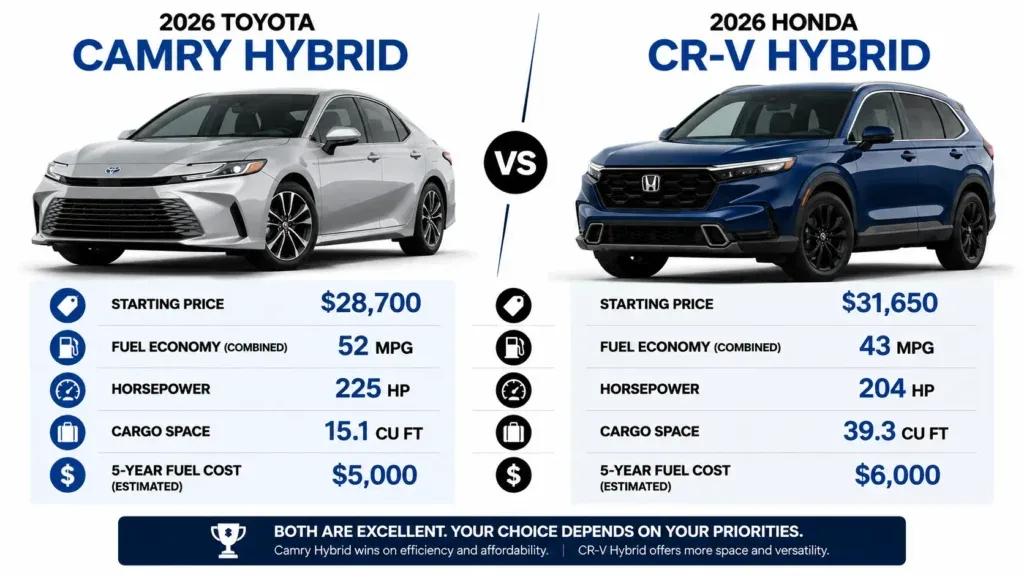
| 2026 Toyota Camry Hybrid | 2026 Honda CR-V Hybrid | |
|---|---|---|
| Starting Price | $31,900 | $37,080 |
| Fuel Economy | 51 MPG combined | 36 MPG combined |
| Horsepower | 225 HP | 204 HP |
| Rear Legroom | 38.9 inches | 41.0 inches |
| Cargo Space | 15.1 cu ft | 39.3 cu ft |
| Ground Clearance | 5.7 inches | 7.8 inches |
| AWD Available | Yes | Optional |
| Towing | 1,000 lbs | 1,500 lbs |
| 5-year fuel cost | ~$6,618 | ~$9,375 |
| Built | Georgetown, KY | East Liberty, OH |
The number that stops most people: 51 MPG vs 36 MPG.
At $4.50 gas and 15,000 annual miles, the Camry Hybrid costs $1,324 per year in fuel. The CR-V Hybrid costs $1,875 per year. That’s $551 per year — or $2,755 over five years — purely from fuel savings.
Combined with the $5,180 lower starting price — the Camry saves approximately $7,935 over five years compared to the CR-V Hybrid. That’s a vacation. That’s a semester of community college. That’s real money that most families spending $40,000 on a car don’t think about when they’re choosing between “sedan” and “SUV.”
Why the Camry Is Suddenly America’s Best-Selling Car
The Camry’s June 2026 dominance isn’t a surprise to anyone who has been watching the market. Three things converged at the same time.
Gas crossed $4.50. At that price, 51 MPG is not a specification — it’s a monthly budget line item that families feel every week. The Camry isn’t getting 51 MPG because Toyota wanted bragging rights. It’s getting 51 MPG because families needed it to.
The 2026 redesign finally gave the Camry a personality. Previous generations were competent and anonymous — the automotive equivalent of sensible shoes. The 2026 model is genuinely handsome, with an available GR Sport trim that adds sport seats, paddle shifters, and a chassis tune that makes the Camry feel like something you’d choose rather than settle for. That perception shift matters. People are buying it because they want it, not just because it’s the responsible decision.
And the hybrid-only lineup eliminated the choice paralysis. There’s no gas-only Camry anymore. If you’re buying a 2026 Camry, you’re getting 51 MPG. Simplified decision. One answer. Buyers responded.
Consumer Reports named the Camry a Top 10 car for 2026. U.S. News ranks it as one of the best midsize sedans available. CarEdge’s 5-year ownership cost projection puts it among the most financially efficient vehicles in America. Every award it matters to win, it’s winning.
Where the CR-V Wins — And This Is Important
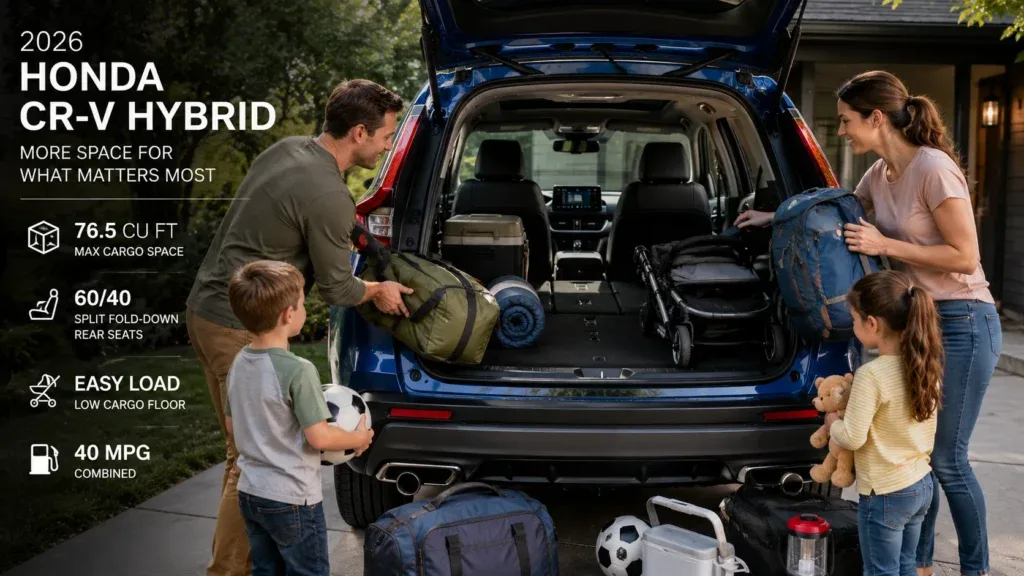
The CR-V’s best-selling SUV status isn’t accidental either. It’s genuinely the right vehicle for a specific buyer — and that buyer is larger than most sedan advocates acknowledge.
41 inches of rear legroom — 2.1 more than the Camry. That gap is felt. If you regularly carry tall adults in the back, the CR-V’s rear seat is meaningfully more comfortable on drives over an hour. The Camry’s back seat is fine. The CR-V’s is excellent.
39.3 cubic feet of cargo versus the Camry’s 15.1. That’s not a slight difference. That’s the difference between loading your gear for a camping weekend and playing Tetris with soft bags. Families who regularly move stuff — sports equipment, strollers, flat-pack furniture, Costco runs — use that cargo space every week.
Ground clearance of 7.8 inches versus 5.7 inches. In states that get real snow — Colorado, Minnesota, Vermont, Michigan — those 2.1 extra inches occasionally matter. Not every day, but on the days they matter, they really matter.
Honda’s dual-motor hybrid system is also smoother than Toyota’s at low speeds. In city traffic, the CR-V transitions between electric and gas invisibly — the engine shuts off at stops and returns at speed so seamlessly that passengers frequently don’t know it happened. For urban families in stop-and-go commutes, this refinement is felt daily.
The Sedan vs SUV Question in 2026 — An Honest Answer
The automotive media has been predicting the sedan’s death since 2018. The June 2026 sales data suggests the opposite is happening.
Hybrids are claiming 49% of the American market. Gas prices are at levels that make fuel economy a genuine financial decision rather than an aspirational one. The Camry Hybrid at 51 MPG and $31,900 represents exactly what buyers need right now: maximum efficiency at accessible price.
But “sedans are back” doesn’t mean SUVs are going anywhere. The CR-V’s 52,872 units sold in 45 days shows that American families still want the higher seating position, the cargo flexibility, and the all-weather confidence that compact SUVs deliver. They’re just being more deliberate about whether that preference justifies the $7,935 five-year premium.
Who Should Actually Buy Which
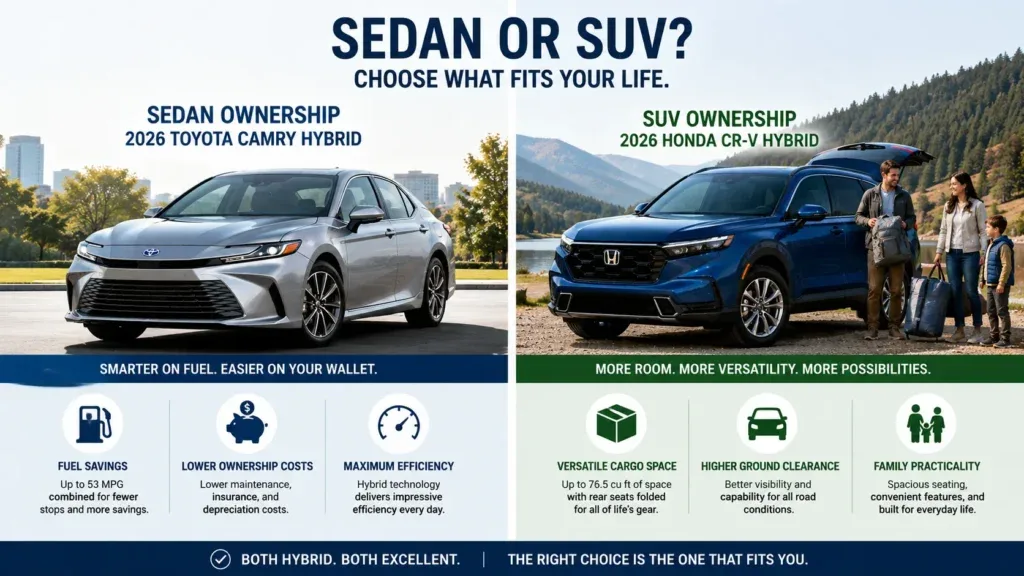
Buy the Toyota Camry Hybrid if:
You drive primarily on roads and don’t need AWD regularly. Your back seat passengers are the same height as you or shorter. Fuel costs are a genuine monthly concern. You want the lowest possible five-year total cost of ownership. Or you want the best-selling car in America and the awards record to back it up.
Buy the Honda CR-V Hybrid if:
You regularly put tall adults in the back seat. You load the cargo area with family gear on a regular basis. You live somewhere with real winter weather and want higher ground clearance. Or the SUV seating position matters to your daily comfort and confidence on the road.
Both are excellent vehicles built in America. Both will run 200,000 miles with basic maintenance. Both will hold their value well.
The right answer is the one that matches your actual life — not the segment that automotive culture tells you is the correct choice in 2026.
Compare your real 5-year ownership costs between both with our Car Ownership Cost Calculator.