
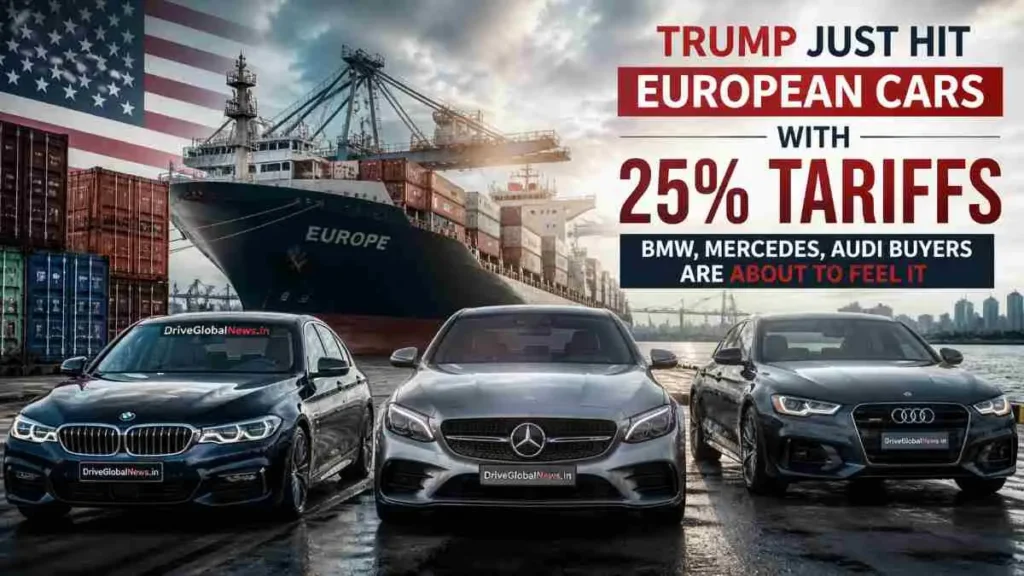
Trump Just Hit European Cars With 25% Tariffs — It’s May 1, 2026 — May Day — and President Trump just dropped a bombshell on anyone planning to buy a European car.
In a Truth Social post Friday afternoon, Trump announced he is raising tariffs on all cars and trucks imported from the European Union to 25%, effective next week. His reason: the EU is “not complying” with the Turnberry Agreement — the existing trade framework the two sides had worked out.
If you’re shopping for a BMW, Mercedes-Benz, Audi, or Volkswagen right now, this changes your timeline immediately.
also read : https://driveglobalnews.in/hyundai-tucson-hybrid-vs-kia-sportage-hybrid/
What Actually Changed — And Why It’s Complicated 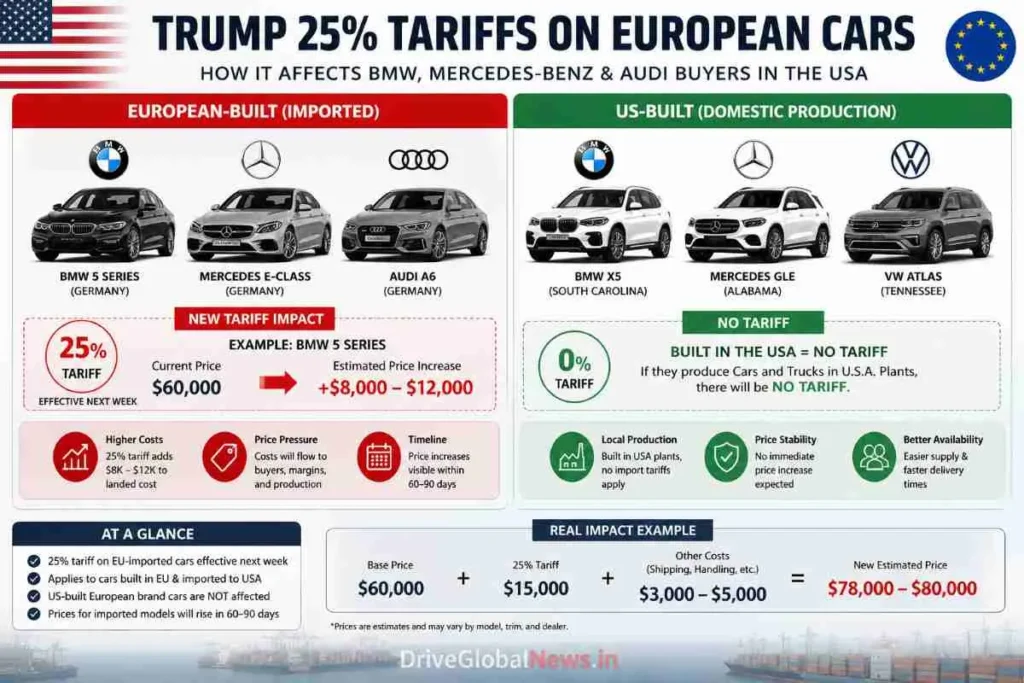
Here’s the background. The original Turnberry Agreement, negotiated between Trump and EU Commission President von der Leyen, set a 15% tariff ceiling on most goods. Then the Supreme Court ruled that Trump’s IEEPA emergency tariff authority was unconstitutional — which actually dropped the floor to 10% for EU vehicles while Washington set up a new tariff framework.
Both sides appeared committed to the 15% deal. The EU was expecting it to save European automakers €500-600 million per month. EU officials described the arrangement as settled.
Then Friday happened. In a single post, without detailed explanation of exactly what the EU had failed to comply with, Trump announced the increase to 25%.
EU officials called it “clear unreliability.” Germany’s auto association urged both sides to honor the existing agreement. The EU’s trade negotiators are scrambling to respond.
Who Gets Hit Hardest
Not all European brands are equally exposed. It depends entirely on where the cars are physically built.
Most exposed — European-built vehicles sold in USA: BMW 3 Series, 5 Series, and 7 Series (built in Germany), Mercedes C-Class, E-Class, S-Class (Germany), Audi A4, A6, Q5 (Germany/Slovakia), Porsche 911, Cayenne (Germany).
Less exposed — US-built European brand vehicles: BMW X3, X4, X5, X6, X7 (Spartanburg, South Carolina — no tariff), Mercedes GLE, GLS (Vance, Alabama — no tariff), Volkswagen Atlas, ID.4 (Chattanooga, Tennessee — no tariff), Volvo XC60, XC90 (Ridgeville, South Carolina — no tariff).
Trump’s own announcement made this clear: “It is fully understood and agreed that, if they produce Cars and Trucks in U.S.A. Plants, there will be NO TARIFF.”
also read : https://driveglobalnews.in/you-can-buy-americas-best-electric-suv-for/
What It Means for Buyers Right Now 
If you’re considering a European-built BMW, Mercedes, or Audi — the window to buy before the 25% tariff kicks in is measured in days, not months. Trump said “next week.”
Will dealers raise prices immediately? Not overnight — cars already in transit and in dealer inventory were purchased at current tariff rates. But new orders from Europe will carry significantly higher costs. Within 60-90 days, you’ll start seeing the price pressure on fresh inventory.
The practical math: a 25% tariff on a $60,000 German-built BMW 5 Series adds roughly $8,000-$12,000 in landed costs before dealer margin. Automakers won’t absorb all of that. Some flows to buyers, some to reduced margins, some to production shifts.
The fastest-moving car buyers in America right now are probably BMW, Mercedes, and Audi dealer sales managers — trying to figure out what they can still sell at current prices before the new rate hits.
For everyone else: if a US-built European vehicle works for you — the BMW X5, Mercedes GLE, or VW Atlas — you have no immediate urgency. If you specifically want a European-built model, the clock just started.