
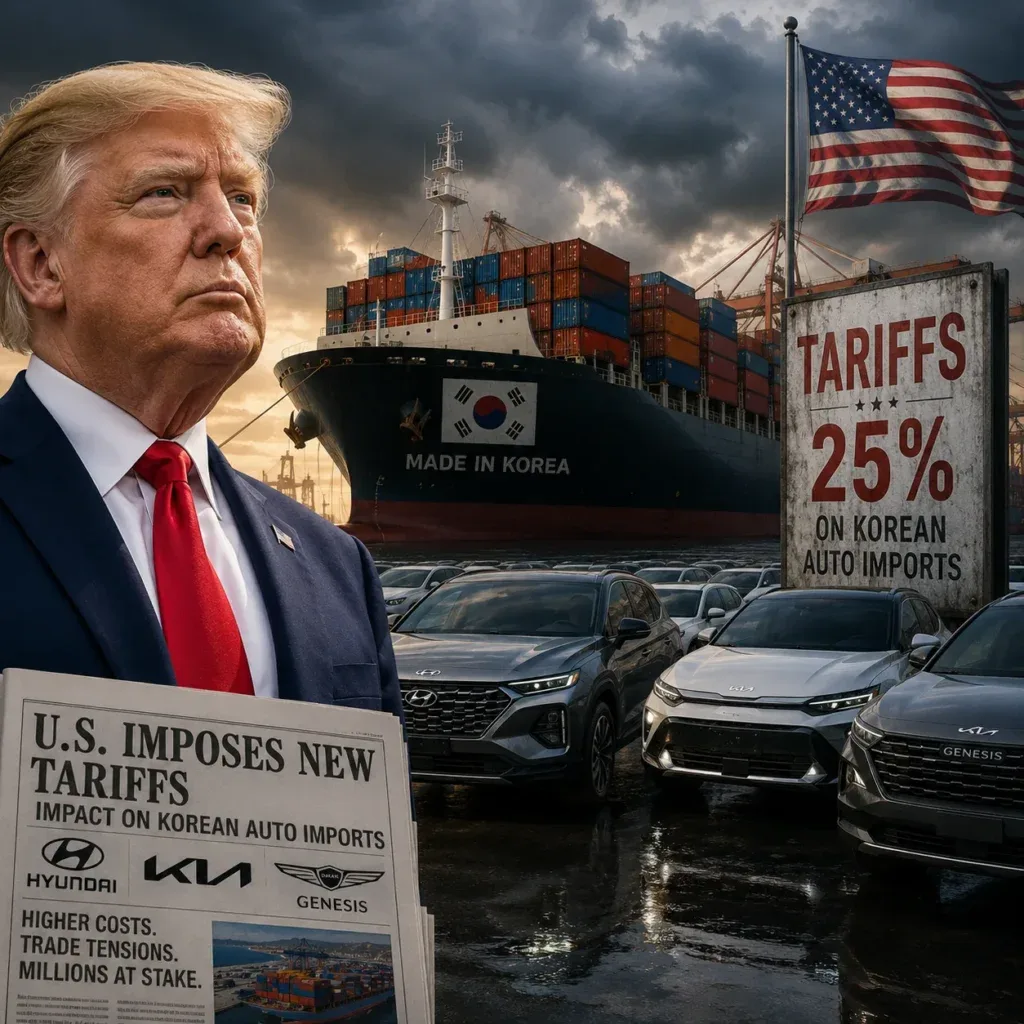
Just when American car buyers thought the tariff situation couldn’t get more complicated — it did.
President Trump threatened on Monday to reimpose 25% tariffs on South Korean cars — a move that, if implemented, would directly affect Hyundai, Kia, and Genesis vehicles built in Korea and sold in America. The tariffs were previously in place, then suspended as part of trade negotiations. Trump’s threat signals they could come back.
For buyers who are currently shopping any Korean brand — or who own one and are wondering about resale value — this news requires immediate attention.
What Trump Actually Said
The threat came Monday in the context of broader trade negotiations with South Korea. Trump stated his administration is considering returning to the 25% tariff on Korean-manufactured vehicles that had been part of earlier trade pressure campaigns.
The key word is “considering.” This is a threat in an ongoing negotiation — not a signed executive order. The history of Trump trade threats is mixed: some become policy quickly, some are used as leverage and never implemented, some get delayed by court challenges.
But the EU auto tariff announced May 1 went from threat to effective in under two weeks. Korean auto executives are not treating Monday’s announcement as mere posturing.
also read : https://driveglobalnews.in/toyota-rav4-hybrid-vs-kia-sportage-hybrid-2026/
Which Vehicles Would Be Affected — And Which Wouldn’t
This is the critical distinction that most coverage is missing.
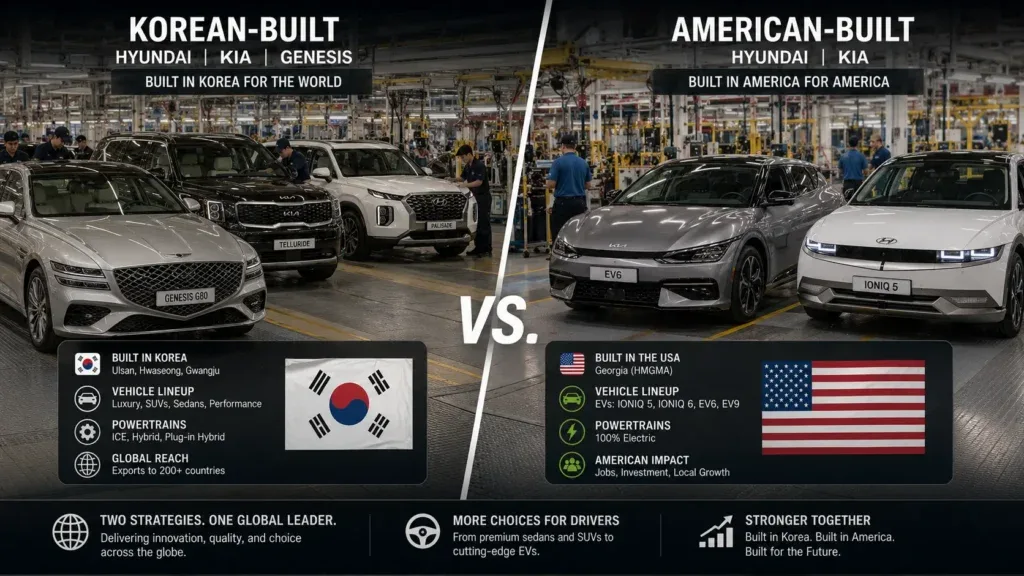
Korean-built vehicles — fully exposed: The Hyundai Tucson (built in Korea), Hyundai Santa Fe (Korea), Kia Carnival (Korea), Kia Sorento (Korea), Genesis G80 (Korea), Genesis GV80 (Korea), and several other models are assembled in South Korea and imported to the US.
American-built Korean brand vehicles — NOT affected: This is the good news buried in the story. Hyundai and Kia have been aggressively expanding US manufacturing specifically to reduce tariff exposure.
The Hyundai Ioniq 5 — built in Ellabell, Georgia. No tariff. The Hyundai Ioniq 6 — built in Montgomery, Alabama. No tariff. The Hyundai Ioniq 9 — built in Georgia. No tariff. The Kia EV6 — built in West Point, Georgia. No tariff. The Kia EV9 — built in Georgia. No tariff. The Hyundai Tucson (some production) — US allocation being shifted.
Hyundai and Kia saw this tariff threat coming. Their investment in Georgia manufacturing wasn’t just about proximity to the American market — it was about insulating their most important models from exactly this kind of policy risk.
The Price Impact If Tariffs Are Implemented
A 25% tariff on a Korean-built vehicle doesn’t add 25% to the sticker price directly. It adds 25% to the landed cost — the price the vehicle costs before dealer markup. The pass-through to consumers depends on how much margin automakers are willing to absorb.
Based on what happened when EU tariffs were implemented earlier this month — the answer is: some now, more over time.
Hyundai’s Tucson Hybrid starts at $31,900 built in Korea. A 25% tariff on a vehicle with a roughly $22,000 landed cost would add approximately $5,500 to Hyundai’s cost basis. They won’t pass all of that to buyers immediately. But $2,000-$3,000 price increases on Korean-built models within 90 days would be consistent with how European brands have handled the EU tariff situation.
For buyers currently cross-shopping a Korean-built Hyundai or Kia against a domestically built alternative — the tariff threat makes the American-built option significantly more attractive on price stability grounds.
also read : https://driveglobalnews.in/car-insurance-cost-2026-state-by-state/
What Buyers Should Do Right Now
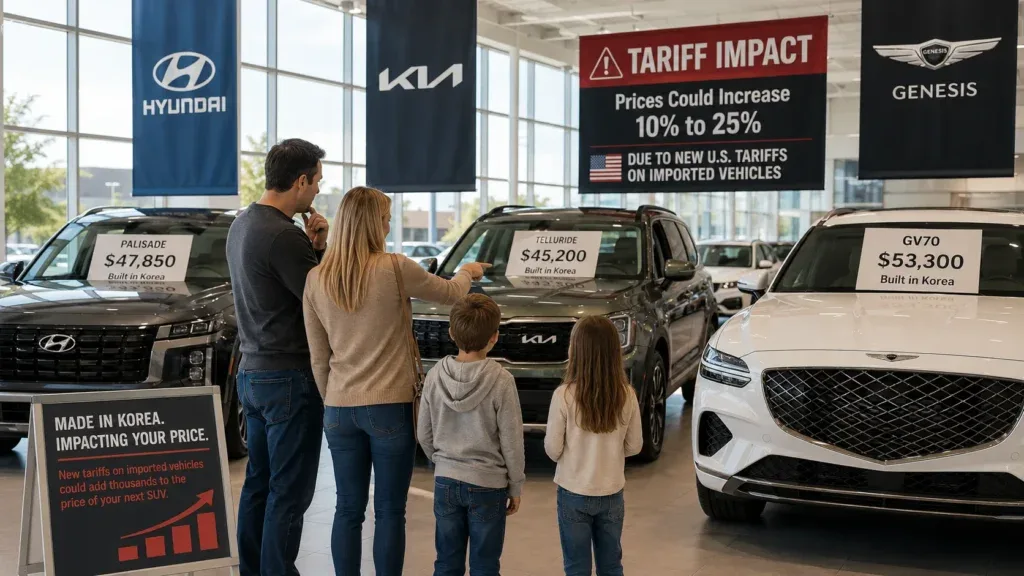
If you’re buying a Hyundai or Kia in the next 30 days: Act now. Existing dealer inventory was priced before the tariff threat. If you wait 60-90 days, Korean-built models could carry higher sticker prices.
If you specifically want the Ioniq 5, EV6, Ioniq 9, or EV9: You’re protected. Georgia-built vehicles are not subject to South Korean import tariffs. Buy with confidence.
If you’re buying a Genesis G80, GV80, or GV90: These Korea-built luxury vehicles are most directly exposed. The G80 and GV80’s premium positioning means Hyundai Motor Group has more margin to absorb some cost — but at $58,000-$80,000 starting prices, even partial pass-through is real money.
If you already own a Korean-built vehicle: Tariffs on new imports don’t affect vehicles already on American roads. Your existing car’s value isn’t immediately affected. Resale value on Korean brand vehicles has been strong and isn’t likely to collapse over this news.
The situation is developing. Korean trade officials are already in contact with US counterparts. A resolution — or an escalation — could come within days or weeks. But buyers who were planning to purchase a Korea-built Hyundai or Kia in the next month have a clear incentive to accelerate that timeline.