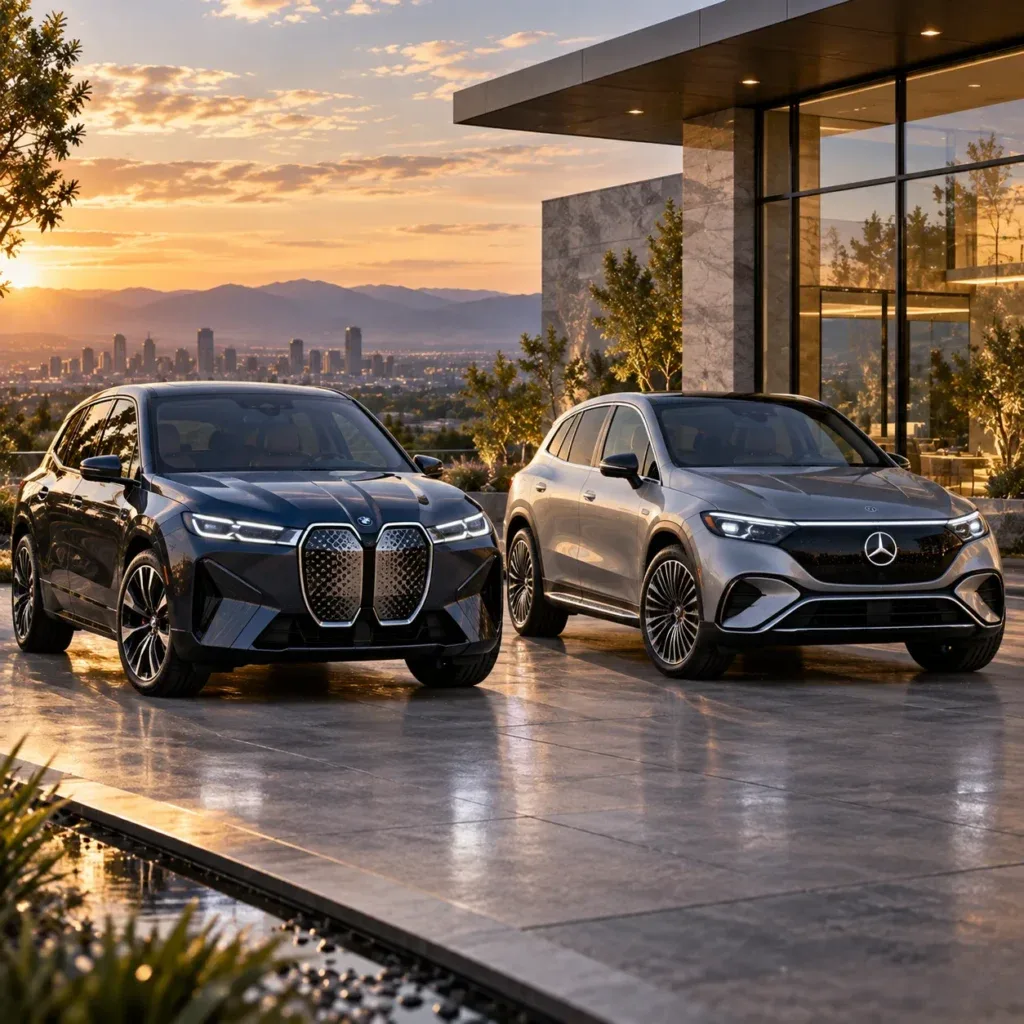
2026 BMW iX vs Mercedes-Benz EQE SUV: Luxury EV Showdown : Let’s be honest—if you’re shopping for a luxury electric SUV in 2026, these two names are at the top of your list. And for good reason.
Both the BMW iX and Mercedes-Benz EQE SUV bring their A-game. But they take completely different approaches to what a luxury EV should be.
BMW focused on driving dynamics and real-world range. Mercedes went for tech, comfort, and a price cut that makes you do a double-take.
So which one actually makes sense for you? Let’s break it down.
Pricing: Mercedes Just Made This Interesting
Start with the numbers—because Mercedes just changed the game.
The 2026 Mercedes-Benz EQE 320+ starts at $64,950** for the rear-wheel-drive version. The all-wheel-drive EQE 320 4MATIC is **$67,450.
Here’s the thing. Mercedes cut prices by as much as $12,950 compared to 2025 models. That’s not a discount—it’s a repositioning. The EQE500 4Matic is gone. The EQE350 became the EQE320. And the price dropped dramatically.
The 2026 BMW iX xDrive45 starts at **$76,325**—roughly $11,000 more than the EQE entry point.
But that’s the base iX. Here’s the full BMW lineup:
| Trim | Horsepower | Range | Price |
|---|---|---|---|
| xDrive45 | 402 hp | 312 miles | $76,325 |
| xDrive60 | 536 hp | 340-364 miles | $88,500 |
| M70 xDrive | 650 hp | 302 miles | $111,500 |
The iX starts higher. But as you’ll see, you get more power for that money.
Performance: BMW Wins on Power
Let’s not sugarcoat this. The BMW iX is the more powerful vehicle across the board.
The base iX xDrive45 produces 402 horsepower and 516 lb-ft of torque. 0-60 takes 4.9 seconds.
The Mercedes EQE 320+ makes 315 horsepower and 417 lb-ft. 0-60 takes 5.9 seconds.
That’s a full second difference. And the iX does it with a bigger battery that gives you more range.
The gap widens as you move up the trims. The iX xDrive60 packs 536 hp and goes 0-60 in 4.4 seconds. The iX M70 hits 650 hp and does it in 3.6 seconds.
Mercedes doesn’t offer a non-AMG EQE variant with more than 315 hp. If you want more power, you’re looking at the AMG version—and that’s a different price bracket entirely.
Range: BMW Goes Further
Range is the other big advantage for BMW.
The iX xDrive45 offers 312 miles of EPA-estimated range on a full charge. But here’s the kicker—real-world testing shows it can exceed that estimate. In one test on a 60-degree day, the xDrive45 traveled 338 miles before the battery hit 5%.
The EQE 320+ offers 302 miles with its rear-wheel-drive setup. That’s solid. But the all-wheel-drive version drops to just 253 miles.
So here’s the choice: Go RWD with the EQE and you’re close to the iX’s range. Go AWD and you lose almost 50 miles compared to the BMW.
Charging: Different Strengths
Both vehicles offer competitive charging speeds, though they approach it differently.
The iX can fast-charge from 10% to 80% in around 35 minutes on a DC fast charger. The xDrive45 accepts up to 175 kW, while the higher trims can take up to 195 kW.
The EQE SUV can charge from 10% to 80% in about 30 minutes at up to 170 kW.
Here’s where Mercedes wins: The 2026 EQE SUV now comes with a standard NACS adapter, giving you access to Tesla’s Supercharger network. The iX also has plug-and-charge capabilities that work with public chargers.
The difference? Mercedes made the Supercharger access standard. With BMW, it’s dependent on which charging network you’re using.
Interior and Technology: Different Philosophies
This is where these two cars really diverge.
BMW iX: The Modern Lounge
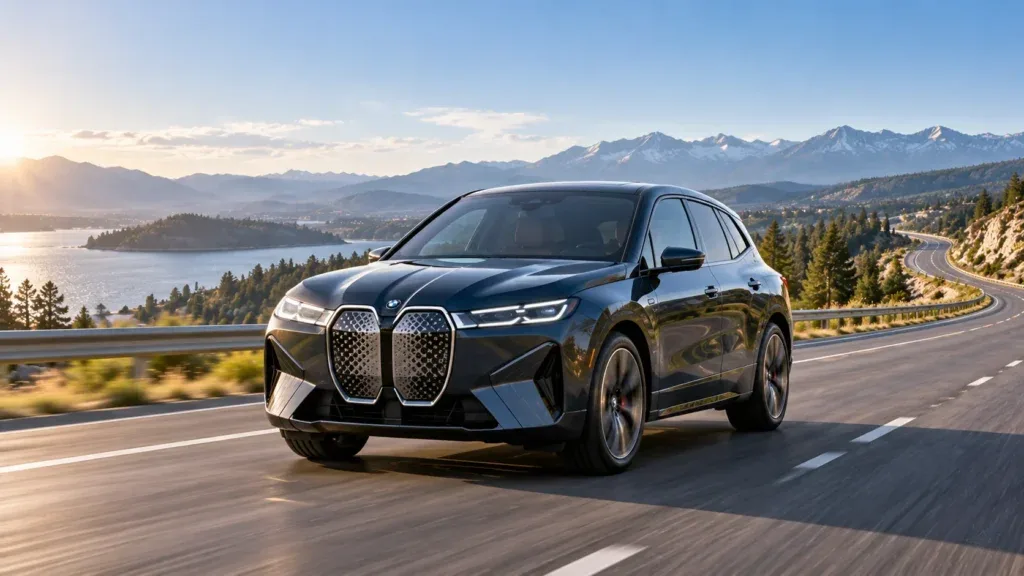
The iX feels like a modern living room on wheels. The curved display combines a 12.3-inch gauge cluster and 14.9-inch touchscreen into one sweeping panel.
The interior uses modern materials like perforated SensaTec leatherette and microfiber/wool textiles. The panoramic eclipsing roof spans the entire cabin and can be shaded at the touch of a button.
The driving experience is where BMW shines. The air suspension delivers 7 Series-level comfort, and the rear-wheel steering makes this large SUV feel agile in city traffic.
The gap between Comfort and Sport modes has widened for 2026. In Comfort, the ride is soft and floaty for highway cruising. Switch to Sport, and the suspension firms up, steering gains weight, and body roll tightens.
One thing to note: The highway hands-free driving assistant is an option, not standard. On higher trims, it’s worth the money.
Mercedes EQE SUV: Tech-Forward and Tempting
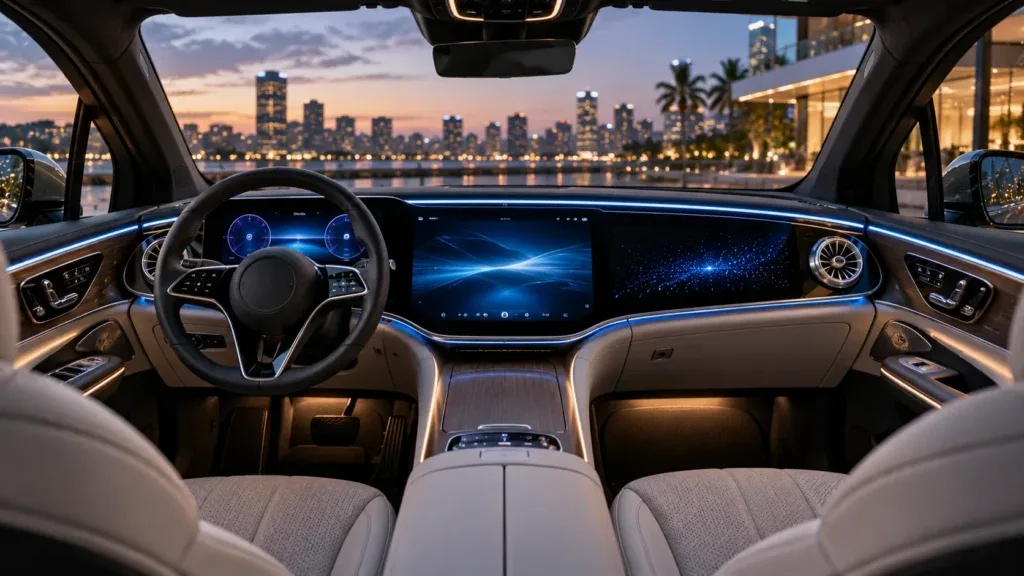
The EQE SUV focuses on tech and options. The standard setup includes a 12.3-inch driver display and a 12.8-inch central touchscreen running MBUX with wireless Apple CarPlay and Android Auto.
The Hyperscreen is the star attraction. For $4,950, you get a 56-inch curved glass display that spans the dashboard, with a 17.7-inch center screen and a 12.3-inch passenger display.
But here’s the catch. The standard 12.8-inch screen is “more than enough,” according to experts. The Hyperscreen is impressive, but you’re paying almost $5,000 for it.
The EQE feels more luxurious in a traditional sense. The fit and finish are excellent. The ambient lighting—64 colors—adds to the upscale feel.
One Important Detail: The EQE’s Single vs Dual Motor
Mercedes made an interesting choice for 2026, and it’s worth paying attention to.
The single-motor EQE 320+ is rear-wheel drive with a 96 kWh battery and 302 miles of range.
The dual-motor EQE 320 4MATIC is all-wheel drive with a smaller 90.5 kWh battery and just 253 miles of range.
Here’s the surprising part. The single-motor version is quicker (5.9 seconds vs 6.2 seconds to 60) because it’s lighter.
Unless you genuinely need AWD for your climate, stick with the single-motor version. You get better range, better performance, and you save $2,500.
Cargo Space: iX Hauls More
If you need to carry stuff, the iX has a clear advantage.
| BMW iX | Mercedes EQE SUV | |
|---|---|---|
| Behind Rear Seats | 35.5 cu-ft | ~14.0 cu-ft |
| Maximum Cargo | 77.9 cu-ft | 55.0 cu-ft |
The iX offers significantly more cargo space—over 20 cubic feet more with the seats folded. That’s the difference between fitting a full family’s luggage for a road trip and playing Tetris with your bags.
The Bottom Line
Both of these are excellent luxury EVs. But they serve different buyers.
Choose the BMW iX if:
-
You want more power (even the base model beats the EQE)
-
Range matters and you don’t want to compromise with AWD
-
You need more cargo space
-
You prioritize driving dynamics and comfort
-
You’re willing to pay a premium for a more capable vehicle
Choose the Mercedes EQE SUV if:
-
Price is your top concern (the EQE starts much lower)
-
You want the tech wow factor (Hyperscreen option)
-
You’re fine with rear-wheel drive and the range it brings
-
You care about brand prestige and traditional luxury feel
-
You don’t need maximum cargo space
The real question isn’t which car is better. It’s which one fits the life you actually live.
If you drive long distances, carry passengers and cargo, and want a vehicle that engages you behind the wheel—the iX is worth the extra money.
If you want a tech-forward luxury EV at a more accessible price point—the EQE, especially the single-motor version, is one of the smartest buys in the segment right now.
One car is the performance-focused luxury SUV. The other is the value-focused tech statement. Both are right. Just for different people.