BYD’s 9-Minute Charging Battery Is a Wake-Up Call for American EVs : On March 5, 2026, BYD — the world’s largest new energy vehicle manufacturer — walked onto a stage in Shenzhen and demonstrated something that made every other automaker’s charging engineers take a hard look at their roadmaps. The BYD Blade Battery 2.0, paired with a new 1,500 kW Flash Charging system, completed a charge from 10% to 97% in 9 minutes under normal conditions. From 10% to 70% in just 5 minutes. Even at -30°C (-22°F) after 24 hours of exposure, the same charge from 20% to 97% took just 12 minutes.
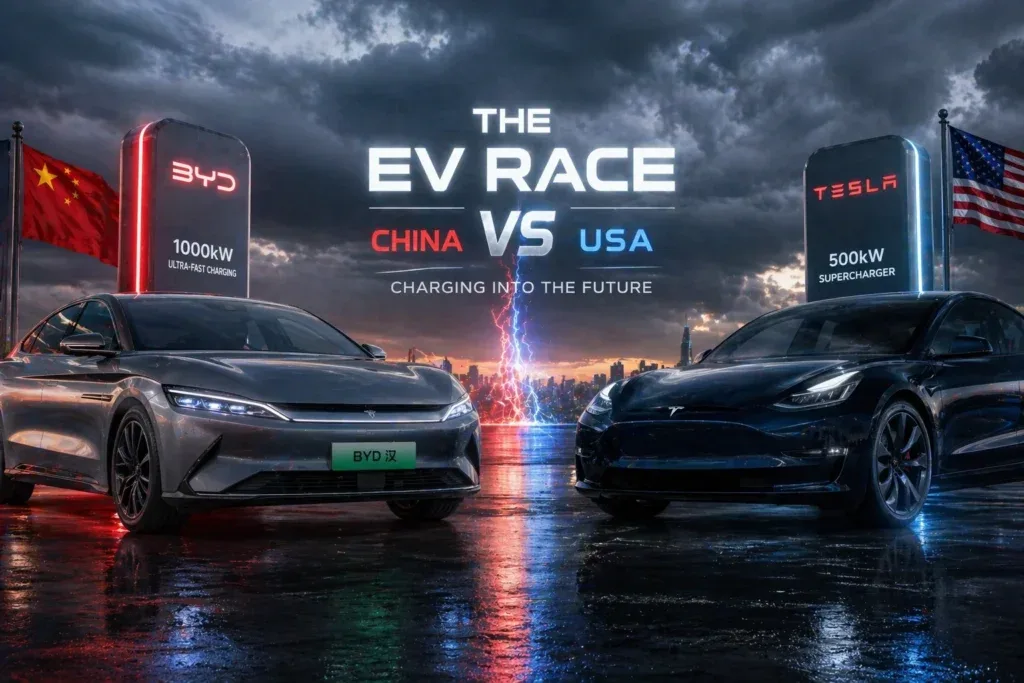
For context: Tesla’s V4 Supercharger delivers up to 250 kW. Most domestic EVs in the U.S. — including the Hyundai Ioniq 5, Ford F-150 Lightning, and Chevy Silverado EV — fast-charge at between 150 kW and 350 kW. BYD’s Flash Charging system delivers 1,500 kW. That is six times the output of Tesla’s fastest charger.
This is not a laboratory concept. BYD says the Blade Battery 2.0 has already launched in 10 mass-production vehicles, and the company is building 20,000 Flash Charging stations across China by the end of 2026.
What Is Blade Battery 2.0?
The original Blade Battery — launched in 2020 — was itself a breakthrough. BYD’s distinctive flat “blade” cell format, designed so the cells serve as structural elements within the battery pack, eliminated the need for traditional module packaging and reduced costs while improving safety. The first-generation Blade Battery powered a wave of BYD products that eventually made the company the world’s top-selling EV manufacturer, surpassing Tesla in total vehicle sales.
Blade Battery 2.0 is a fundamental chemistry upgrade. Three core innovations combine into what BYD calls the FlashPass Ion Transport System:
Flash-Release Cathode: Uses a Lithium Manganese Iron Phosphate (LMFP) chemistry with a directionally engineered, multi-level particle-size architecture. This enables dense packing and dramatically faster lithium-ion release during charging — the key to the extreme charging speed.
Flash-Flow Electrolyte: AI-optimized electrolyte formulation designed for maximum ionic conductivity and ion mobility. Traditional electrolyte formulations are a significant limiting factor in fast charging; BYD’s AI-driven optimization addresses this systematically.
Flash-Intercalate Anode: A silicon-carbon composite anode with multi-dimensional lithium insertion sites, allowing 360-degree, three-dimensional lithium-ion intercalation at extremely high rates.
The combination of these three systems is what enables the 10C charging rate — where “C” refers to the battery’s capacity. A 1C charge rate fills the battery in one hour. A 10C rate theoretically fills it in six minutes. BYD achieves this in nine minutes in practice, accounting for battery management and thermal management overhead.
Energy density also improved. The new Blade Battery 2.0 achieves approximately 162 Wh/kg system-level energy density — about 15% better than the previous generation. This enables BYD’s Denza Z9GT to achieve a 1,036 km (644 miles) CLTC range, and the Yangwang U7 to achieve 1,006 km (625 miles). In U.S. EPA-equivalent terms, these translate to roughly 400–450 miles of real-world range — competitive with the longest-range American EVs available.
Cold weather performance — historically a weakness of lithium iron phosphate chemistry — has been dramatically addressed. The first-generation Blade Battery struggled at low temperatures, with significant range degradation. The 2.0 can charge from 20% to 97% in just 12 minutes at -30°C — a figure that outperforms virtually every Western EV battery in extreme cold conditions.
The Infrastructure Play: 20,000 Flash Chargers
Battery chemistry means nothing without compatible charging infrastructure. BYD’s announcement addresses this directly with the Flash Charging China initiative — a plan to deploy 20,000 Flash Charging stations across China by the end of 2026.
The strategy is clever. Rather than building entirely new standalone charging locations (expensive and slow), BYD is embedding Flash Charging piles within existing public charging networks using a “station-within-a-station” model. BYD’s Flash Charging piles use energy storage batteries as a buffer, drawing power from the existing charging network infrastructure to charge the storage batteries, then delivering 1,500 kW peak output to compatible vehicles. This sidesteps the need for costly grid upgrades at each location.
The deployment plan includes 2,000 highway Flash Charging stations covering roughly one-third of China’s highway service areas, with a Flash Charging station accessible every 100 km on major routes.
Overseas expansion is also planned. BYD specifically mentioned Europe as the first international target for Flash Charging deployment. The first European vehicle to feature Blade Battery 2.0 and Flash Charging will be the Denza Z9GT.
What This Means for U.S. EV Buyers Right Now 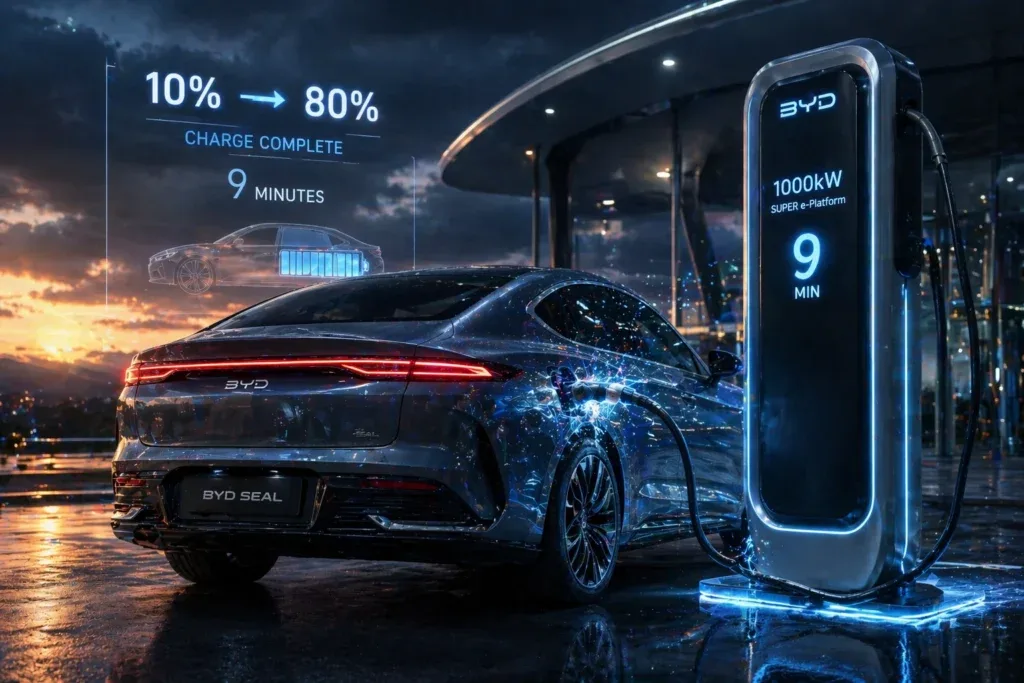
The honest assessment: BYD’s Flash Charging and Blade Battery 2.0 are not available in the U.S. and won’t be anytime soon, given the significant import tariffs that currently block Chinese vehicles from the American market.
But this technology benchmark matters for several reasons:
It raises the bar for what “fast charging” means. The industry has been celebrating 350 kW DC fast charging as a premium feature. BYD has just demonstrated that mass-market vehicles can charge at 1,500 kW. American consumers will increasingly compare what their $45,000 Hyundai or Toyota EV offers against what the global benchmark has become.
It pressures American and European automakers to accelerate. BMW, Mercedes, Stellantis, and others are watching BYD’s technology demonstrations carefully. The next generation of U.S.-market EVs will need to close this charging speed gap or explain why they haven’t. Battery suppliers like CATL — which supplies many Western brands — are racing to match BYD’s Blade Battery 2.0 with their own Shenxing supercharging technology.
It validates the EREV approach for trucks. The reason the Ram 1500 REV uses a range-extender rather than a pure battery is that current U.S. fast-charging infrastructure can’t practically support very large batteries for work trucks. If BYD’s charging technology eventually arrives in American charging networks, the case for pure-electric work vehicles becomes significantly stronger.
It confirms that battery anxiety is a solvable problem. A 9-minute charge to 97% is faster than filling up most gas tanks. If this technology becomes standard, the primary practical objection to EV ownership — charging time — essentially disappears.
The gap between Chinese and American EV technology is narrowing on some metrics and widening on others. Charging speed is one area where Western manufacturers have significant catching up to do.
also read https://driveglobalnews.in/2026-beijing-auto-show-opens-worlds-largest/
Want to see how charging costs compare between today’s US EVs? Our EV Charging Cost Calculator shows monthly electricity costs. Our EV vs Gas Cost Calculator compares total running costs, and our EV Cost Per Mile Calculator shows per-mile operating cost. Compare your options with our Car Ownership Cost Calculator.