
Here’s the thing about car ownership that dealerships don’t put on the window sticker.
The price you pay on day one is not the price you pay to own the car. It’s just the beginning.
The average American spends $1,013 per year on maintenance and repairs — and that’s assuming nothing goes seriously wrong. That number has been climbing every year as parts get more expensive, labor rates increase, and modern cars become more complex to service.
But here’s what that average hides: Toyota owners spend $633 per year. Honda owners spend $583 per year. BMW owners spend over $1,200 per year — nearly double the Toyota figure, in a car that also cost twice as much to buy.
Over ten years, the gap between the cheapest brand to maintain and the most expensive is nearly $8,000. That’s a used car. That’s a year of college tuition. That’s real money that most people are accidentally giving away because they bought the wrong car for the wrong reasons.
Here are the actual cheapest cars to maintain in America — with real numbers, not guesses.
also read : https://driveglobalnews.in/the-biggest-mistake-suv-buyers-are-making-righ/
Why Some Cars Cost More to Maintain — The Simple Explanation
Before the list, the explanation is worth understanding because it applies to everything you’ll ever buy.
Cars cost less to maintain when three things are true: parts are cheap and widely available, mechanics can work on them without expensive specialized tools, and the engineering is simple enough that routine jobs stay routine.
Toyota and Honda win the maintenance cost battle because they’ve been making the same basic engines and platforms for decades. A Toyota mechanic in rural Montana can service a 2026 Corolla with the same tools and knowledge they’ve been using for 15 years. Parts are made by dozens of suppliers worldwide because the volume of Toyota vehicles makes that market worth serving. The result is competitive part prices and labor costs that stay reasonable because nothing is mysterious.
European luxury brands lose the maintenance cost battle for the exact opposite reasons. Proprietary engineering. Parts that come from a single source. Diagnostic software that requires expensive equipment. Labor procedures that take twice as long because the systems are more complex. You pay for that on every visit, for the life of the car.
The Cheapest Cars to Maintain in America
Toyota Corolla Hatchback — Lowest Total Cost of Ownership in America
CarEdge analyzed millions of data points and ranked the Toyota Corolla Hatchback as the car with the lowest five-year total cost of ownership in all of America for 2026. Not the cheapest to buy. The cheapest to own — when you factor in depreciation, maintenance, fuel, insurance, and financing together.
The numbers that drive that ranking: only 20% projected depreciation over five years, which is extraordinary for a mass-market car. Annual maintenance that runs $400-$500 — less than half the national average. A powertrain that’s been in continuous production long enough that every mechanic understands it completely.
Oil changes are $50-$70. Brake pads are $150-$250 for a full set. These are the kinds of services that stay predictable year after year rather than evolving into diagnostic sessions that cost $200 before the wrench even touches the car.
For commuters, students, first-time buyers, and anyone who primarily needs reliable transportation at the lowest possible all-in cost — nothing in America matches this car on real ownership economics.
also read : https://driveglobalnews.in/10-most-reliable-suvs-americans-can-buy-in-2026/
Toyota Prius — $4,359 Over 10 Years

The Prius has a maintenance cost advantage that’s counterintuitive until you understand why.
The hybrid system’s regenerative braking means the physical brake pads last dramatically longer than in a conventional car — sometimes 100,000+ miles before replacement. The engine runs fewer total hours because the electric motor handles low-speed driving. Fewer combustion hours means slower wear on engine components.
CarEdge’s 10-year maintenance cost for the Prius: $4,359 — the lowest of any Toyota, and genuinely remarkable for a vehicle that’s been in continuous production since 1997. The failure modes are comprehensively documented. Major component failures on maintained examples are rare enough to qualify as unusual rather than expected.
Toyota’s 10,000-mile oil change interval on the Prius also means fewer service visits per year than conventional cars with 5,000-mile intervals. Less frequent routine maintenance at manageable costs.
Toyota Camry — One of the Most Reliable Sedans on Earth
The Camry is slightly more expensive than the Corolla to own — but it earns its place on this list because it consistently delivers low maintenance costs at a size that serves more buyers.
Toyota’s 10-year maintenance cost across the brand averages $5,470. The Camry comes in below that brand average. Oil changes, tire rotations, and standard service intervals run through decades of Camry ownership without drama for most buyers. The 2026 Camry Hybrid — now the only powertrain available — adds the Prius-style braking advantage while improving fuel economy to 51 MPG combined.
Honda Civic — The Most Practical Alternative
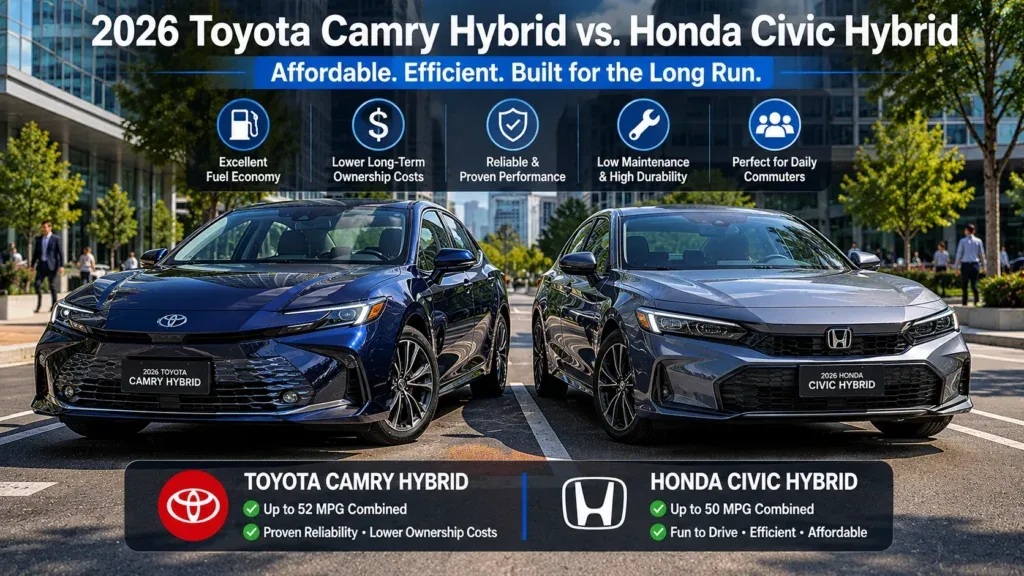
Honda’s annual maintenance cost of $583 per year is actually lower than Toyota’s $633 on a per-year basis, according to ConsumerAffairs data. Over a decade, CarEdge shows Toyota coming out ahead at $5,470 versus Honda’s $6,799 — but both figures are dramatically better than the industry average of over $10,000 for ten years.
The Civic’s maintenance advantage comes from the same sources as the Corolla’s: enormous production volume creates a parts market with genuine competition, keeping prices reasonable. Mechanics who know Civics are everywhere. Diagnostic procedures are straightforward. Routine maintenance stays routine.
The 2026 Civic Hybrid specifically — iSeeCars’ best new car for money per year of ownership — projects a 13.5-year lifespan at $2,058 per year in total cost. That’s the whole picture: depreciation, insurance, maintenance, and fuel combined. For a car you can buy new for under $30,000, that’s genuinely extraordinary.
Honda CR-V — The SUV That Doesn’t Drain Your Account
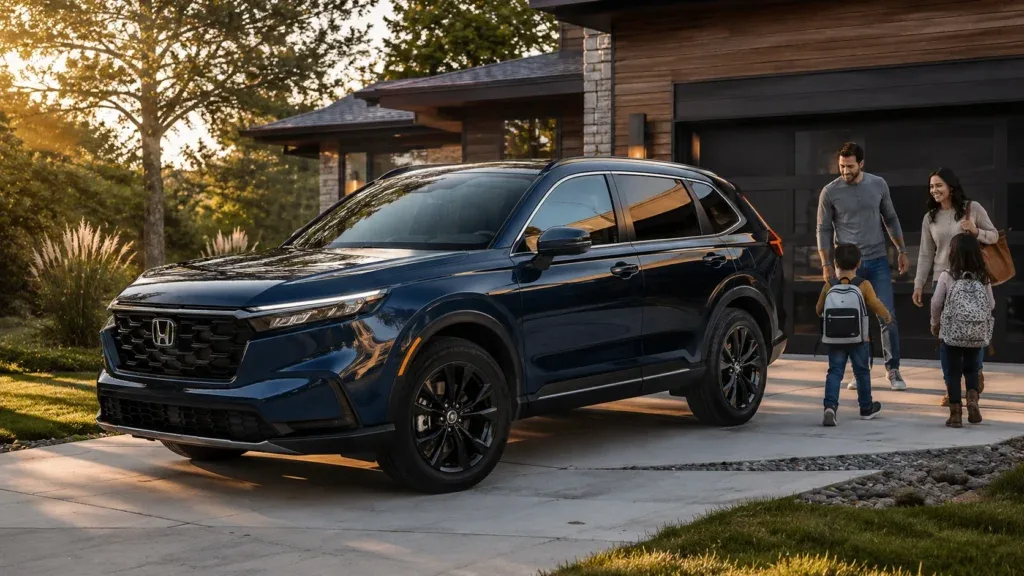
For buyers who need SUV practicality rather than sedan efficiency, the CR-V consistently ranks among the most economical compact SUVs to maintain.
Its popularity ensures parts availability that keeps prices competitive. The repair procedures are standardized. Annual maintenance typically runs $500-$650 — reasonable for a vehicle at this size and capability level.
The CR-V Hybrid specifically adds the braking advantage while delivering 36 MPG combined. For families who need more space than a sedan offers but want to keep maintenance costs manageable — the CR-V is the honest answer.
The One Category to Avoid If Maintenance Costs Matter

Luxury European brands.
BMW averages over $1,080 per year in maintenance according to RepairPal. Their 10-year costs exceed $15,000. Parts are more expensive because supply chains are narrower. Labor takes longer because procedures are more complex. Diagnostic equipment requirements add cost to every visit.
Land Rover exceeds $20,000 in 10-year maintenance by most measures. Mercedes averages maintenance costs more than double what Toyota owners pay. These aren’t brands that are unreliable in a catastrophic sense — they’re brands whose routine maintenance is expensive because of deliberate engineering choices that prioritize performance and innovation over serviceability and parts cost.
That trade-off is fine if you’re aware of it going in. Most buyers aren’t.
The Bottom Line
The sticker price is where most people focus their attention. The maintenance cost is where the money actually goes.
Toyota and Honda win this comparison because they designed vehicles that mechanics can fix affordably, that parts suppliers serve competitively, and that run long enough to benefit from both advantages for 200,000 miles or more.
Buy a Corolla or Civic and you’re buying 15+ years of predictable, affordable ownership. Buy a European luxury brand and you’re buying a different experience — more impressive in some ways, significantly more expensive to maintain in ways that add up quietly for a decade.
Know the real number before you decide which one is worth it to you.