Tesla Is Betting Everything on One Idea : There are two ways to look at Tesla right now.
The first is as an electric car company facing more competition than ever before.
The second is as a company that no longer wants to be viewed as a car company at all.
And honestly, that second version might be the more important story.
Because while most automakers are still fighting for EV market share, Tesla is increasingly talking about something else entirely.
Robotaxis.
Artificial intelligence.
Autonomous driving.
A future where the company makes money not just from selling vehicles, but from operating them.
That’s the future Elon Musk keeps describing.
And whether people believe it or not, Tesla is clearly building the company around that idea.
also read : https://driveglobalnews.in/cheapest-cars-to-maintain-in-america-the-honest/
Tesla Doesn’t Want to Win the EV Race Anymore
A few years ago, the conversation around Tesla was simple.
How many vehicles did it sell?
How fast was production growing?
Could competitors catch up?
Now the discussion feels different.
Because Tesla itself seems different.
The company still sells electric vehicles.
The Model Y remains one of the most recognizable EVs in America.
But more and more of Tesla’s future appears tied to autonomy rather than traditional vehicle sales.
That’s a major shift.
And it helps explain why Tesla keeps talking about robotaxis even when investors ask about vehicle deliveries.
The Robotaxi Push Is Becoming Impossible to Ignore

For years, robotaxis felt like one of those Tesla promises that always seemed just over the horizon.
Now they’re actually operating.
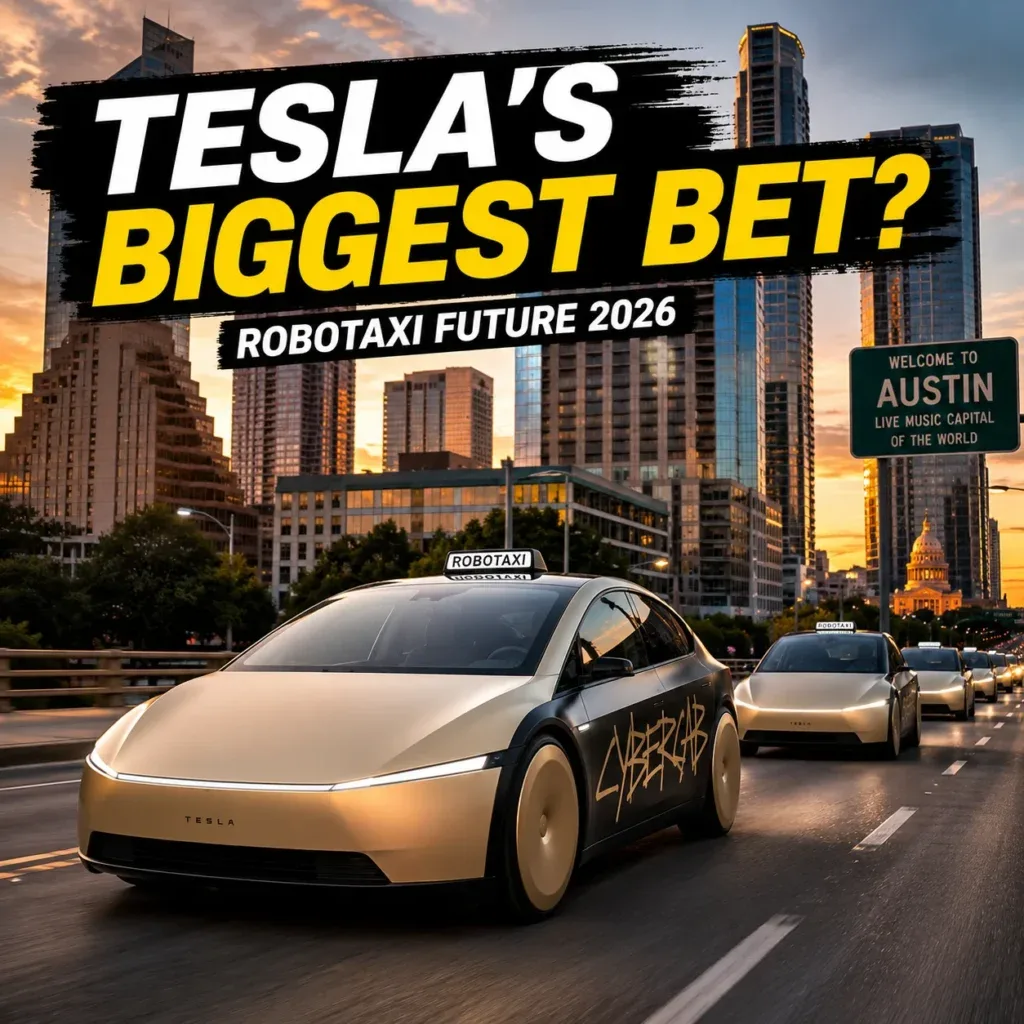
Tesla has been expanding robotaxi activity across parts of Texas, including Austin, Dallas, and Houston, while continuing to test autonomous ride-hailing services. Elon Musk recently said he expects robotaxis to become much more widespread across the United States by the end of the year.
That sounds ambitious.
Because with Tesla, it usually is.
But the difference today is that robotaxis are no longer theoretical.
They’re real vehicles carrying real passengers.
The bigger question is whether Tesla can scale the system fast enough.
also read : https://driveglobalnews.in/toyota-rav4-hybrid-vs-honda-cr-v-hybrid/
The Problem Nobody Wants to Talk About
The robotaxi story sounds exciting.
The reality is more complicated.
Tesla’s autonomous fleet remains relatively small compared to competitors like Waymo. Reports show Tesla’s robotaxi operations in Texas are still limited while rivals have significantly larger autonomous fleets already operating in multiple cities.
That’s important because scaling autonomous transportation isn’t just a technology challenge.
It’s a trust challenge.
People need to believe the vehicles are safe.
Regulators need to believe the vehicles are safe.
Cities need to believe the vehicles are safe.
And right now, that remains one of Tesla’s biggest hurdles.
Why Investors Still Keep Betting on Tesla
Here’s the fascinating part.
Despite all the uncertainty, investors continue treating Tesla differently than almost every other automaker.
Because many investors aren’t valuing Tesla like a car company anymore.
They’re valuing it like a future AI company.
A robotics company.
An autonomy company.
A company that could eventually operate millions of self-driving vehicles.
That’s why every robotaxi update receives so much attention.
The market isn’t simply watching Tesla’s current business.
It’s trying to predict what Tesla could become.
Tesla’s Biggest Advantage
For all the criticism Tesla receives, the company still has one major advantage.
Data.
Millions of Tesla vehicles are already on roads around the world.
Every mile driven helps improve Tesla’s systems.
Every interaction creates more information.
That’s a powerful asset.
Tesla believes that scale gives it an advantage many competitors can’t easily replicate.
The company’s entire autonomy strategy is built around that belief.
If Tesla is right, the payoff could be enormous.
If Tesla is wrong, the consequences could be equally significant.
The Cybercab Changes Everything

One reason Tesla appears so focused on robotaxis is the Cybercab.
Unlike the Model Y or Model 3, the Cybercab wasn’t designed around traditional ownership.
It was designed around autonomy.
No steering wheel.
No pedals.
No pretending it’s a normal car.
Tesla recently confirmed Cybercab production progress as the company pushes further into autonomous transportation. The vehicle represents one of the clearest examples yet of where Tesla believes the industry is heading.
And that’s what makes the Cybercab so important.
It’s not just a vehicle.
It’s a statement.
Tesla is telling the industry that it believes autonomous transportation will become a major business category.
The Risk Is Larger Than Most People Realize
Here’s the uncomfortable reality.
The more Tesla focuses on robotaxis and AI, the less room there is for failure.
Because the company’s future story increasingly depends on those technologies succeeding.
Traditional automakers can survive disappointing software projects.
Tesla has attached a huge part of its future identity to autonomy.
That raises the stakes dramatically.
Especially when safety concerns continue generating headlines and questions about how quickly fully autonomous driving can realistically scale.
The Real Story
Most people think Tesla is fighting an EV battle.
That’s not really what’s happening anymore.
The company already changed the electric vehicle industry.
Now it’s trying to change transportation itself.
That’s a much bigger goal.
And a much riskier one.
Because building a great electric vehicle is difficult.
Convincing millions of people to trust a driverless future is something else entirely.
Tesla seems willing to take that risk.
The company keeps investing.
Keeps expanding testing.
Keeps talking about autonomy as if it’s inevitable.
Maybe that’s confidence.
Maybe it’s ambition.
Maybe it’s both.
But one thing is becoming increasingly clear.
Tesla is no longer betting its future on selling more electric cars.
It’s betting its future on a world where cars eventually drive themselves.
And if that vision works, Tesla could look incredibly smart.
If it doesn’t, the company may discover that the biggest opportunities are often attached to the biggest risks.
Either way, Tesla isn’t thinking like a traditional automaker anymore.
And that might be the most important Tesla story happening right now.