
Lowest Insurance Costs in America : There are two kinds of SUV buyers.
The first group spends weeks comparing prices.
The second group spends months paying for a decision they didn’t fully calculate.
The difference usually comes down to one thing.
Insurance.
It’s one of the least exciting parts of buying a vehicle.
Nobody walks into a dealership dreaming about insurance premiums.
Nobody watches YouTube reviews comparing insurance rates.
Nobody posts Instagram photos of affordable coverage.
And yet it’s one of the largest ownership costs most Americans face.
The strange part?
Many buyers will spend hours researching horsepower, fuel economy, and touchscreen sizes while completely ignoring insurance costs.
Then six months later they discover their “great deal” costs hundreds more per year to insure than expected.
That’s why smart SUV buyers don’t just ask:
“How much does it cost to buy?”
They ask:
“How much does it cost to own?”
The SUVs on this list aren’t necessarily the cheapest to purchase.
But they’re among the friendliest to your insurance budget.
And over five years of ownership, that difference can become surprisingly significant.
also read : https://driveglobalnews.in/toyota-rav4-hybrid-vs-honda-cr-v-hybrid/
What Makes an SUV Cheap to Insure?
Insurance companies aren’t randomly assigning prices.
They’re looking at risk.
Vehicles that are frequently stolen, aggressively driven, expensive to repair, or involved in more accidents usually cost more to insure.
Vehicles with strong safety ratings, lower repair costs, and family-oriented ownership patterns often cost less.
That’s why some surprisingly expensive SUVs can have lower insurance costs than cheaper vehicles.
The insurance company isn’t looking at what you paid.
It’s looking at what might happen next.
And these SUVs tend to make insurers feel comfortable.
also read : https://driveglobalnews.in/cheapest-cars-to-maintain-in-america-the-honest/
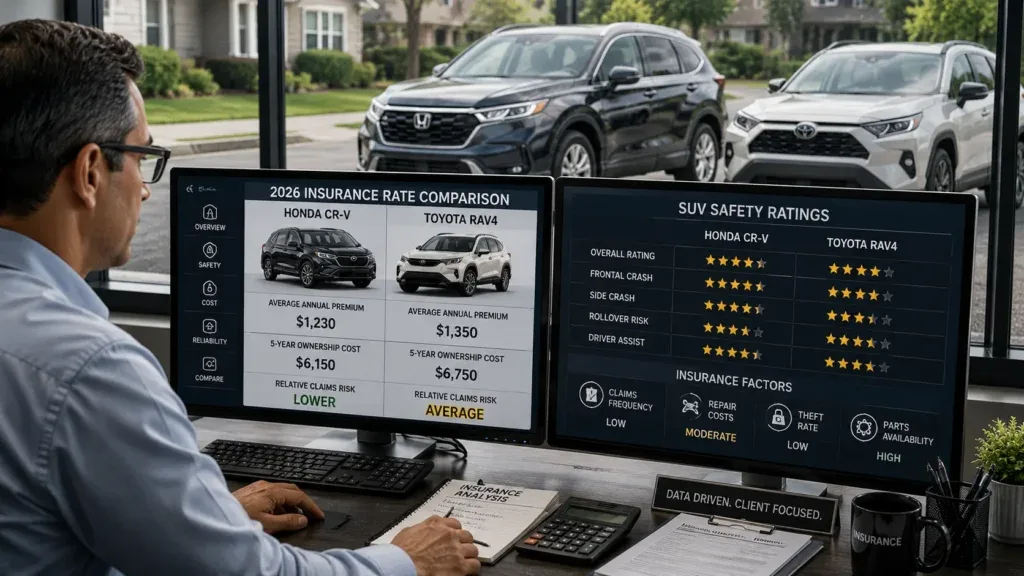
1. Honda CR-V
Best For: Families Who Hate Unexpected Expenses
There may not be a safer answer in the compact SUV world.
The Honda CR-V has spent years building a reputation as one of America’s most practical family vehicles.
Insurance companies love predictability.
The CR-V is predictable.
Strong safety scores.
Reliable ownership history.
Reasonable repair costs.
Responsible drivers.
All those factors combine to keep insurance premiums relatively affordable.
The CR-V rarely wins attention with flashy headlines.
Instead, it wins something more valuable.
Trust.
2. Toyota RAV4
Best For: Buyers Who Want Low Stress Ownership
If reliability had a competition, the RAV4 would probably make the finals every year.
Insurance companies know it.
Owners know it.
And that’s reflected in insurance costs.
The RAV4 consistently attracts drivers focused on practicality rather than performance.
That matters.
Because insurance pricing is heavily influenced by driver behavior and historical claims data.
The RAV4 benefits from years of responsible ownership patterns.
The result?
Lower premiums than many buyers expect.
3. Subaru Forester
Best For: Snow States and Outdoor Families
The Forester has built one of the most loyal owner communities in America.
Part of that comes from capability.
Part comes from reliability.
And part comes from affordability.
Subaru owners tend to keep their vehicles for a long time.
Insurance companies notice trends like that.
The Forester’s excellent safety ratings and standard all-wheel drive further strengthen its insurance profile.
It’s one of those vehicles that quietly saves money in multiple ways.
4. Hyundai Tucson
Best For: Value-Focused Buyers
The Tucson doesn’t always get as much attention as the RAV4 or CR-V.
Maybe it should.
Hyundai has dramatically improved quality, safety technology, and overall ownership experience over the past decade.
Insurance costs have benefited from those improvements.
The Tucson often delivers a strong combination of affordability, modern features, and reasonable insurance expenses.
For budget-conscious families, that’s a powerful combination.
5. Mazda CX-5
Best For: Drivers Who Want Something More Interesting
Some affordable SUVs feel boring.
The Mazda CX-5 isn’t one of them.
It offers a premium feel without creating premium insurance costs.
That’s part of its appeal.
The CX-5 attracts mature buyers, earns strong safety ratings, and avoids the high-risk profile associated with performance-focused vehicles.
Insurance companies tend to reward that combination.
Owners often benefit from surprisingly reasonable premiums.
6. Chevrolet Equinox
Best For: American Buyers Looking for Value
The Equinox rarely dominates automotive headlines.
But it consistently delivers one important advantage.
Affordability.
That affordability extends beyond the purchase price.
Insurance costs are often competitive compared to many rivals.
The Equinox’s practical design, widespread parts availability, and mainstream ownership profile help keep insurance expenses manageable.
For many families, that’s exactly what matters most.
7. Toyota Highlander
Best For: Larger Families
Three-row SUVs often bring larger insurance bills.
The Highlander is one of the exceptions.
Toyota’s reputation for safety and reliability works in its favor once again.
The Highlander is typically purchased by families rather than thrill-seekers.
Insurance companies understand that.
Combined with excellent crash-test performance and strong long-term dependability, the Highlander frequently maintains insurance costs that remain reasonable despite its size.
8. Buick Envision
Best For: Comfortable, Low-Drama Ownership
The Envision is one of the most underrated SUVs in America.
And that’s exactly why it belongs here.
It’s comfortable.
It’s practical.
It’s rarely involved in the kind of high-risk ownership patterns that increase insurance costs.
Many buyers overlook Buick entirely.
Insurance companies don’t.
The Envision’s ownership profile helps create some surprisingly affordable insurance premiums.
And that’s worth paying attention to.
The Quick Reality Check

Let’s be honest.
Insurance costs depend on more than the vehicle.
Your age.
Your driving record.
Your ZIP code.
Your coverage level.
All of those factors matter.
But the vehicle itself still plays a major role.
Choosing the right SUV can save hundreds of dollars every year.
Over five years, that can easily become thousands.
That’s real money.
Money that could stay in your savings account instead of disappearing into insurance payments.
Which One Should You Actually Buy?
If you want the safest overall recommendation, start with the Honda CR-V or Toyota RAV4.
If winter weather is part of your life, the Subaru Forester deserves serious attention.
If value matters most, the Hyundai Tucson and Chevrolet Equinox are difficult to ignore.
And if you want something that feels a little more premium without increasing ownership costs, the Mazda CX-5 might be the smartest choice on this list.
The bigger lesson, however, isn’t about any single SUV.
It’s about how Americans shop for vehicles.
Too many buyers focus on the purchase price.
Too few focus on ownership costs.
The smartest SUV buyers understand both.
Because the vehicle that saves you money at the dealership isn’t always the vehicle that saves you money over the next five years.
And when insurance premiums arrive month after month, year after year, that difference becomes impossible to ignore.
The best SUV isn’t always the cheapest one to buy.
Sometimes it’s the one that quietly costs less to own.