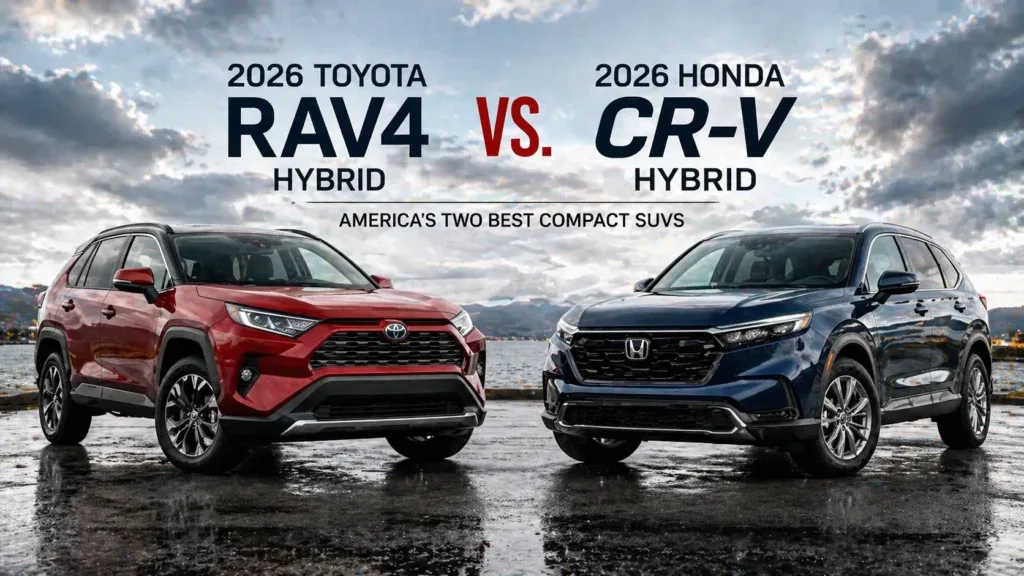
Two SUVs. Both hybrid. Both from brands Americans have trusted for decades. Both perpetually on every “best compact SUV” list printed in the last five years.
And yet — they are not the same car. Not even close.
The Toyota RAV4 Hybrid and the Honda CR-V Hybrid target the same buyer on paper: a practical family who wants good fuel economy, standard AWD, and the peace of mind that comes from a Japanese brand with a reliability track record a mile long.
In reality, they make different decisions at every turn. Better fuel economy versus more rear legroom. More towing versus a quieter cabin. Lower starting price versus more interior space.
One of them is almost certainly better for your specific situation. Here’s how to figure out which one.
The Numbers First
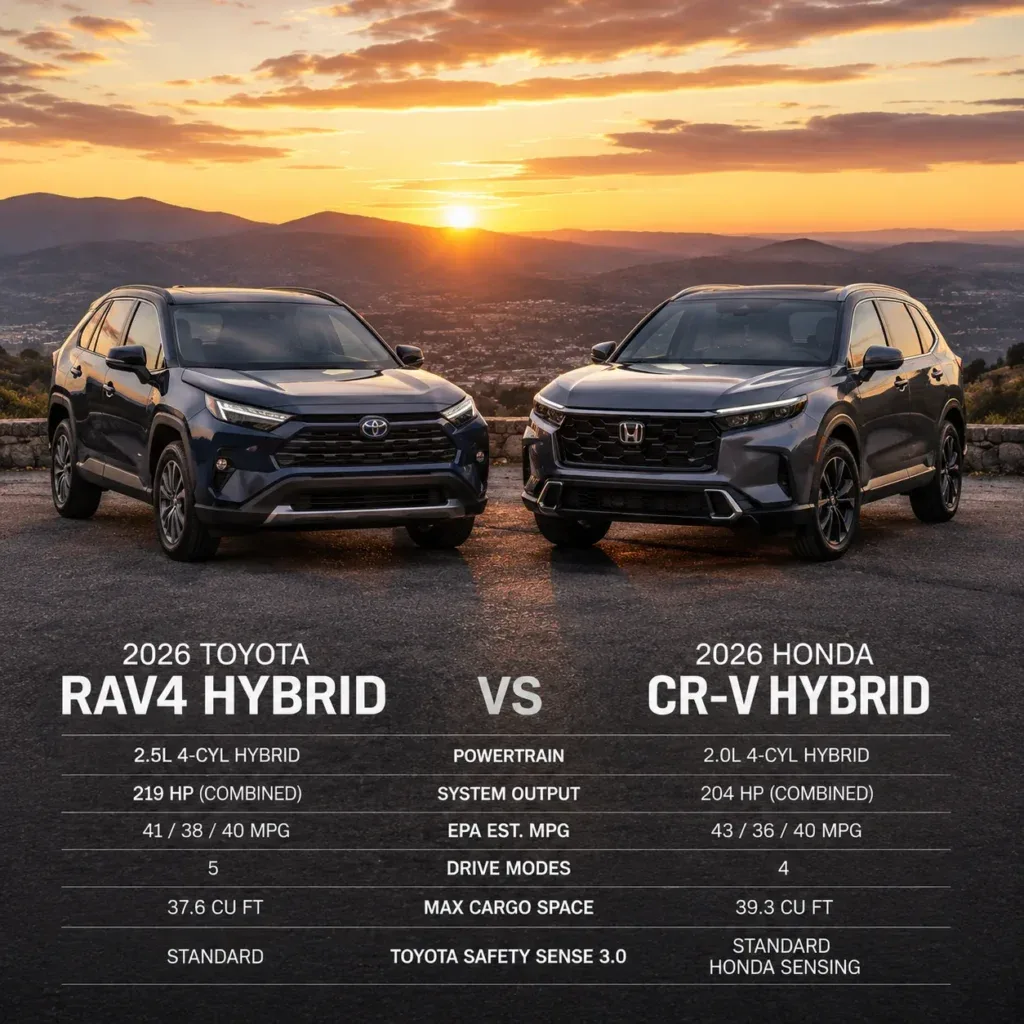
| 2026 Toyota RAV4 Hybrid | 2026 Honda CR-V Hybrid | |
|---|---|---|
| Starting Price | $33,700 | $37,080 |
| Fuel Economy (AWD) | 40 MPG combined | 36 MPG combined |
| Horsepower | 236 HP | 204 HP |
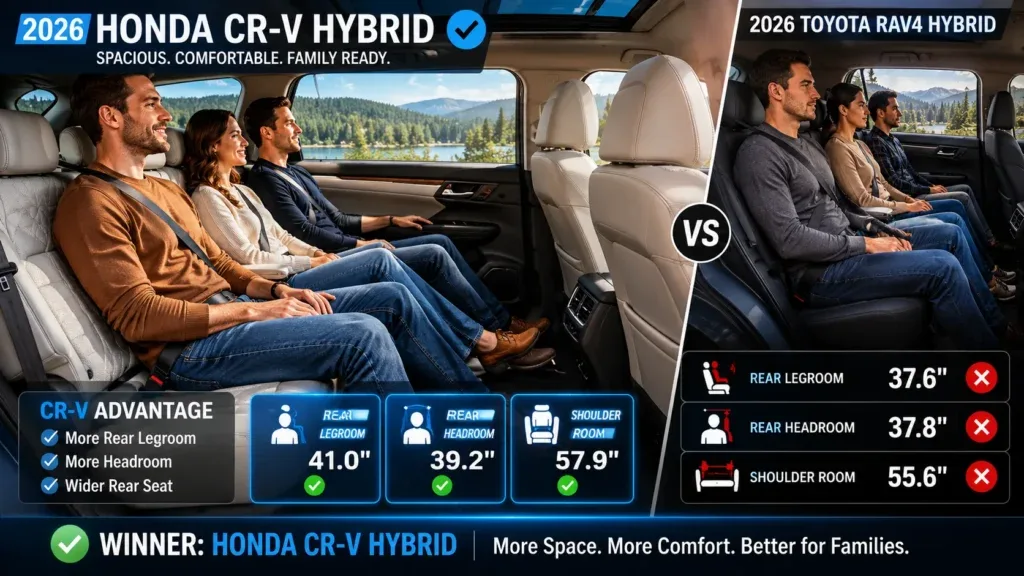
| Rear Legroom | 37.8 inches | 41.0 inches |
| Cargo (seats up) | 37.6 cu ft | 39.3 cu ft (gas) |
| Towing Capacity | 3,500 lbs | 1,000-1,500 lbs |
| Noise (full accel) | 75 decibels | 72 decibels |
| AWD | Standard | Optional |
| Built | Georgetown, KY | East Liberty, OH |
Three numbers from that table define which car wins your comparison.
The RAV4 starts $3,380 cheaper, gets 4 more MPG, and tows 2,000-2,500 more pounds.
The CR-V has 3.2 more inches of rear legroom and a quieter cabin.
Everything else is close enough that most buyers won’t notice the difference in daily life.
also read : https://driveglobalnews.in/toyota-camry-hybrid-vs-honda-accord-hybrid-202/
The Case for the Toyota RAV4 Hybrid — And It’s Genuinely Strong
Edmunds ran the value comparison and gave it to the RAV4. Their reasoning is hard to argue with.
Every 2026 RAV4 sold in America is a hybrid. Toyota made that decision because the hybrid version is simply better — more power, better fuel economy, same price. You don’t have to figure out which trim level unlocks the hybrid powertrain like you do with the CR-V. Every base RAV4 at $33,700 already has it.
The fuel economy gap is real and it compounds. At $4.50 gas and 15,000 annual miles, 40 MPG costs approximately $1,688 per year in fuel. The CR-V at 36 MPG costs $1,875. That’s $187 per year — over seven years of ownership, $1,309 in fuel savings just from the MPG difference. Combined with the $3,380 lower starting price — the RAV4 Hybrid is approximately $4,700 cheaper to own over seven years before you factor in anything else.
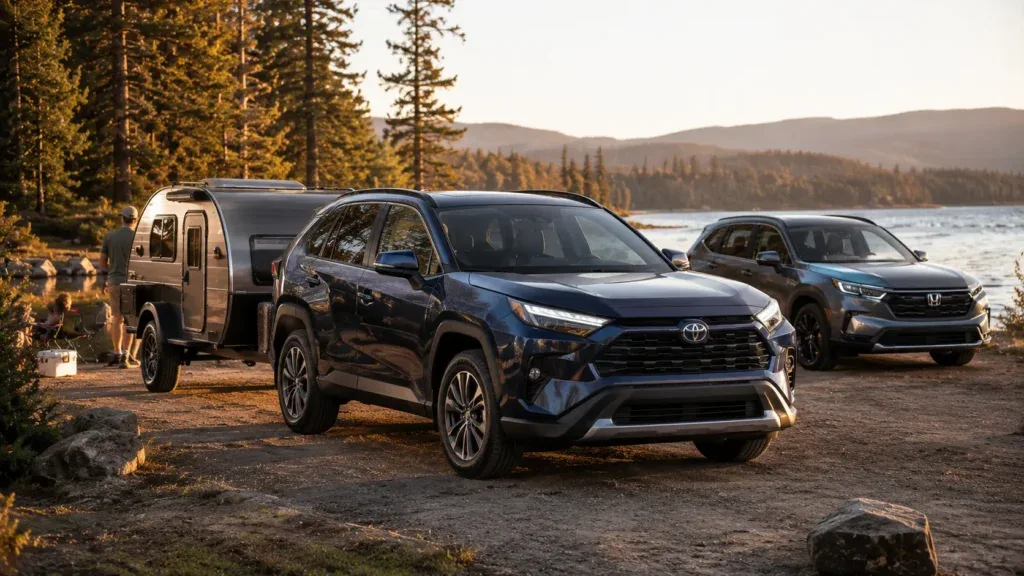
The towing capacity is where the RAV4 wins the argument outright for a specific buyer. 3,500 pounds versus 1,000-1,500 pounds from the CR-V isn’t a slight difference. That’s the difference between towing a small camper, a boat, or a utility trailer — and being limited to a bike rack and a lightweight cargo trailer.
Autoblog drove both the 2026 RAV4 Woodland and CR-V TrailSport back-to-back in April and put it directly: “The Toyota’s towing figure gives the Woodland real-world SUV credibility that the CR-V somewhat lacks.” That assessment applies across the lineup, not just the off-road trims.
The 2026 RAV4’s redesign is also genuinely significant. New 12.3-inch instrument cluster. 12.9-inch touchscreen on most trims. A GR Sport trim that actually makes the RAV4 feel like someone who enjoys driving might have had input on it. The previous generation was practical to the point of being anonymous. This generation has personality.
Buy the RAV4 if: Budget matters. You occasionally tow anything beyond a bike rack. Fuel economy is a monthly priority. You want AWD standard without paying extra. Or you want the option to add the PHEV version later with 50 miles of electric range.
also read : https://driveglobalnews.in/best-family-suvs-in-the-usa-for-2026-ranked-by/
The Case for the Honda CR-V Hybrid — The One Reviewers Love to Drive
Here’s the thing about the CR-V that spec sheets don’t capture.
It’s quieter. Not slightly — measurably. Independent testing clocked the CR-V at 72 decibels during full acceleration versus the RAV4’s 75 decibels. Three decibels sounds small. In an enclosed car cabin, it’s the difference between a conversation that flows easily and one where you’re subconsciously raising your voice on the highway.
U.S. News noted that the RAV4’s interior focuses on “hard-wearing, long-lived materials rather than aesthetically pleasing ones,” while the CR-V’s 2026 refresh “widens the gap” in interior refinement. GreenCars described the Honda’s driving experience as feeling “much more like an EV under almost all conditions” — the engine-to-wheel coupling is different from Toyota’s parallel hybrid, creating a smoother, quieter transition between power sources.
The rear legroom number matters more than most comparisons acknowledge. 41 inches versus 37.8 inches. Put a 6-foot adult behind a 5’10” driver in a RAV4 and they’re managing. Same setup in a CR-V and they’re comfortable. For families who regularly carry adults in the back — or parents whose teenagers haven’t stopped growing — those 3.2 extra inches are felt on every drive over 30 minutes.
The TrailSport trim is worth mentioning for outdoor-oriented buyers. Honda added 18-inch wheels, all-terrain tires, and TrailSport badging specifically to compete with the RAV4’s adventure aesthetic. It works visually. The 1,000-pound tow rating still limits it to very light loads — but for families who want the rugged look without genuinely rugged use, it’s a compelling option at $40,250.
Buy the CR-V if: You regularly carry tall adults in the rear seats. A quieter, more refined ride matters to your daily experience. You find the interior quality difference worth the $3,380 premium. Or you live in an area without real winter and don’t need AWD on the base trim.
The Honest Final Verdict
Edmunds gave the value win to the RAV4. The driving experience win goes to the CR-V.
For most American families making this decision in 2026 — the RAV4 is the right answer. The fuel economy advantage, the towing advantage, the lower purchase price, and the AWD-standard approach combine into a financial and practical case that’s hard to overcome with comfort preferences alone.
But “most families” isn’t every family.
If your car regularly carries adults who sit in the back for any significant distance — the CR-V’s rear legroom is worth the $3,380 premium. If highway refinement matters to your daily experience and you drive a long commute — the quieter cabin and EV-like power delivery are genuinely different to live with every day.
The worst answer is buying the CR-V purely out of Honda loyalty without acknowledging the RAV4’s financial advantages. The second worst answer is buying the RAV4 for a family of tall adults who spend three hours in the back seat every weekend.
Know your back-seat passengers. Know your towing needs. The right car announces itself.
See your real 5-year ownership cost difference with our Car Ownership Cost Calculator.