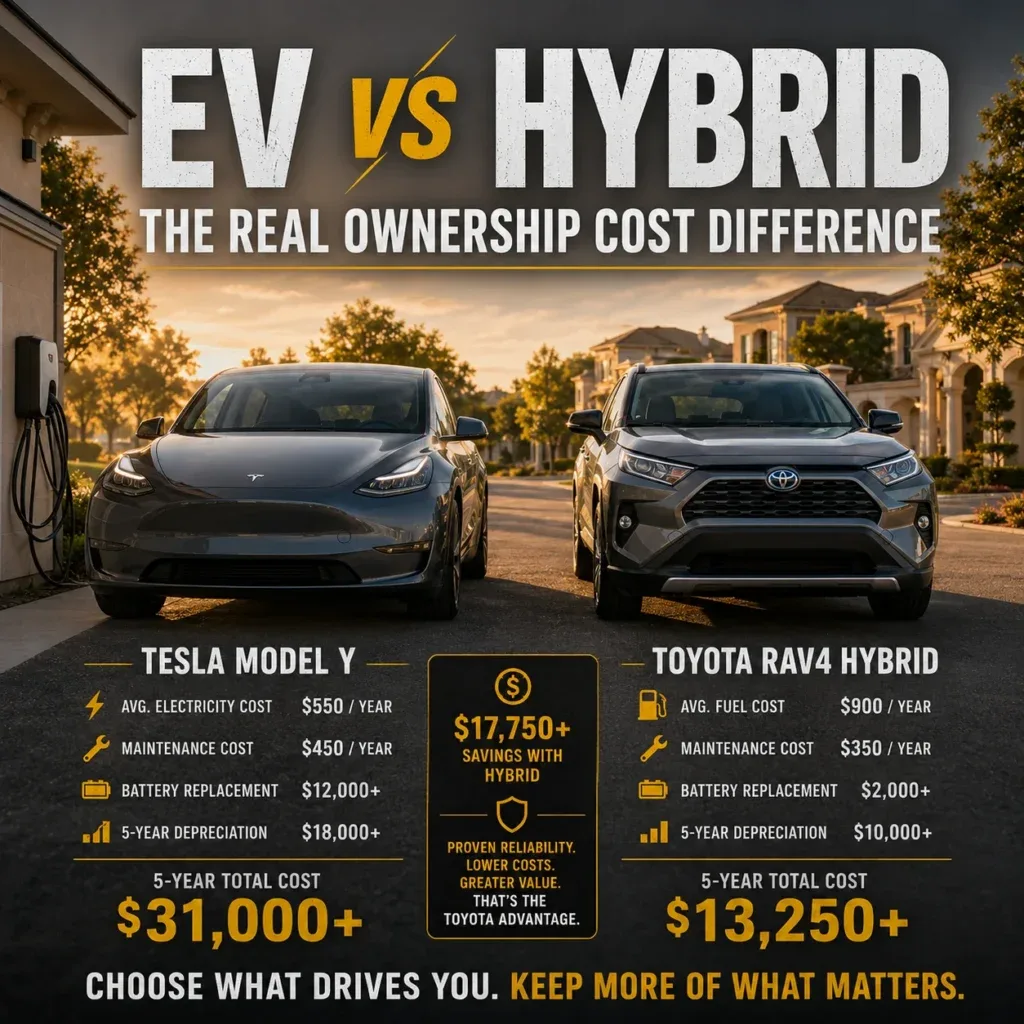
EV vs Hybrid The Real Ownership Cost Difference : There are two kinds of people shopping for a vehicle right now.
The first group is trying to decide what they want to drive.
The second group is trying to figure out what they can actually afford to own.
The second group is asking the better question.
Because buying a vehicle and owning a vehicle are two completely different experiences.
One lasts an afternoon.
The other lasts years.
And that’s where the EV versus hybrid debate becomes far more interesting.
Most buyers already know the basics.
Electric vehicles use less energy.
Hybrids use less fuel.
Both can save money compared to traditional gasoline vehicles.
But that’s not the real question.
The real question is much simpler.
Which one actually costs less to live with?
And the answer is more complicated than most people expect.
The Purchase Price Is Only The Beginning
Walk into a dealership today and you’ll notice something immediately.
In many cases, electric vehicles still cost more upfront than comparable hybrid vehicles.
Not always.
But often.
That’s important because many buyers focus almost entirely on the purchase price.
They shouldn’t.
The purchase price is only the opening chapter of the ownership story.
What happens over the next five to ten years matters far more.
Fuel costs.
Insurance.
Maintenance.
Depreciation.
Repairs.
All of those expenses eventually become part of the equation.
And sometimes they completely change the outcome.
EVs Usually Win The Fuel Cost Battle
Let’s start with the most obvious advantage.
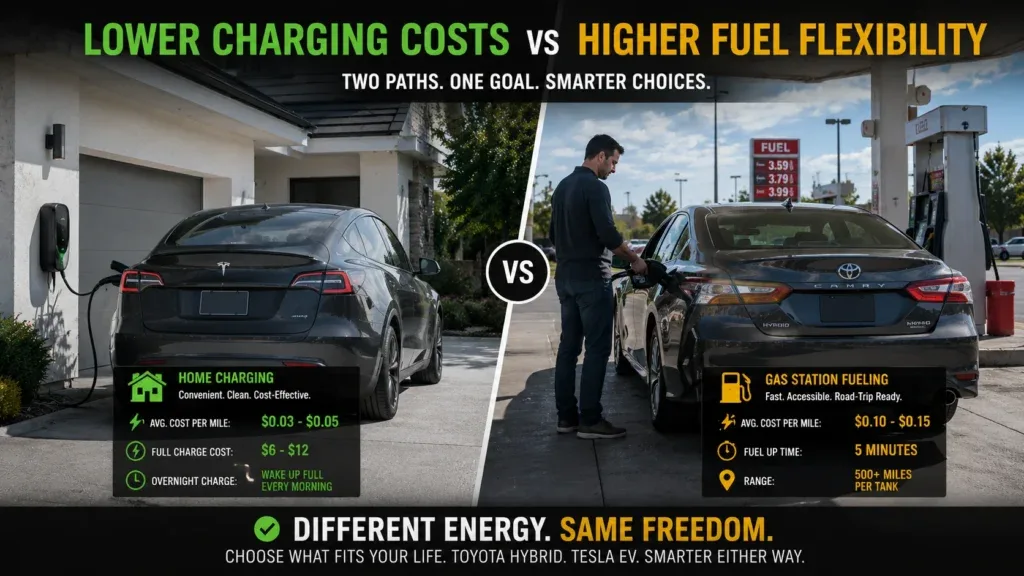
Electricity is generally cheaper than gasoline.
That’s not a controversial statement.
It’s basic math.
A typical American driver covering 15,000 miles per year will usually spend significantly less charging an EV at home than filling a gasoline tank.
For high-mileage drivers, those savings can become substantial.
Month after month.
Year after year.
The more you drive, the more this advantage matters.
That’s one reason EV owners often become passionate advocates.
They see the savings every week.
Not just on a spreadsheet.
In real life.
But Hybrids Are Surprisingly Close
This is where many people get surprised.
Modern hybrids are incredibly efficient.
Vehicles like the Toyota RAV4 Hybrid, Honda CR-V Hybrid, and Toyota Camry Hybrid regularly achieve fuel economy numbers that would have seemed impossible a decade ago.
That changes the conversation.
Because while an EV may save more on energy costs, a hybrid often narrows the gap significantly.
Especially for drivers who don’t rack up huge annual mileage.
The result?
The fuel savings advantage isn’t always as dramatic as buyers expect.
Insurance Can Change Everything
Nobody likes talking about insurance.
Unfortunately, insurance likes talking about your wallet.
And this is where ownership costs become more complicated.
Some electric vehicles can cost more to insure.
Not because they’re dangerous.
Because they’re expensive to repair.
Advanced sensors.
Specialized parts.
Battery-related repairs.
Those costs matter to insurance companies.
And insurance companies eventually pass those costs to consumers.
Hybrids aren’t automatically cheap to insure either.
But many mainstream hybrid models have established ownership histories that insurers understand well.
That can help keep premiums more predictable.
Maintenance Isn’t The Whole Story
One of the strongest arguments in favor of EVs involves maintenance.
And it’s a good argument.
Electric vehicles don’t need oil changes.
They have fewer moving parts.
Brake wear is often reduced thanks to regenerative braking.
Those are genuine advantages.
But maintenance and repair costs aren’t the same thing.
A vehicle may require less routine maintenance while still creating expensive repair scenarios if something major goes wrong.
That’s why long-term ownership discussions remain complicated.
The routine costs may favor EVs.
The uncertainty sometimes favors hybrids.
Depreciation Is The Expense Nobody Wants To Discuss
Most buyers focus on fuel costs.
The smartest buyers focus on depreciation.
Because depreciation often becomes the largest ownership expense.
Not fuel.
Not maintenance.
Depreciation.
And the EV market has experienced significant pricing shifts over the past few years.
New incentives.
Manufacturer price cuts.
Rapid technology improvements.
All of these factors influence resale values.
For some buyers, that’s created uncertainty.
Hybrids have generally benefited from strong demand and stable consumer interest.
That has helped many models maintain solid resale values.
It’s an advantage worth considering.
Charging Convenience Matters More Than People Admit
This isn’t technically a cost.
But it affects ownership satisfaction.
And ownership satisfaction matters.
For homeowners with reliable home charging, living with an EV can feel effortless.
Plug in overnight.
Wake up with a full battery.
Simple.
For apartment residents or buyers without convenient charging access, the experience can be very different.
Public charging remains improving, but convenience still varies significantly depending on where you live.
Hybrids avoid this conversation entirely.
That’s part of their appeal.
No charging strategy required.
No planning.
Just fuel up and go.
The Hidden Value Of Flexibility
One reason hybrids continue attracting buyers is flexibility.
A hybrid works almost everywhere.
Urban environments.
Rural communities.
Long road trips.
Cold weather.
Apartment living.
Suburban life.
The vehicle adapts to the owner’s lifestyle.
Not the other way around.
EVs continue improving rapidly.
But some buyers still value the flexibility hybrids provide.
Especially when they’re uncertain about future driving habits.
So Which One Actually Costs Less?
Here’s the answer many readers won’t love.
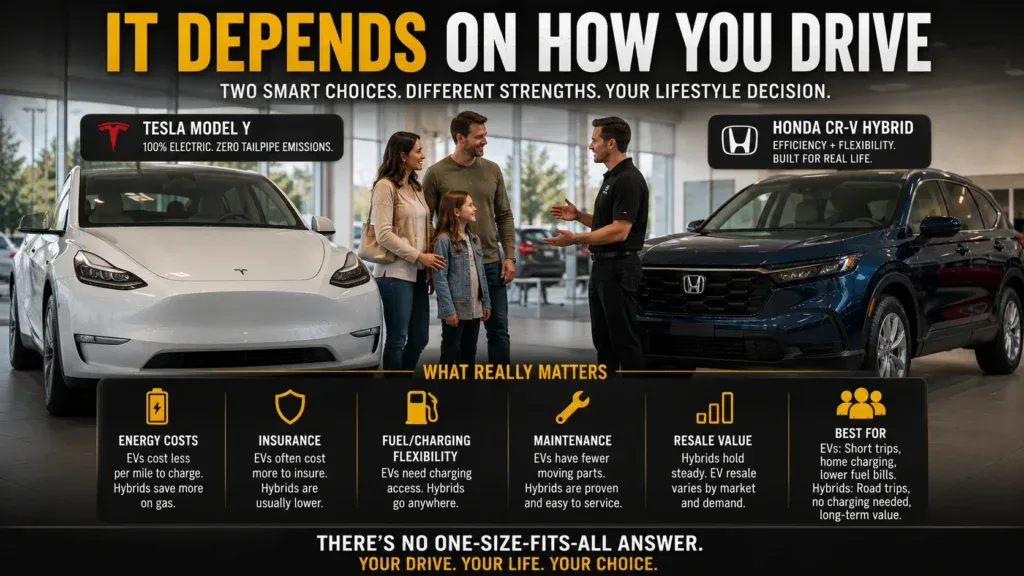
It depends.
For drivers with home charging, high annual mileage, and access to affordable electricity, an EV can absolutely become the lower-cost ownership option.
The savings can be substantial.
But for buyers focused on predictable ownership costs, strong resale value, flexibility, and lower purchase prices, hybrids remain incredibly compelling.
That’s exactly why hybrid sales continue growing.
Consumers aren’t rejecting EVs.
They’re choosing the solution that fits their lives.
And for millions of Americans, that’s still a hybrid.
Also Read: https://driveglobalnews.in/why-more-americans-are-delaying-ev-purchases/ – The surprising reasons many buyers are waiting before making the switch to electric vehicles.
Also Read: https://driveglobalnews.in/7-hybrid-suvs-that-feel-more-premium-than-their-price-tag/ – Hybrid SUVs that deliver a luxury-like experience without the luxury price.
The Real Lesson
The biggest mistake buyers make is assuming this debate has one winner.
It doesn’t.
The better question isn’t whether EVs are better than hybrids.
It’s whether an EV or hybrid is better for you.
Because ownership costs aren’t determined by headlines.
They’re determined by habits.
How far you drive.
Where you live.
How you charge.
How long you keep your vehicles.
That’s what ultimately determines which option saves more money.
And that’s why the smartest buyers spend less time arguing about EVs versus hybrids and more time understanding their own needs.
The answer is usually waiting there.
Long before they ever step into a dealership.