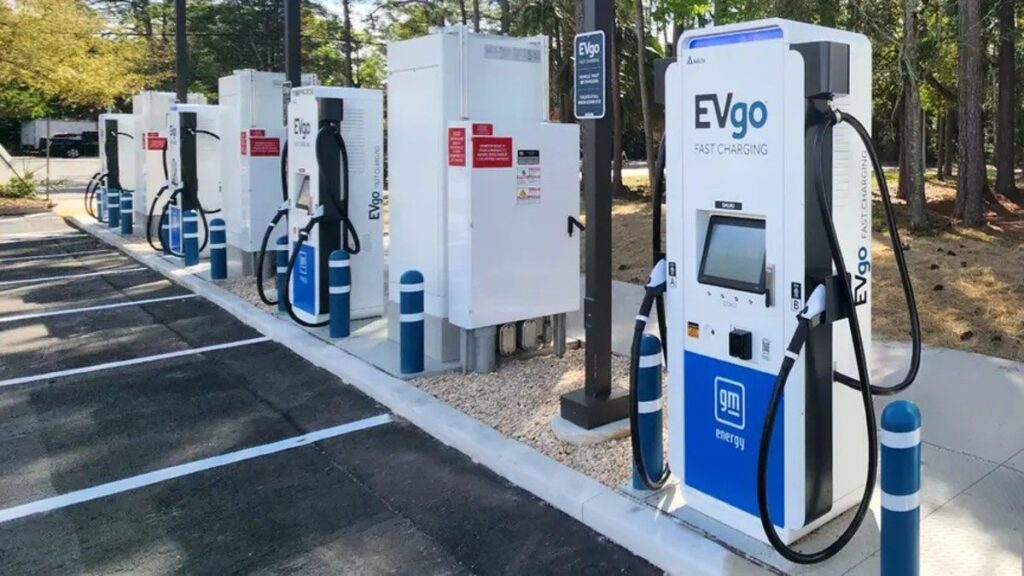
EVgo fast chargers: EVgo just committed to installing more than 400 new fast-charging stalls at U.S. grocery shopping centers starting in 2024, with each unit pushing at least 100 kW—enough to add roughly 100 miles of range in about 15 minutes. That’s a meaningful bet on a specific slice of the charging ecosystem, but it raises a $0.30 to $0.50 per kWh question that every urban EV driver without a driveway needs answered before getting excited. So, does this retail rollout actually solve your charging problem, or is it just another press release dressed up as infrastructure progress? Let’s dig into the numbers and the real-world friction that comes with plugging in while you shop for produce.
EVgo fast chargers: The Grocery Store Play: Why Retail Charging Makes Sense on Paper

EVgo’s strategy targets a captive audience: the estimated 20% of EV owners who rely entirely on public charging because they lack home or workplace options. If you’re spending $40 to $60 weekly on groceries anyway, a 30-minute shopping trip aligns almost perfectly with a 100 kW+ charging session that can recover 60 to 80 miles of range. That’s the difference between making it to work all week or scrambling for a late-night top-up at a lonely highway rest stop, and for urban dwellers in apartments or condos, this kind of co-location is arguably more valuable than another bank of chargers at a deserted office park.
The timeline matters too: rollout begins in 2024 and stretches through 2025, which means these aren’t vaporware promises but contracted installations at existing retail properties. EVgo isn’t building from scratch; they’re piggybacking on real estate that already has high foot traffic, security lighting, and restrooms—amenities that sound trivial until you’re standing next to a dumpster at 9 PM waiting for a charge. But here’s the catch that should give any buyer pause: the average downtime for U.S. charging networks hovers around 20%, and placing chargers at busy grocery stores doesn’t automatically fix the maintenance backlog that plagues this industry.
The Reliability Elephant: More Stalls, Same Broken Promise?
Let’s talk about the uncomfortable reality that EVgo’s announcement conveniently glosses over: charger uptime, not charger count, is the metric that actually determines whether you’ll be stranded with a dead battery and a cart full of frozen food. A 20% average downtime figure means that on any given day, one in five stalls at a typical U.S. network site could be out of service, and high-traffic retail locations often suffer worse because they attract more users who may not report issues promptly. EVgo hasn’t released specific uptime guarantees for these new grocery store units, and that silence is telling for anyone who’s pulled up to a “100 kW fast charger” only to find a screen displaying an error code.
The counterintuitive angle here is that adding 400 more stalls might actually increase frustration if the maintenance model doesn’t scale alongside the hardware. More chargers mean more potential failure points, and if EVgo’s service response times mirror the industry average—which can stretch to days or even weeks for parts replacement—then you’re just getting more opportunities to be disappointed. The real question isn’t whether these chargers exist; it’s whether they’ll work when you need them, and that’s a reliability bet that no press release can guarantee.
Cost Per kWh: The Premium You’ll Pay for Convenience

Now for the financial gut check that most coverage skips: fast charging at these grocery store locations will likely cost between $0.30 and $0.50 per kWh, which translates to a $10 to $15 premium over home charging for a full 60-75 kWh battery pack. If you’re a typical urban driver covering 250 miles per week, that’s an extra $40 to $60 monthly just for the privilege of charging while you shop, and that’s assuming you time your grocery runs perfectly to avoid idle fees or peak pricing windows. Compare that to the $0.12 to $0.20 per kWh you’d pay with a home charger, and the math starts to look less like a convenience and more like a tax on people without driveways.
So, does this actually justify the premium on your monthly transportation budget? For the urban EV driver who would otherwise be completely stranded, the answer is yes—because the alternative is not charging at all, which makes the car useless. But for anyone who has access to even a Level 2 charger at work or home, these retail rates are hard to swallow, and you’d be better off treating grocery store charging as an emergency backup rather than a primary strategy. EVgo hasn’t published a definitive pricing structure for these new sites, and that uncertainty alone should make you cautious about factoring them into your routine.
Who Wins, Who Walks, and What’s Still Missing
The clear winners here are urban EV drivers without home charging who already structure their lives around grocery shopping—for them, this is a genuine lifeline that turns a necessary errand into a dual-purpose stop. If you’re spending $40 to $60 weekly on groceries and live within a 10-minute drive of a participating shopping center, these chargers could eliminate the anxiety of hunting for an available stall across town. The convenience factor is real, and co-locating charging with retail errands is the kind of practical thinking that could actually shift behavior for apartment dwellers who’ve been sitting on the EV fence.
But if you’re a long-distance commuter who needs en-route fast charging to make a 200-mile round trip, these grocery store stops are not your solution—they’re too slow, too location-bound, and too expensive for the kind of high-throughput charging you need on a highway corridor. You should walk away from this news entirely and focus on networks like Electrify America or Tesla Superchargers that prioritize roadside locations with 150-350 kW output. And for everyone else, the unanswered question remains: what happens when these 400 stalls are occupied by a mix of Leafs, Bolts, and Cybertrucks all fighting for the same six plugs on a Saturday afternoon?
EVgo’s expansion is a step forward, but it’s a step that needs to be paired with aggressive maintenance commitments and transparent pricing to truly serve the buyers it claims to help. If you’re an urban dweller without home charging, this could be the infrastructure that finally makes EV ownership practical—but wait for real-world uptime reports before you commit to a lease based on these promises. The verdict: cautiously optimistic for city drivers, irrelevant for road warriors, and a reminder that charger count means nothing if the chargers don’t work when you’re standing there with a trunk full of groceries and a dying battery.