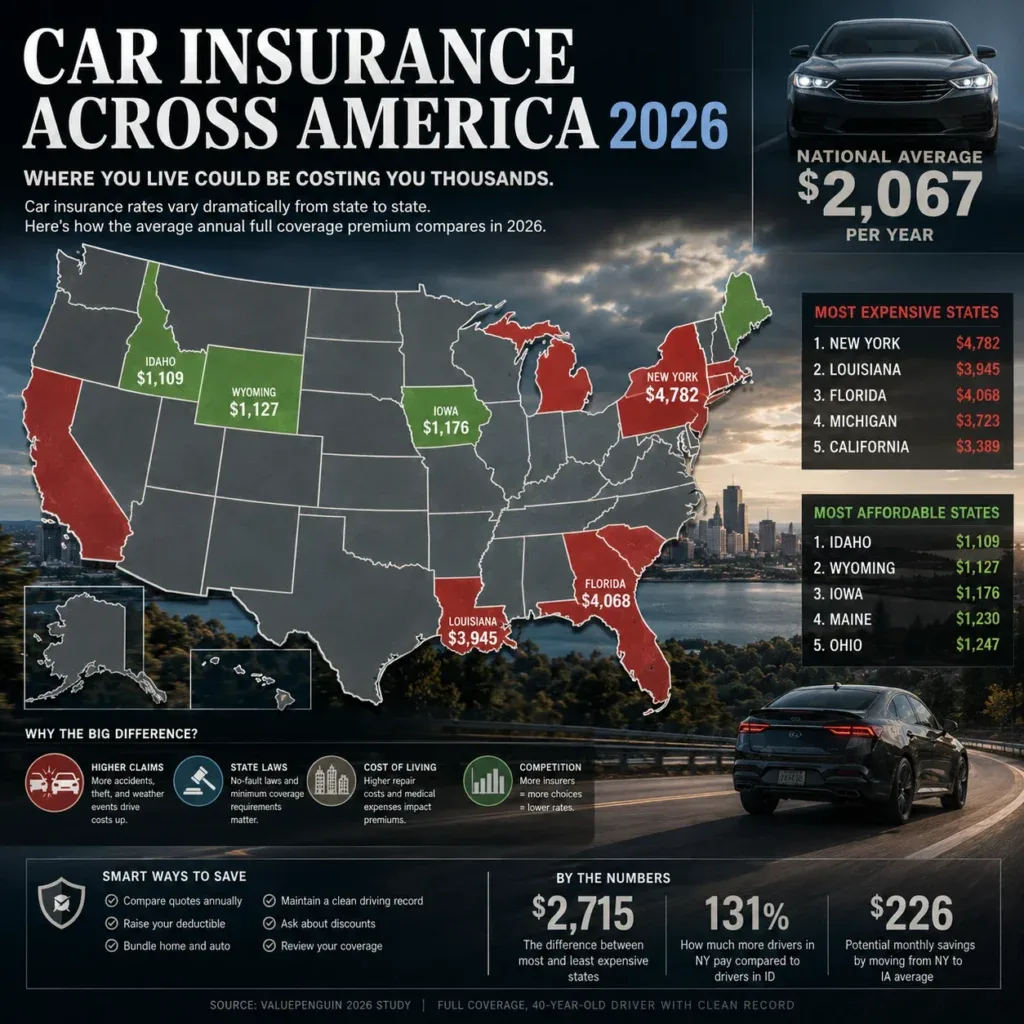
The average American is paying $2,700 per year for car insurance in 2026.
Every single month — $225 out of your account. Before the car payment. Before gas. Before maintenance. Just to be legally allowed to drive.
The frustrating part? Most people are paying $500-$1,100 more than they need to. Not because the insurance market is unfair. Because they set up their policy once and never went back to look at it.
Here are 7 moves that actually lower the bill. Real savings numbers. No vague advice about “comparing quotes” without telling you what to do next.
Move 1: Shop at Every Renewal — This One Alone Saves $700-$1,100

Insurance companies offer their best rates to new customers.
Read that again. The company you’ve been loyal to for six years is charging you more than it would charge a new customer walking in today. Loyalty in the car insurance industry is financially punished. The companies count on you being too busy to notice.
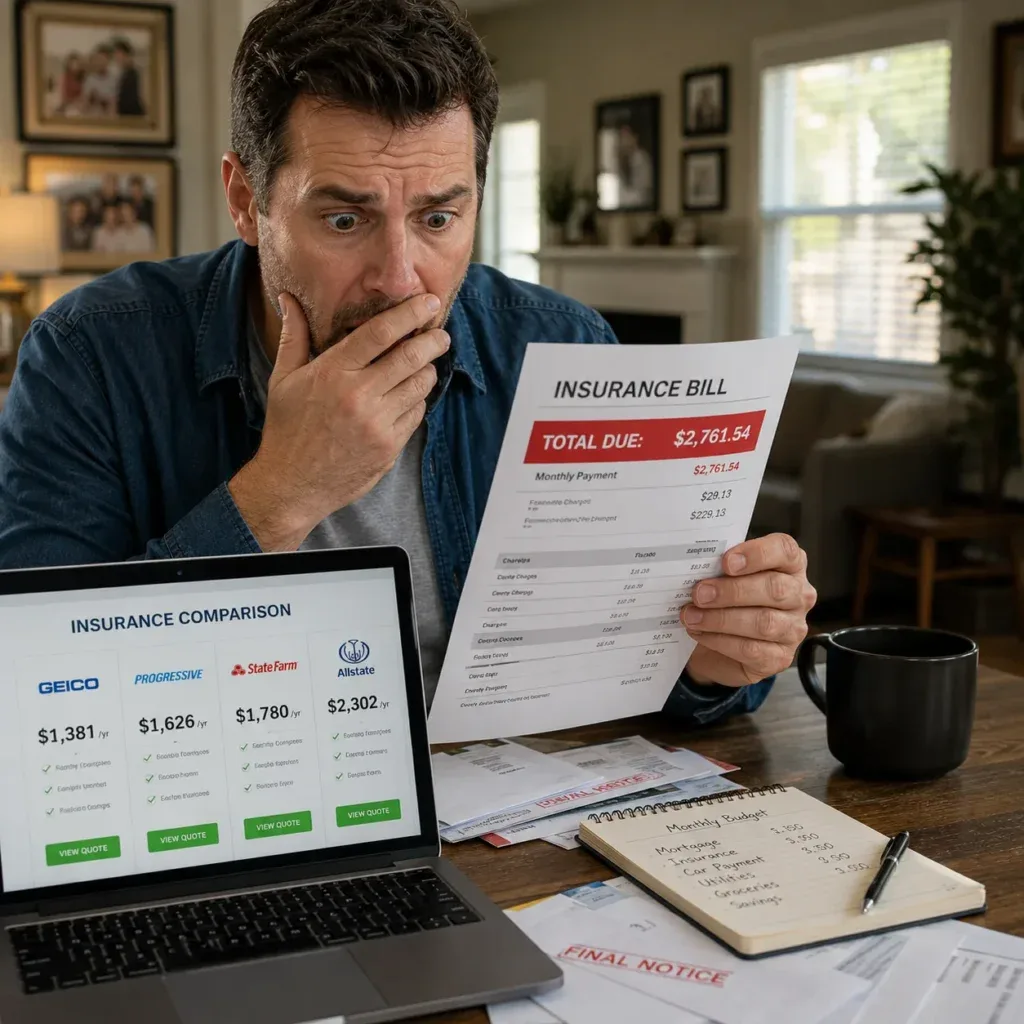
Consumer Reports confirmed it in May 2026: the average driver overpays by $700-$1,100 per year simply by staying with the same insurer without shopping. A record 47.3% of Americans shopped their auto insurance in the last 12 months — the other half is subsidizing them.
What to actually do: Set a calendar reminder 30 days before your renewal date. Get quotes from Travelers, GEICO, Progressive, and State Farm — all four, not just one. Compare them against your current rate. If any quote is $200+ cheaper — switch. The process takes 20 minutes online.
Savings: $700-$1,100 per year for the average driver who hasn’t shopped in 3+ years.
State Farm is cutting rates 4% in 2026. Allstate is raising them 1.98%. If you’re with Allstate and haven’t compared recently — start with State Farm this week.
Move 2: Fix Your Credit Score — This One Is Worth $1,000+ Per Year
This is the one nobody talks about enough.
In most states, your credit score is one of the biggest factors in your car insurance rate. Drivers with bad credit pay an average of 76% more for car insurance than drivers with good credit.
On a $2,700 national average — that gap is enormous. A driver with poor credit might be paying $4,752 per year. The same driver with good credit: $2,700. Same car. Same driving record. Same zip code.
What to actually do: Check your credit score free through your bank, Credit Karma, or AnnualCreditReport.com. If it’s below 650 — the impact on your insurance premium is significant and worth addressing. Make on-time payments. Reduce credit utilization. Dispute inaccurate negative items.
Credit improvement takes months, not days. But for every 50 points your credit score improves — your car insurance rate typically drops meaningfully at your next renewal.
Savings: Up to $1,000+ per year for drivers improving credit from poor to good.
Move 3: Raise Your Deductible — A Single Phone Call Saves $150-$300 Per Year
Your deductible is the amount you pay out of pocket before insurance covers a claim.
Most people accepted the default deductible when they set up their policy — often $250 or $500 — and never changed it. Raising your deductible from $500 to $1,000 typically reduces your collision and comprehensive premium by 10-15%.
On a $1,400 annual collision and comprehensive premium — that’s $140-$210 saved every year. For a single phone call.
The math to check before doing this: Do you have $1,000 in savings you could access if you were in an accident? If yes — raise the deductible. If no — build that emergency fund first, then make the call.
What to actually do: Call your insurer or log into your account. Ask specifically: “What does my collision and comprehensive premium drop to if I raise my deductible to $1,000?” The answer takes two minutes to get.
Savings: $150-$300 per year.
Move 4: Bundle Your Home and Auto — 10-25% Off Both Policies
If your home insurance and car insurance are with two different companies right now — you’re leaving money on the table every single month.
Most major insurers offer 10-25% discounts when you bundle home and auto policies. On a $2,700 auto premium — a 15% bundle discount saves $405 per year. On a $1,800 home insurance premium — same 15% saves $270 per year.
Combined: $675 per year just for having both policies with the same company.
What to actually do: Call your current car insurance company and ask what your rate would be if you moved your home insurance to them. Then call your home insurance company and ask the same question in reverse. Take whichever bundled deal is cheaper overall.
Savings: $300-$675 per year for most homeowners.
Renters count too. Renters insurance typically costs $15-$20 per month. Bundling it with auto insurance frequently saves more on the auto side than the renters policy costs. Net result: you get renters coverage essentially free while lowering your car insurance.
Move 5: Enroll in a Telematics Program — Safe Drivers Save Up to 30%
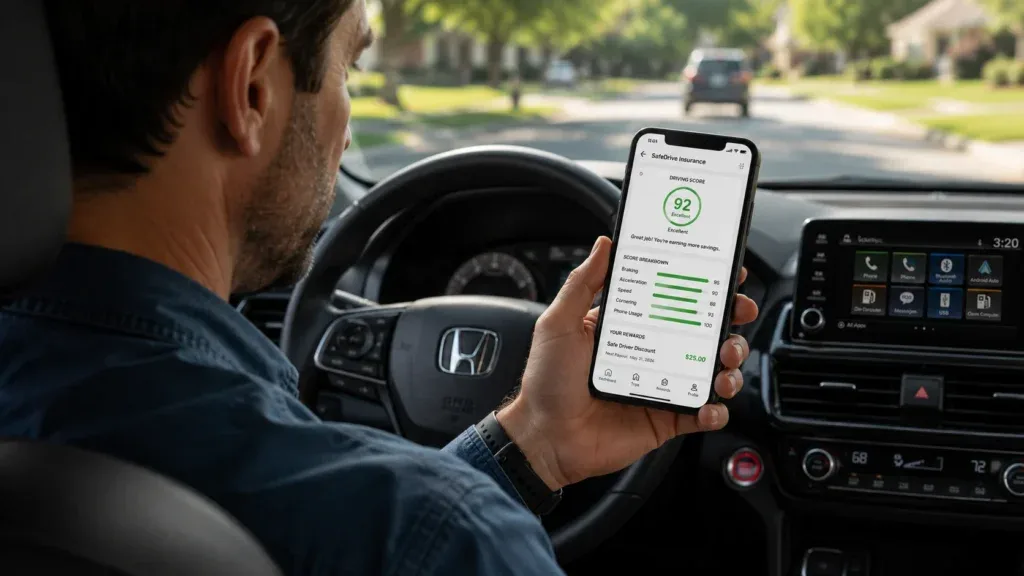
Progressive Snapshot. State Farm Drive Safe & Save. Allstate Drivewise.
These programs track your actual driving behavior through a smartphone app. Safe habits — smooth acceleration, no hard braking, reasonable speeds, lower late-night driving — earn discounts of 10-30%.
On $2,700 in annual premium — a 20% telematics discount saves $540 per year. For driving the same way you were already driving.
Most programs give you 3% off just for enrolling before they’ve tracked a single mile of your driving. That discount costs nothing. It’s free money for downloading an app.
The one thing to know before enrolling: A small number of insurers can raise your rate if the telematics data shows risky driving habits. Progressive Snapshot and State Farm’s program specifically will not raise your rate above your current premium based on driving data — they can only leave it the same or lower it. Allstate Drivewise also does not penalize. Confirm this with your insurer before enrolling.
Savings: $270-$810 per year for safe drivers.
Move 6: Drop Coverage You Don’t Need on Old Cars
Full coverage — comprehensive plus collision — makes sense when your car is worth enough that losing it to an accident or theft would be financially painful.
When your car is worth $5,000 and you’re paying $1,200 per year for collision and comprehensive coverage — the math breaks down. You’re paying $1,200 annually to protect an asset worth $5,000. One bad year and the insurer pays $5,000 minus your deductible. Best case scenario: break-even after five years of premiums.
The rule financial advisors use: If your annual comprehensive and collision premium exceeds 10% of your car’s current value — consider dropping to liability-only.
What to actually do: Look up your car’s current private sale value on KBB or CarGurus. Then ask your insurer to break out specifically what you pay for collision and comprehensive (separate from liability). Do the 10% math. If the ratio is over 10% — call your insurer.
Caveat: This ONLY applies to paid-off vehicles. If you’re still making loan payments, your lender requires full coverage. No exceptions.
Savings: $400-$800 per year for drivers of older paid-off vehicles.
aslo read : https://driveglobalnews.in/most-reliable-toyota-suvs-in-the-usa-ranked/
Move 7: Ask About Discounts You’re Not Getting
This is the one that surprises most people.
Insurance discounts rarely get applied automatically. Companies offer them. They don’t announce them. You have to ask.
Discounts that exist at most major insurers — and that most customers don’t realize they qualify for:
Good student discount: Full-time students with a B average or better typically get 15-25% off. State Farm specifically offers up to 25%. It applies through age 25 for enrolled students.
Defensive driving course: Completing an approved course (costs $30-$75, takes a few hours online) earns 5-15% off at most insurers. The discount pays for itself in the first month.
Autopay and paperless billing: Most insurers offer $30-$75 per year in discounts for setting up automatic payment and paperless statements. Takes five minutes to set up.
Anti-theft device discount: If your car has a factory alarm, GPS tracking, or aftermarket anti-theft device — ask specifically about a discount. Some insurers credit 5-10% for these features.
Loyalty discount: Some insurers offer small discounts for staying beyond 3 or 5 years. Worth asking about — though it rarely offsets the savings from shopping elsewhere.
Professional or alumni discounts: Teachers, nurses, engineers, military personnel, and members of certain alumni associations often qualify for group discounts through affiliated insurers. Call your employer’s HR department or your college alumni association and ask if they have auto insurance partnerships.
What to actually do: Call your insurer, ask to speak with a licensed agent, and say these exact words: “What discounts am I currently receiving, and what discounts am I eligible for that I’m not currently receiving?” Write down the answer.
Savings: $100-$400 per year from forgotten or unapplied discounts.
also read : https://driveglobalnews.in/5-mistakes-that-are-making-your-car-insurance/
The Real Number — How Much You Could Save
If you apply all seven moves to a typical American driver paying $2,700 per year:
| Move | Estimated Saving |
|---|---|
| Shop at renewal | $700 |
| Improve credit score | $400 |
| Raise deductible | $200 |
| Bundle home + auto | $400 |
| Telematics program | $400 |
| Drop old car coverage | N/A (depends on vehicle) |
| Claim forgotten discounts | $200 |
| Realistic total | $1,200-$2,300/year |
Not everyone qualifies for every move. Not every insurer offers every discount. The specific savings vary by driver, location, and vehicle.
But the average driver who takes these seven steps seriously — shopping at renewal, improving credit over time, raising deductibles, bundling policies, enrolling in telematics, and asking about discounts — typically reduces their annual premium by $800-$1,500 per year.
That’s $800-$1,500 that was leaving your account every year for no reason.
It’s still there. You just have to go looking for it.