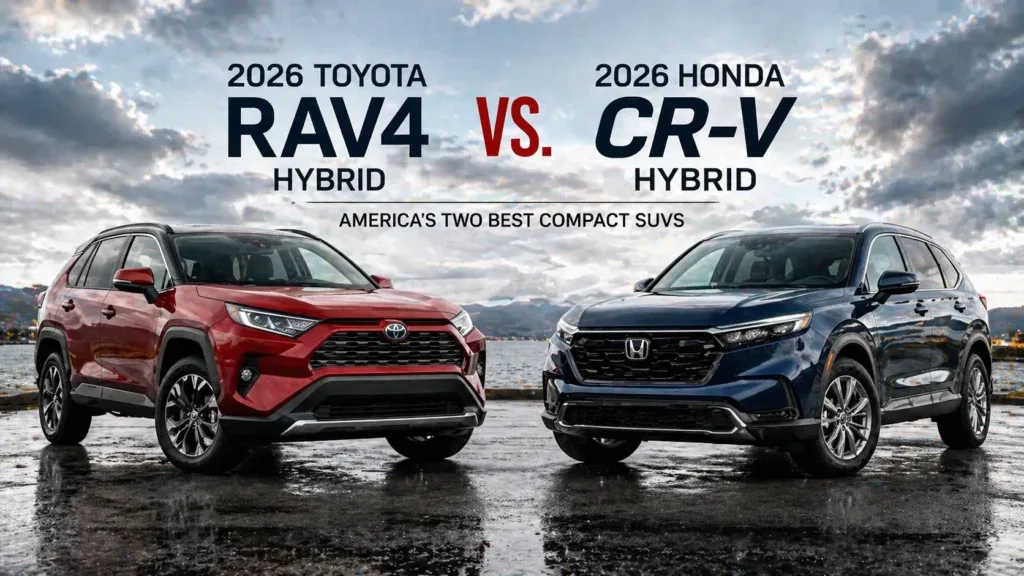

These two SUVs own the compact hybrid segment for a reason. They’re practical, efficient, and sell in huge numbers. For 2026 the fight got more interesting: Toyota redesigned the RAV4 and made it hybrid-only, while Honda kept refining the CR-V Hybrid.
If you’re shopping in this class right now, this is the comparison that actually matters.
Power and Driving Feel
The RAV4 Hybrid has the clearer edge here. Its 2.5-liter hybrid system makes 226 horsepower in front-wheel-drive form and 236 horsepower with all-wheel drive. The CR-V Hybrid’s 2.0-liter system produces 204 horsepower.
That difference shows up in everyday driving. The Toyota feels stronger when merging or passing, and most tests put it roughly half a second quicker to 60 mph. The Honda is smooth and quiet, but it doesn’t have the same urgency.
Both use sophisticated hybrid systems that keep the gas engine from working harder than it needs to. Neither feels like a traditional CVT slog.
Fuel Economy
This is where the RAV4 pulls ahead for most buyers.
Front-wheel-drive RAV4 Hybrids are rated as high as 47 mpg city, 40 highway, and 43 combined. All-wheel-drive versions still land in the low-to-mid 40s combined on most trims. The CR-V Hybrid is strong at 40 mpg combined with front-wheel drive and 37 with all-wheel drive, but it trails the Toyota by a few miles per gallon in most configurations.
Over 12,000 to 15,000 miles a year, those extra mpg add up. The RAV4 also benefits from Toyota’s long track record of hybrid systems that hold their efficiency over time.
Space and Comfort
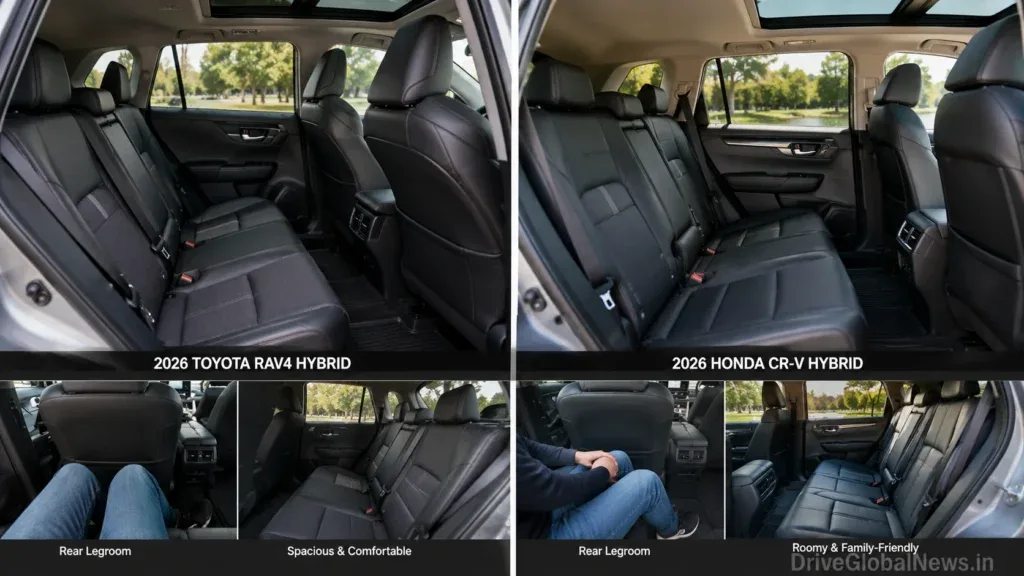
Honda fights back hard here. The CR-V offers noticeably more rear legroom — about 41 inches versus the RAV4’s 37.8 inches. Adults sit more comfortably in the back of the Honda, and the overall cabin feels a bit more open.
Cargo space is close. The RAV4 has a slight edge with the rear seats up in some measurements, while the CR-V often wins with the seats folded. Both are practical family haulers, but the Honda gives rear passengers more breathing room.
Ride quality favors the CR-V for many drivers. It’s quieter and more composed over rough pavement. The new RAV4 improved in this area, but the Honda still feels a touch more refined day to day.
Price and Value
The RAV4 Hybrid starts lower — roughly in the low $32,000 to $33,000 range depending on destination and trim — while the CR-V Hybrid typically starts a few thousand dollars higher. Toyota also includes longer hybrid battery coverage in many cases (often 10 years/150,000 miles) and stronger resale values historically.
Honda counters with a well-equipped base hybrid and a comfortable, feature-rich cabin. Both hold value well for the segment, but the RAV4 has the edge on pure long-term cost of ownership for most owners.
Reliability and Ownership
Both brands score well. Toyota’s hybrid systems have an outstanding long-term reputation, and the RAV4 benefits from that. Honda’s reliability is also strong, and the CR-V Hybrid has posted solid predicted scores in recent owner data.
Neither is a high-risk choice. The RAV4’s hybrid experience and resale strength give it a slight long-term advantage for buyers who plan to keep the vehicle many years.
Who Should Buy Which?
Choose the Toyota RAV4 Hybrid if you want the strongest efficiency, more power, lower starting price, and excellent resale. It’s the better pure numbers play for most people.
Choose the Honda CR-V Hybrid if rear-seat space, ride comfort, and a slightly more refined daily experience matter more to you. It’s the one that feels more like a premium compact SUV to many families.
The Bottom Line
These two remain the clearest choices in the compact hybrid SUV class. The 2026 RAV4 Hybrid wins on efficiency, performance, and overall value for a lot of buyers. The CR-V Hybrid wins on space and everyday comfort.
There’s no bad decision here — just different priorities. Sit in both, drive both, and decide which one fits how you actually use a vehicle.
Which one are you leaning toward, and what’s the most important factor for you — MPG, space, or price?