
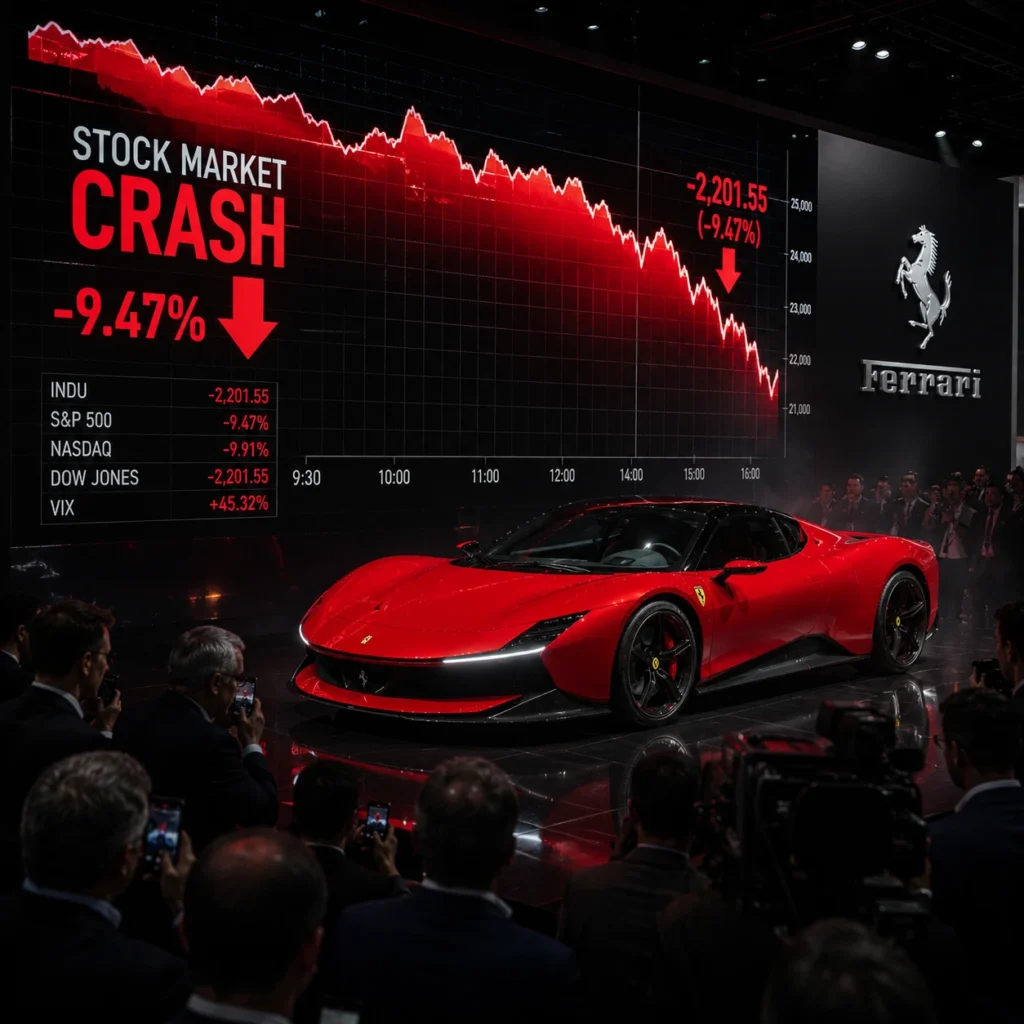
Ferrari premiered the Luce yesterday.
The world’s most anticipated electric car reveal — years in the making, $645,000 price tag, Jony Ive interior, 1,000+ horsepower, Apple’s abandoned micro-LED technology. The automotive world had been building toward this moment for months.
And then the stock market responded.
Ferrari shares fell.
CNBC reported it plainly: “Ferrari shares fall after carmaker unveils first fully electric vehicle.”
That reaction tells you something important about what Ferrari actually built — and whether the Luce is a triumph or a miscalculation.
also read : https://driveglobalnews.in/ferraris-first-electric-car-uses-technology/
What Wall Street Saw That the Headlines Missed
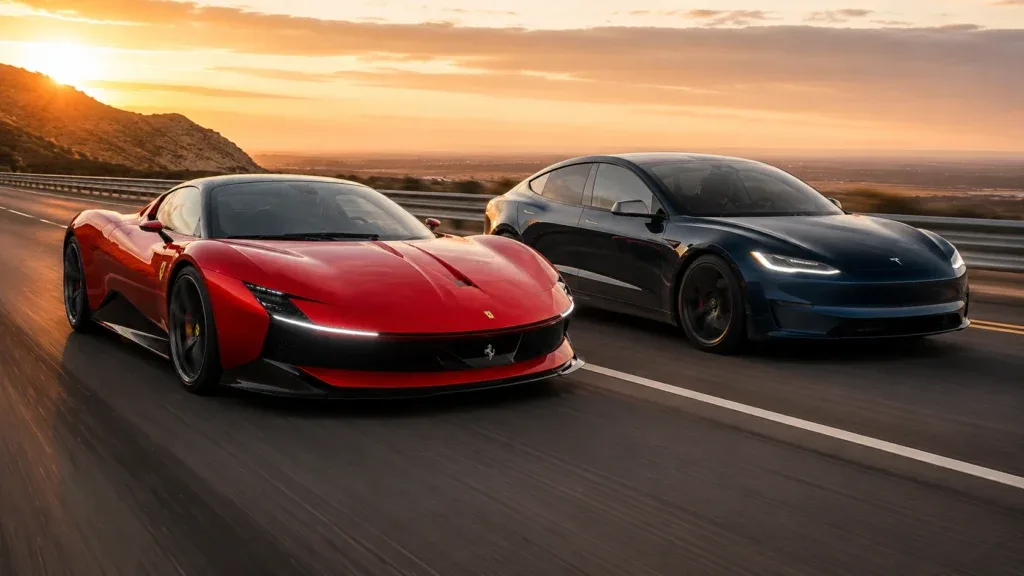
The automotive press coverage of the Luce premiere focused on the right things: the extraordinary interior, the Jony Ive design philosophy, the micro-LED displays, the quad-motor performance. All real. All genuinely impressive.
Wall Street focused on a different set of numbers.
The Luce does 0-60 in approximately 2.4 seconds. That sounds extraordinary until you compare it to the Tesla Model S Plaid at 1.99 seconds for $97,000 — or the Lucid Air Sapphire at 1.89 seconds for $250,000. Ferrari’s $645,000 flagship electric vehicle is measurably slower in the metric most performance car buyers check first than cars costing 87% less.
The Luce’s range is approximately 375 miles. Impressive. But the Lucid Air Grand Touring achieves 516 miles at $138,000. Again — a vehicle costing 79% less goes significantly further.
Investors don’t buy cars. They price stocks based on competitive positioning and long-term revenue sustainability. The analysis they ran after the premiere went something like this: Ferrari built a vehicle that costs $645,000, is slower than a $97,000 Tesla, has less range than a $138,000 Lucid, and enters a luxury EV market that multiple established brands are already competing in aggressively.
The question the market asked: is Ferrari’s brand premium large enough to justify a price that’s 6-7x the closest competitor on key performance metrics?
The shares fell because enough investors answered: maybe not.
also read : https://driveglobalnews.in/used-ev-vs-new-gas-car-in-2026-with-price-parit/
The Counter-Argument — And It’s Not Stupid
Here’s what the stock market reaction misses, or at least underweights.
Ferrari has never competed on value. The brand’s entire commercial model is built on the opposite of value — on deliberately constrained supply, extraordinary brand prestige, and a buying experience that treats customers like members of an exclusive club rather than purchasers of transportation.
Ferrari’s waitlists for popular models routinely extend 18-24 months. Their customers don’t cross-shop a Ferrari against a Lucid Air Sapphire any more than they cross-shop a Hermès Birkin against a well-made leather bag from a department store. The product categories technically overlap. The purchasing logic doesn’t.
The 160 allocations Ferrari is making for the Luce’s first production run will be purchased. All of them. By existing Ferrari customers who have relationships with dealers, who have purchased multiple Ferraris previously, and who are adding the Luce to a collection that already includes gas-powered models. For these buyers, the 0-60 comparison to a Plaid is irrelevant. The Luce is a Ferrari. That’s the point.
What This Means for the Broader Luxury EV Market
The market’s negative reaction to the Ferrari Luce premiere is the most interesting data point from this week’s automotive news for anyone watching the luxury EV space.
It signals that investors believe even Ferrari’s brand power may not fully justify a $645,000 EV that doesn’t lead its segment on measurable performance metrics. If that’s true for Ferrari — the most powerful automotive brand in the world — it raises genuine questions about every other luxury EV trying to command a significant premium over technically superior Korean and American alternatives.
The Porsche Cayenne Electric at $109,000. The BMW iX3 at $60,000. The Genesis GV70 Electrified at $58,000. Each of these justifies its premium through specific driving character, brand cachet, or technology advantages. But the Ferrari Luce situation asks a broader question: how much brand premium can survive in a market where the best-performing EVs are also frequently the most affordable?
The answer, for Ferrari specifically, is probably: enough. The brand is too powerful and the production volume too limited for the Luce to fail commercially. But the stock market’s immediate reaction suggests the premium may be getting tested in ways that will shape how every luxury automaker prices its electric vehicles going forward.