
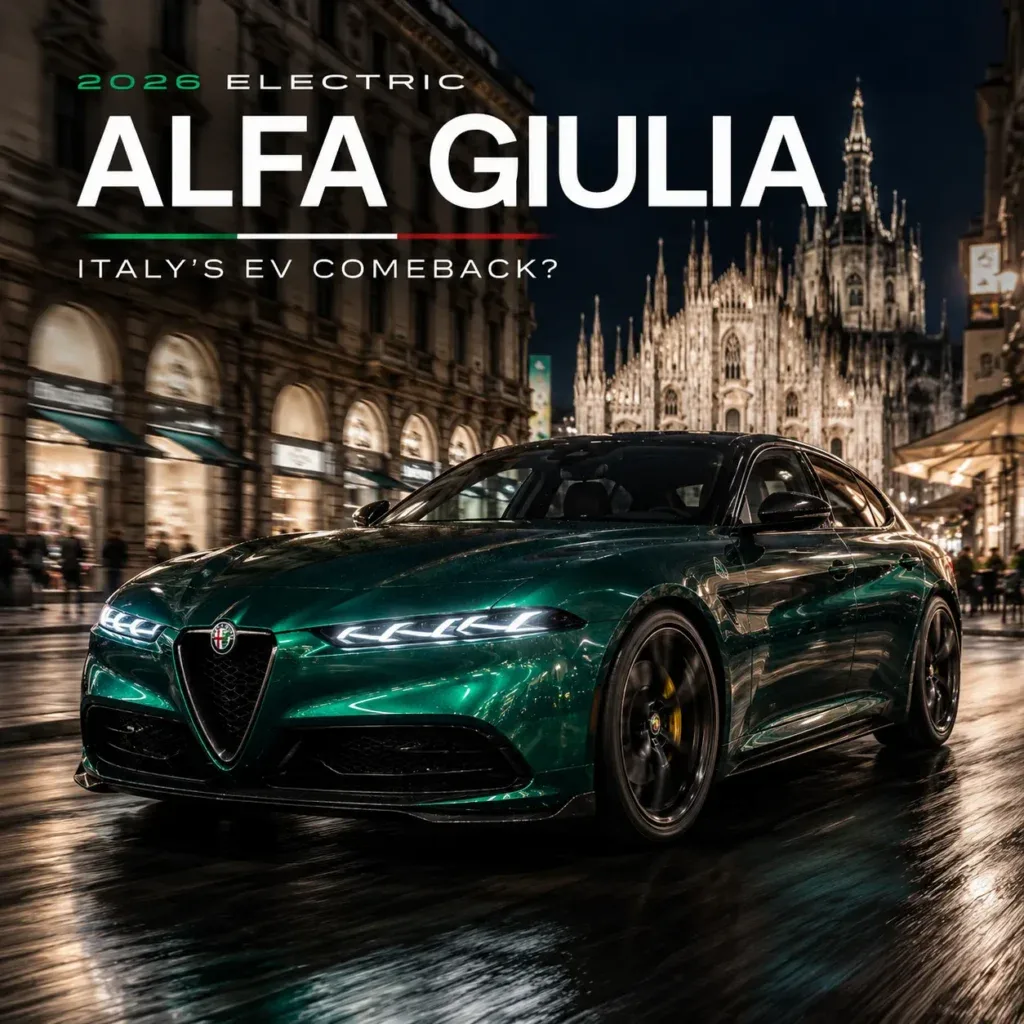
There are car companies that survive on legacy. And then there are car companies that use legacy as fuel for something genuinely new.
Alfa Romeo has spent the last decade in an uncomfortable middle space — a brand with one of the most emotional histories in automotive history, producing cars that never quite lived up to what the badge promises. The Giulia Quadrifoglio was wonderful. The Stelvio was solid. But the brand’s smaller cars disappointed, sales were modest, and the question “is Alfa Romeo still relevant?” kept appearing in automotive journalism.
The electric Giulia is Alfa’s answer. And based on what’s been confirmed, it might actually be the right one.
What’s Being Confirmed
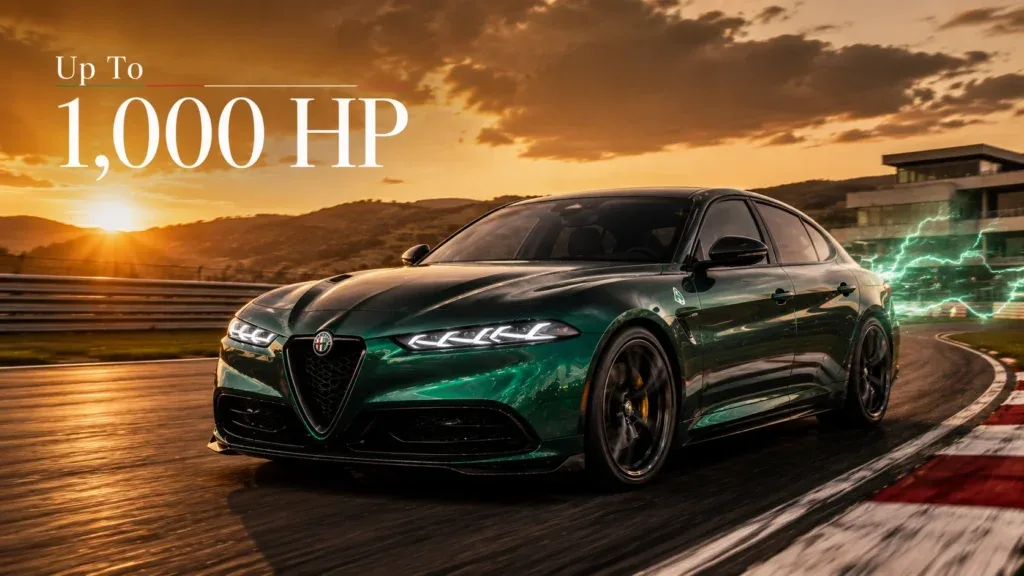
Alfa Romeo confirmed the electric Giulia launches by 2026 for the 2027 model year, following the new Stelvio SUV and preceding a large SUV in a planned three-model offensive.
The confirmed headline number: performance models will produce up to 1,000 horsepower. The base variant is confirmed at 345 horsepower — enough to make it competitive with the BMW i4 eDrive40 (340 HP) and the Hyundai Ioniq 6 N (641 HP in performance trim) at this price point.
Rapid charging is specifically called out in Alfa’s official communications — “impressive range and rapid charging” are the terms used. Given Stellantis’s STLA platform capabilities and the competitive landscape requiring 800-volt charging, expect something in the 150-320 kW range. Exact figures pending final confirmation.
Range: Alfa Romeo hasn’t released EPA targets, but “impressive range” combined with a sports sedan platform suggests 280-320 miles in base configuration — appropriate for a luxury sports sedan that will be purchased primarily as a driver’s car.
Platform: The electric Giulia is built on Stellantis’s STLA Large platform — the same architecture underpinning the Dodge Charger EV and Jeep Wagoneer S, but significantly updated for the Giulia’s application. For an Italian sports sedan, the platform’s rear-wheel-drive bias in base configuration is appropriate — maintaining the Giulia’s handling DNA in the electric era.
Why This Is a Bigger Deal Than It Sounds
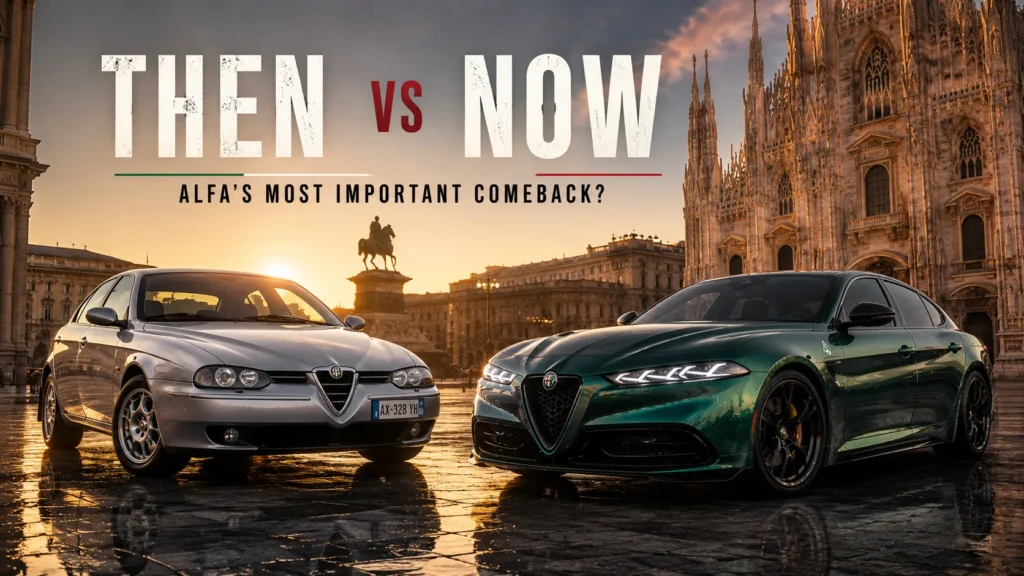
The original Giulia arrived in 2015 to critical acclaim and commercial disappointment. It was genuinely the better-driving car than the BMW 3 Series in every independent comparison — the Quadrifoglio famously lapped the Nürburgring faster than any production sedan of its time. But Alfa’s reliability reputation, limited dealer network, and the challenge of convincing American buyers to choose Italian over German held it back.
The electric Giulia has a different set of variables. Reliability concerns fade with electric powertrains — fewer moving parts, fewer oil changes, fewer of the quirky electrical gremlins that plagued earlier Alfas. The charging architecture that Stellantis has been developing can match competitors. And the emotional appeal of an Italian electric sports sedan with up to 1,000 HP is genuinely novel in a segment that has been dominated by German and Korean brands.
The Giulia Quadrifoglio was the driver’s car that enthusiasts loved but the market mostly ignored. An electric Giulia at competitive pricing — with the range and charging infrastructure that removes practical objections — could finally give Alfa Romeo the mainstream success that has been frustratingly out of reach.
also read : https://driveglobalnews.in/2026-genesis-gv90-the-100000-korean/
The Honest Concern
Stellantis. That’s the concern, stated plainly.
Alfa Romeo’s parent company had one of the worst years in recent automotive history in 2025. The $22.3 billion loss, canceled EV programs, and the ongoing challenges rebuilding trust with dealers and buyers are all real context for any Stellantis-built vehicle announced right now.
The STLA platform is capable. The engineering team working on the electric Giulia in Turin is talented. But Stellantis’s track record of actually delivering announced products on time, at the promised price, with the promised quality — deserves scrutiny from potential buyers.
The Giulia Quadrifoglio’s legendary Nürburgring lap time was achieved by a small, passionate team that cared deeply about the product. The electric Giulia needs that same care, without the organizational chaos that has been Stellantis’s backdrop in 2025-2026.
also read : https://driveglobalnews.in/rivian-r2-vs-bmw-ix3-in-2026-two-of-the-year/
Pricing and Timeline
Final pricing hasn’t been announced. Based on the gas Giulia’s positioning ($47,000-$80,000 depending on trim) and the competitive landscape for electric sports sedans:
Base (345 HP): Expected $50,000-$60,000 — competing directly with the BMW i4 and Genesis G60 Electric.
Performance trims: $70,000-$90,000 range, competing with the BMW i4 M50 and Porsche Taycan Sport Turismo.
Top Quadrifoglio equivalent (1,000 HP): Likely $100,000+ — the halo model that earns media coverage and Nürburgring lap records.
The base trim arriving in 2026/2027 is the volume product. The 1,000 HP flagship is the headline. Both need each other — the headline generates desire, the base trim generates sales.
Whether Alfa Romeo can finally convert the desire their cars always generate into the sustained commercial success that sustains a brand — the electric Giulia is the most credible shot they’ve taken in years.