

These two have been trading the compact-SUV crown for twenty years. 2026 is the first year Toyota made the RAV4 hybrid-only and gave it a new generation. Honda kept the current CR-V and the 204-hp two-motor setup America already knows.
The headline writes itself. One window sticker says 40 mpg combined. The other says more like 42. One rear bench has 41.0 inches of legroom. The other has 37.8. Pick the number that actually hits your life.
The MPG Split
Honda CR-V Hybrid FWD: 43 city / 36 highway / 40 combined. AWD Sport and Sport Touring: 40/34/37. TrailSport: 38/33/35. That 40 is the number in the title, and it is real — if you buy the front-driver.
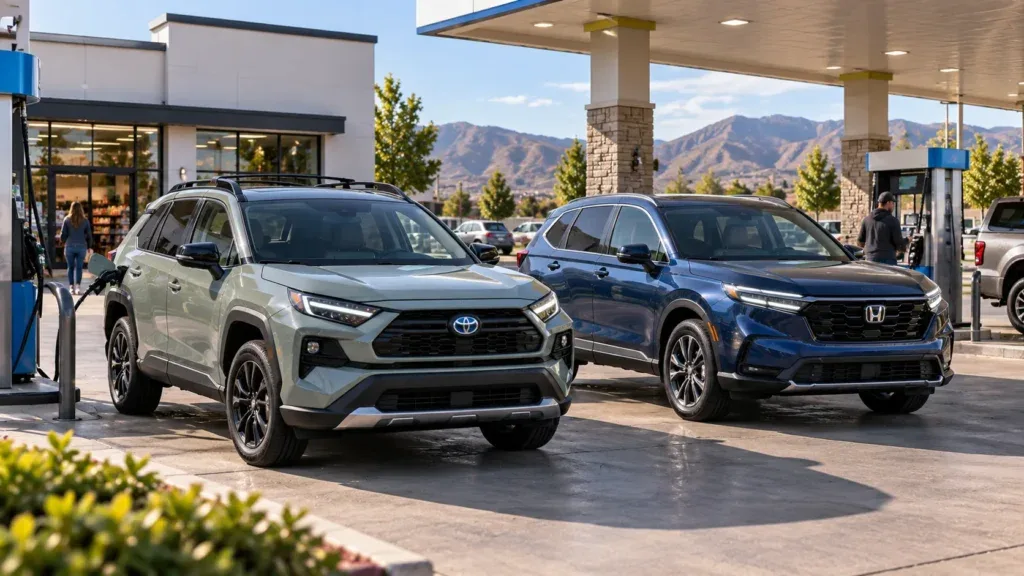
The sixth-gen RAV4 Hybrid is the new math. AWD LE figures in current EPA and Toyota estimates cluster around 46–47 city, 39–40 highway, 42 combined. FWD LE quotes run even higher in some books — high 40s city. Woodland and bigger-wheel trims give some of it back.
Car and Driver’s island loop saw mid-30s in both when you drive them like testers, not like EPA robots. The sticker gap is 2–5 mpg depending on which boxes you tick. At 12,000 miles and $3.50 gas, 2 mpg combined is about $80–$120 a year. Not nothing. Not a second car payment.
Toyota still tows more. RAV4 Hybrid is up to 1,750–3,500 pounds depending on trim talk. CR-V Hybrid is a 1,000–1,500-pound grocery hitch. If the trailer is real, stop reading.
The Room Split
This is not close.
CR-V Hybrid rear legroom: 41.0 inches. Front: 41.3. Passenger volume around 103.5 cubes. Max cargo with the seats down is often quoted 71.8–76.5. Behind the second row Honda still looks generous — mid-to-high 30s.
RAV4 Hybrid rear legroom: 37.8 inches. That is 3.2 inches you feel when a 12-year-old’s knees hit the back of the front seat. Cargo behind the second row can edge Honda in some books (high 37s). Seats-down max is usually a hair under the Honda.
If the car is a commuter plus a weekend Costco run, Toyota’s mpg wins. If the car is school, grandparents, and a rear-facing seat, Honda’s bench wins. U.S. News testers have already said taller rear passengers should look at the CR-V or a Forester before they assume the new RAV4 is “roomy enough.”

Money on the Lot
CR-V Sport Hybrid with destination sits near $37,080. Sport-L and TrailSport live around $40,000. Sport Touring AWD is the $43,000–$44,000 car.
New RAV4 Hybrid LE undercuts that — mid-$33,000s with dest on some national quotes, AWD a step up. XLE and Limited climb into the same $38,000–$45,000 band as Honda’s loaded hybrids. The cheap Toyota is cheaper. The loaded ones meet in the middle.
Resale still favors the RAV4 badge. Reliability forums still favor both. Honda builds CR-V Hybrids in Indiana. Toyota’s new RAV4 is the volume play of the entire U.S. market. Neither is a unicorn.
The Winner
Buy the CR-V Hybrid if people sit in the second row more than the pump does. 41 inches is the feature. The ride is quieter in comparison tests. The interior still looks like Honda spent the money inside instead of on a new generation.
Buy the RAV4 Hybrid if the commute is the product. 42-ish combined, more tow, a new platform, and a starting price that undercuts Honda’s hybrid by a few thousand before you option heated seats. The rear seat is the tax.
Do not buy either as a three-row. Do not buy the TrailSport or Woodland if mpg was the whole pitch. Those tires cost you the number on the title.
Same class. One car for knees. One car for gallons.
Would you give up 3 inches of rear legroom for 2 extra mpg — or is that the year the kids finally sat up front?
Related: EV vs Gas Savings Calculator